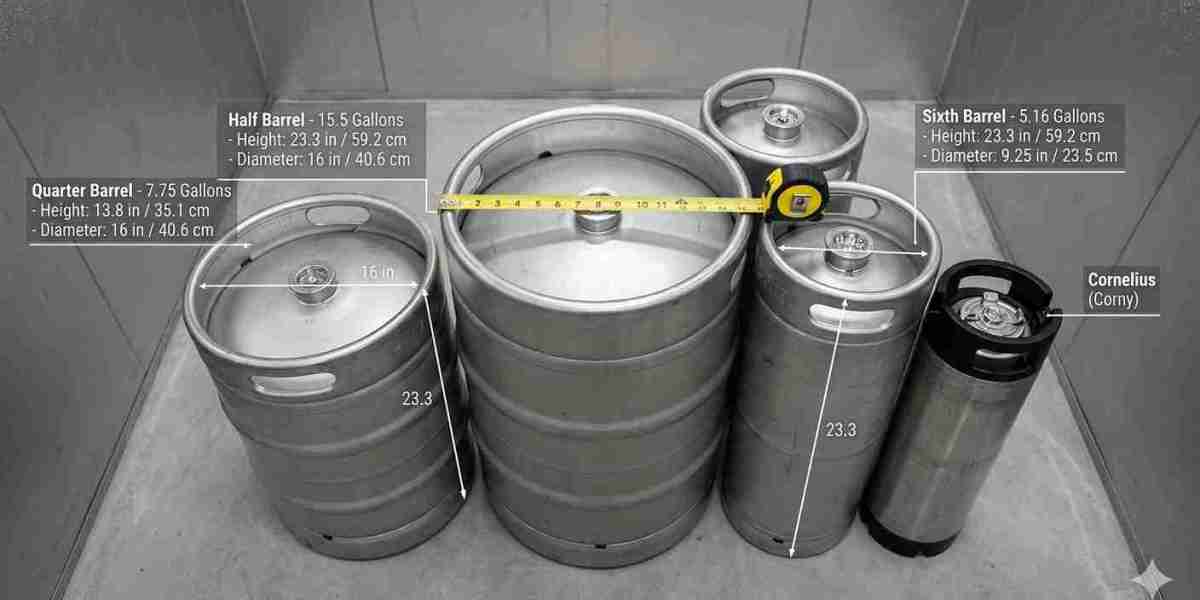
For bar owners, restaurateurs, and dedicated homebrewers, the standard stainless steel keg is a vessel of liquid gold. But beneath its metallic sheen lies a critical logistical puzzle: measurements. Knowing the exact dimensions of your kegs isn't just trivia; it's essential for spatial planning, inventory management, and maximizing efficiency. A quarter-inch discrepancy in height might mean your walk-in cooler door won't close, and failing to account for the width of a "pony" keg could derail your taproom layout.
This guide provides a comprehensive breakdown of standard keg measurements, ensuring you select the perfect vessel for your operational footprint.
Sizing Matters: Why Accurate Measurements Are Crucial
Before we dive into the dimensions, let's establish why these measurements of a keg matter in real-world application:
1. Maximizing Cooler Capacity
Refrigerated storage is expensive real estate. Knowing the height and diameter of your kegs is the only way to calculate exactly how many you can fit into your walk-in cooler, bar setup, or home keezer. This is how you prevent empty tap handles and maximize profit per square foot.
2. Kegerator Compatibility
The market is flooded with diverse kegerator models. Choosing the wrong keg size can lead to frustrating compatibility issues. A standard upright full-size keg will not fit into most converted mini-fridges, and a "Sixtel" requires a completely different coupling space than a "Pony."
3. Spatial and Inventory Planning
From ordering frequency (a smaller keg means more frequent deliveries) to the layout of your back-of-house, every logistical decision stems from understanding how much liquid you can store—and where you can store it.
Standard U.S. Keg Measurements Breakdown
While variations exist, most commercial kegs in the United States conform to a few standard sizes. The dimensions provided here are averages; always double-check with your supplier, especially for specific imports.
1. Half Barrel (Full Size Keg)
The Half Barrel is the most common and recognizable keg size in the U.S. It is the vessel used for high-volume domestic beer.
Average Height: 23.3 in / 59.2 cm
Average Diameter: 16 in / 40.6 cm
Total Volume: 15.5 Gallons / 58.7 Liters
Approximate 12 oz. Beers: 165
Common Use: High-volume domestic drafts (e.g., macro-lagers).
2. Quarter Barrel (Pony Keg)
The Quarter Barrel is effectively half the volume of a Full Size Keg and retains the identical footprint (diameter). This is what people usually mean by a "pony" keg.
Average Height: 13.8 in / 35.1 cm
Average Diameter: 16 in / 40.6 cm
Total Volume: 7.75 Gallons / 29.3 Liters
Approximate 12 oz. Beers: 82
Common Use: Medium-volume drafts, parties, and smaller gatherings.
3. Slim Quarter Barrel (Tall Quarter)
The Slim Quarter barrel has the same volume as a standard Quarter Barrel but features a unique "tall and skinny" form factor. Its key logistical advantage is its narrow diameter.
Average Height: 23.3 in / 59.2 cm
Average Diameter: 11.25 in / 28.6 cm
Total Volume: 7.75 Gallons / 29.3 Liters
Approximate 12 oz. Beers: 82
Common Use: Craft beer, where the slender diameter allows multiple kegs to share the same narrow space (like under a counter).
4. Sixth Barrel (Sixtel / Torpedo Keg)
The Sixtel is the "Skinny Minnie" of commercial kegs. It has the smallest standard diameter and is often used by craft breweries to distribute lower-volume products.
Average Height: 23.3 in / 59.2 cm
Average Diameter: 9.25 in / 23.5 cm
Total Volume: 5.16 Gallons / 19.5 Liters
Approximate 12 oz. Beers: 55
Common Use: Craft beer, specialized releases, and small bars with limited menu variety.
The Homebrewer Special: Cornelius (Corny) Keg
For homebrewers, the "Corny" keg is ubiquitous. While similar in volume to a Sixth Barrel, its configuration (ball-lock or pin-lock disconnects) makes it unique.
Average Height: 23 in / 58.4 cm
Average Diameter: 9 in / 22.9 cm
Total Volume: 5.0 Gallons / 18.9 Liters
Approximate 12 oz. Beers: 53
Common Use: Homebrewing only.
Final Thoughts
Accurate measurements are the foundation of efficient back-of-house operations. By understanding these standard dimensions, you can transform your back-of-house logistics. Measure your space, calculate your peak demand, and always confirm specific dimensions with your supplier. The right keg not only protects your beer—it protects your spatial efficiency, your inventory flow, and your bottom line.