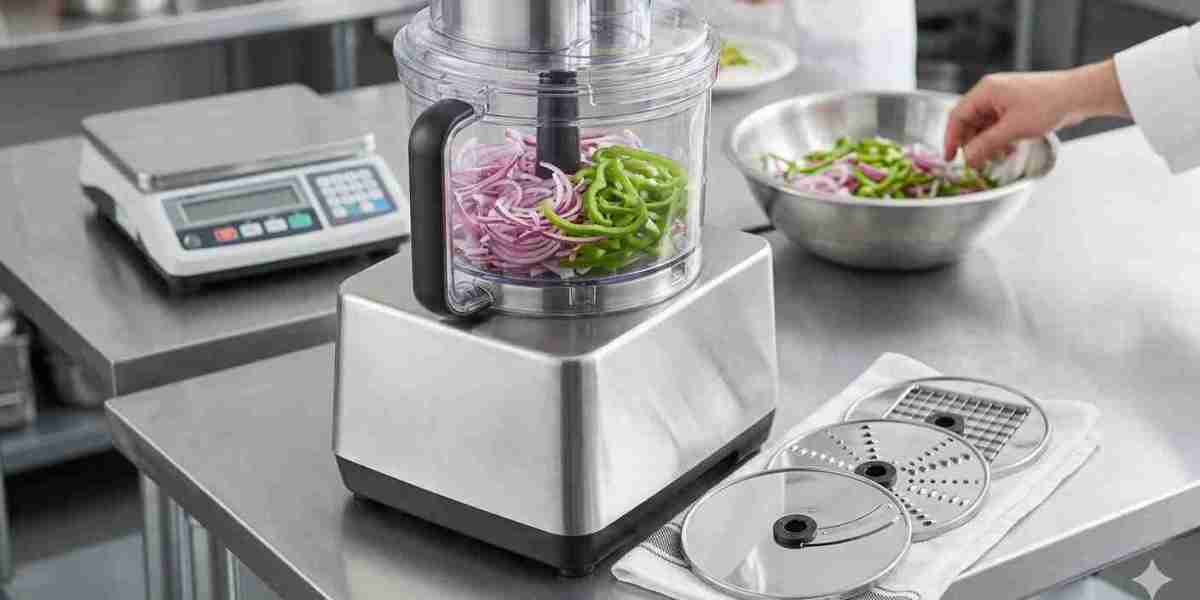
In the demanding world of professional food service, efficiency is not just a goal; it's a prerequisite for survival. While flashy charcoal grills and precise sous-vide circulators often grab the spotlight, the true workhorse driving prep efficiency in high-volume kitchens is the commercial food processor. Far more than just a larger version of a home appliance, a commercial-grade processor is a robust, engineered solution designed to slash labor costs and maximize consistency in demanding operational environments.
Engineering Efficiency: How They Work and Why They Last
The core defining characteristic of a commercial food processor is durability and power. While a home unit is designed for occasional use and small batches, a commercial model is engineered for continuous or heavy-duty operation.
How it Works: Commercial food processors utilize powerful, high-torque industrial motors, often featuring direct-drive mechanisms rather than belts. This provides consistent, unrelenting power needed to process large quantities of dense ingredients without stalling or overheating. Crucially, they operate with a highly precise blade-to-bowl clearance. This tight engineering ensures that ingredients are processed uniformly, eliminating the uneven chunks often found in consumer models.
Versatility in High-Volume Applications
The commercial food processor is invaluable because it is a master of multitasking. With interchangeable blades and attachment options, a single base unit can execute dozens of critical prep tasks simultaneously, saving labor and space.
Chopping and Mincing: Creating large batches of mirepoix (onions, carrots, celery) for soups, sauces, and stews in seconds.
Slicing and Grating: Achieving uniform slices of vegetables for salads, pizzas, or sandwich toppings, and consistent grating for cheese (shredding blocks in seconds) or vegetables. This level of consistency is impossible to achieve by hand, ensuring that portion control and dish appearance are always uniform.
Pureeing and Emulsifying: Making smooth hummus, aioli, pesto, various nut butters, and delicate emulsified sauces like mayonnaise and hollandaise. Commercial processors are powerful enough to achieve incredibly smooth results, essential for refined plating.
Dicing (Specialized Models): While not all processors can dice, specialized heavy-duty models or specific attachments can create thousands of perfect vegetable cubes for salsas, pico de gallo, or fruit salads. This is a primary differentiator from home units, which do not offer true dicing capability.
Specialized Models for Specific Needs
There are two primary categories of commercial processors designed for different workflow requirements:
1. Bowl Processors (Bulk Processing)
These models process ingredients directly inside a contained bowl. When a specific quantity is needed (e.g., 2 quarts of pesto), a bowl processor is used. The main constraint is that you must stop and empty the bowl once it reaches capacity. This is best for batch work and creating purees.
2. Continuous-Feed Processors (High-Volume Flow)
For continuous, high-volume production, the continuous-feed processor is the ultimate choice. It features a chute or hopper system where ingredients (e.g., potatoes, onions, cabbage) are continuously added. A spinning plate then ejects the processed food directly into a separate prep container or large metal bowl beneath. This eliminates the need to stop and empty, allowing a kitchen to process hundreds of pounds of produce in a single shift. This model is indispensable for salad bars, commissaries, and large institutions.
Conclusion
The commercial food processor is more than just a piece of equipment; it is a critical investment in your kitchen’s operational health. By prioritizing rugged durability, powerful performance, and essential safety features (like magnetic safety interlocks), you are selecting an appliance that will protect your ingredient quality and save your staff thousands of labor hours. For any kitchen striving to meet high-volume demands with precision and speed, the commercial food processor is not just a luxury; it is the cornerstone of efficient prep.