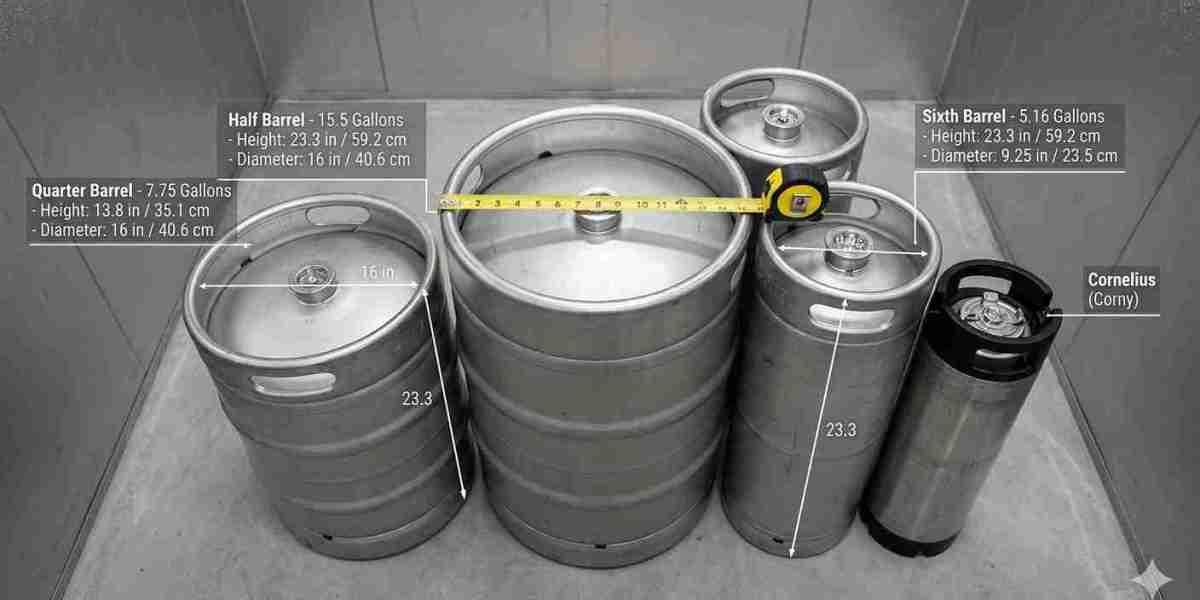
If you are planning an event, managing a bar, or setting up a home draft system, you have likely encountered the term "Sixtel." It is the industry shorthand for a 1/6 barrel keg. This specific size has become the "gold standard" for craft breweries and small-to-medium-sized taprooms, but it is often a source of confusion regarding exactly how much liquid it contains.
Knowing your yield is not just about logistics; it is the difference between running out of beer mid-party and managing your inventory with precision. If you are wondering how many beers are in a 1/6 barrel, the answer is surprisingly consistent, provided you know the math.
The Capacity Breakdown
A standard 1/6 barrel keg, commonly called a Sixtel, holds 5.16 gallons of liquid. To determine how many servings you can get, we look at the standard serving sizes: a 12-ounce bottle equivalent and a 16-ounce standard pint.
Since one US gallon equals 128 fluid ounces, a 1/6 barrel holds approximately 660 total ounces of beer ($5.16 \times 128 = 660.48$ ounces).
Serving Yield Reference
| Serving Size | Total Ounces | Approximate Yield |
| 12 oz. (Can/Bottle Equivalent) | 660 oz. | ~55 Beers |
| 16 oz. (Standard Pint Glass) | 660 oz. | ~41 Pints |
These numbers serve as your "theoretical maximum." In a perfectly controlled laboratory setting, you would get exactly 55 cans or 41 pints. However, in the real world of taps, lines, and glass pouring, the actual number of servings can vary slightly.
Why the Sixtel is the Craft Beer Favorite
The 1/6 barrel has surged in popularity because of its physical footprint. A standard full-size keg (Half Barrel) is heavy, cumbersome, and takes up a massive amount of refrigerator space. The Sixtel, by contrast, is sleek and narrow.
This form factor allows bar owners and home enthusiasts to squeeze multiple different beer options into the same footprint as a single, full-sized keg. If you are running a bar with limited cooler space, the Sixtel allows you to diversify your menu significantly. You can offer an IPA, a Stout, a Lager, and a Cider all in the same space that would have previously held only one or two full-sized kegs.
The "Loss" Variables: Why You Might Get Fewer Servings
While the math suggests 55 beers, professional operators often plan for slightly less. Several factors contribute to "inventory loss" that you should account for when planning:
Excessive Foam: The primary thief of your yield is foam. If your CO2 pressure (PSI) is not perfectly balanced for the temperature of the keg, or if your beer lines are not clean, the beer will "break out" of solution and come out as foam. Every inch of foam in the glass represents beer that you paid for but cannot sell.
Tap Calibration: The speed and angle at which a faucet opens can influence how much foam is created during the pour. A well-calibrated tap ensures a smooth pour that maximizes every ounce.
The "Last Drop" Factor: At the very end of a keg, the flow often sputters as CO2 takes over the line. Most professional systems leave a small amount of liquid in the very bottom of the keg that cannot be dispensed, often accounting for a few ounces of "dead" inventory.
Conclusion
When planning for your next event or managing your inventory, you can confidently bank on approximately 55 beers (12oz) or 41 pints (16oz) from a 1/6 barrel. By maintaining a clean draft system and training your team on proper pouring techniques, you can ensure that your actual yield stays as close to that theoretical maximum as possible. Whether you are stocking a home kegerator or a commercial taproom, the Sixtel remains the most efficient, versatile choice for serving high-quality craft beer.