Market Overview and Growth Outlook
Demand is increasing because aircraft heat exchangers manage thermal loads across engines, environmental control systems, avionics, and hydraulic systems. By dissipating excess heat and maintaining stable thermal conditions, they support safety, fuel efficiency, operational performance, and system longevity. These factors define Aircraft Heat Exchanger Market growth across aerospace market intelligence.
Market Segmentation Analysis
Aircraft Heat Exchanger Market, by Aircraft Type includes Commercial Aircraft, Regional Aircraft, General Aviation, Helicopter, Military Aircraft, and UAV. Commercial Aircraft is expected to remain dominant, while UAV is expected to be the fastest-growing aircraft type. This highlights demand from large-volume aircraft platforms and emerging unmanned aviation applications.
Aircraft Heat Exchanger Market, by Medium Type includes Air and Liquid. Liquid is expected to remain the dominant and fastest-growing medium type. Liquids have higher specific heat capacity than gases, enabling them to absorb and transfer more heat per unit volume. This makes liquid heat exchangers relevant for aircraft engines and high-heat aircraft components.
Aircraft Heat Exchanger Market, by Construction Type includes Tubular and Plate-Fin. Tubular heat exchangers are expected to dominate the market. Their suitability for high-pressure and high-temperature environments supports use in demanding aircraft systems, while their relatively simple design helps streamline manufacturing, inspection, and maintenance.
Aircraft Heat Exchanger Market, by Material Type includes Aluminum, Nickel Alloys, Steel Alloys, Copper, and Titanium. Aluminum is expected to stay the top material, while Titanium is anticipated to be the fastest-growing material type. Aluminum’s lightweight properties help reduce aircraft weight, while its thermal conductivity supports stable operating conditions.
Aircraft Heat Exchanger Market, by Application Type includes Engine System, Environment Control System, Avionics, and Hydraulic System. Engine System is anticipated to remain the dominant application. The source identifies Engine Oil Cooling as the leading sub-application and IDG/ VFSG Oil Cooling as the fastest-growing sub-application.
Aircraft Heat Exchanger Market, by End-User Type includes Original Equipment Manufacturer (OEM) and Aftermarket. Original Equipment Manufacturer (OEM) is expected to remain the foremost end user. This reflects demand for heat exchangers integrated into new aircraft during production as OEMs support commercial and defense aircraft programs.
Regional Market Insights
North America is expected to be the largest regional market. The source attributes this position to a strong aerospace industrial base, major manufacturers such as Boeing and Lockheed Martin, military modernization, defense budgets, commercial airline expansion, and rising passenger traffic that increases the need for efficient aircraft heat exchangers.
Asia-Pacific is expected to be the fastest-growing region. The source highlights China and India’s rising air travel demand, expanding fleets, and increasing defense budgets in China, India, and Japan. These conditions support demand for next-generation military and commercial aircraft requiring advanced thermal management systems.
Request a free sample report:
https://www.stratviewresearch.com/Request-Sample/3915/aircraft-heat-exchanger-market.html#form
Emerging Trends Shaping the Aircraft Heat Exchanger Market
The market is being shaped by the shift toward more powerful and efficient aircraft systems. Modern turbofan and turbojet engines create higher thermal loads, while onboard power systems such as IDG and VFSG require reliable oil cooling. Industry trends point to greater demand for efficient thermal transfer as aircraft systems become more performance-intensive.
Key Growth Drivers of the Market
- Increasing air travel and fleet growth are driving commercial aviation expansion, which raises demand for heat exchangers in new aircraft platforms.
- Modern engines are becoming more powerful and efficient, creating higher thermal loads that require advanced heat management solutions.
- Heat exchangers help maintain optimal engine temperatures, supporting fuel efficiency and lower operational costs within aircraft systems.
- Growing integration of IDG and VFSG systems creates heat during operation, increasing demand for effective oil cooling.
- Military modernization and defense aircraft procurement support demand for advanced thermal management systems in North America and Asia-Pacific.
Competitive Landscape
Top Companies in the Market
Honeywell International Inc.
Meggitt PLC (now part of Parker Hannifin Corporation)
Triumph Group, Inc.
AMETEK, Inc.
Collins Aerospace (a subsidiary of Raytheon Technologies Corporation)
TAT Technologies Ltd.
Sumitomo Precision Products Co., Ltd.
Safran S.A.
Boyd Corporation
Unison Industries (a division of GE Aviation)
Conclusion and Strategic Outlook
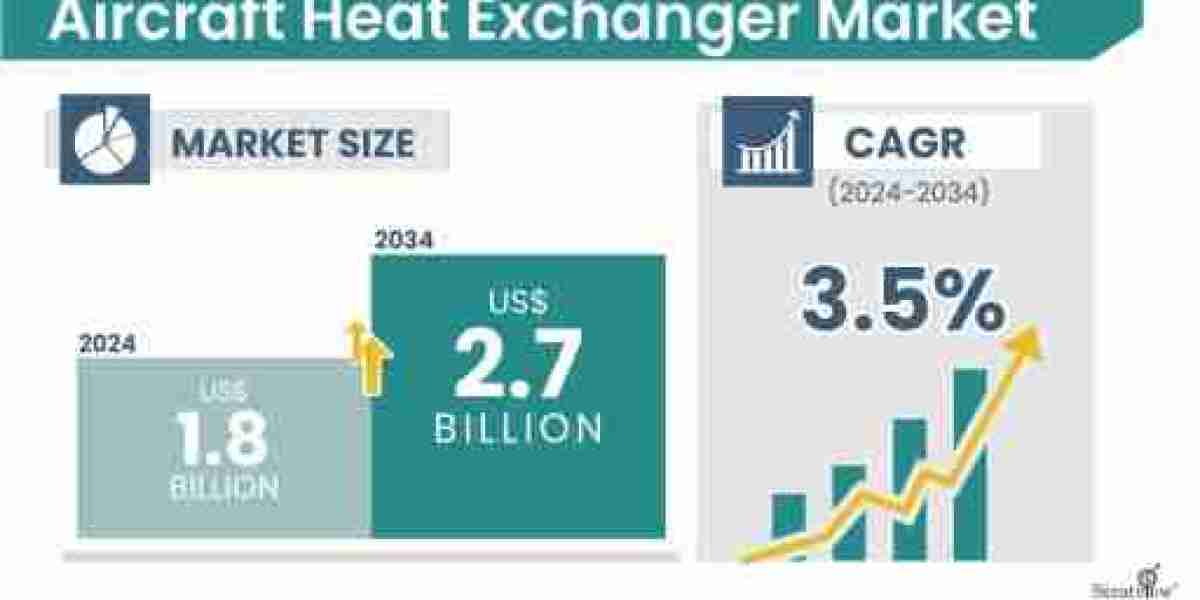
The Aircraft Heat Exchanger Market is forecast to reach USD 2.7 billion by 2034, expanding at a CAGR of 3.5% during 2025–2034. Growth trends remain anchored in commercial aircraft demand, OEM production, engine thermal management, liquid medium adoption, and Asia-Pacific’s faster regional expansion. The market outlook remains steady and systems-driven.
FAQs – Aircraft Heat Exchanger Market
What is the Aircraft Heat Exchanger Market forecast value?
The Aircraft Heat Exchanger Market is forecast to reach USD 2.7 billion by 2034. It is expected to rise from USD 2.0 billion in 2025.
What is the expected CAGR of the Aircraft Heat Exchanger Market?
The Aircraft Heat Exchanger Market is expected to grow at a CAGR of 3.5% during 2025–2034. This growth reflects sustained aircraft thermal management demand.
What are the main Aircraft Heat Exchanger Market growth drivers?
Key drivers include commercial aviation expansion, higher thermal loads, fleet growth, environmental regulations, and demand for efficient aircraft systems. These factors increase adoption of advanced heat exchanger technologies.
Which region dominates the Aircraft Heat Exchanger Market?
North America is expected to be the largest region. Asia-Pacific is expected to be the fastest-growing region due to fleet expansion and rising defense budgets.
What should stakeholders watch in the Aircraft Heat Exchanger Market?
Stakeholders should monitor OEM demand, engine system applications, liquid medium adoption, and regional growth patterns. The source page does not list specific risks or challenges.