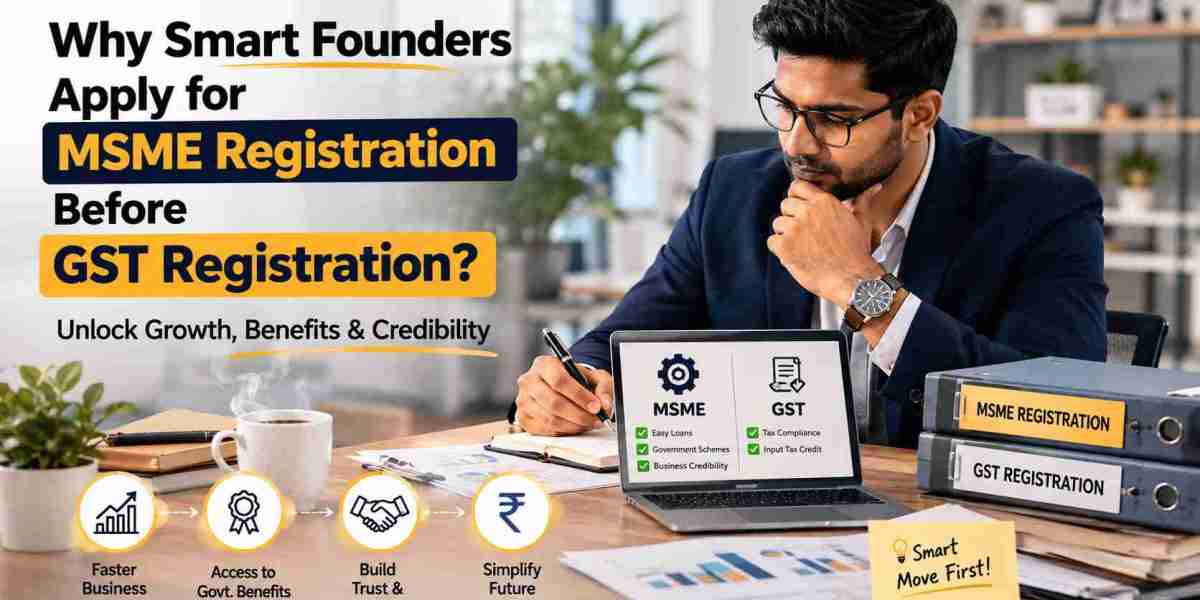
If you're launching a business in India, your compliance checklist probably has GST Registration near the top. That's understandable. GST is mandatory once your turnover crosses the threshold, and it unlocks the ability to issue tax invoices and claim input tax credit. But here's what experienced founders have quietly figured out: getting your Udyam Registration (MSME registration) first is one of the smartest sequencing decisions you can make.
This isn't a technicality. It's a strategic move that affects your access to credit, your eligibility for government schemes, your legal protections, and - frankly, the speed at which your business gets off the ground.
Let's break down exactly why the order matters, and what you stand to gain.
What Is Udyam Registration?
Udyam Registration is the official government process through which micro, small, and medium enterprises (MSMEs) get recognized and registered under the Ministry of MSME. It replaced the older Udyog Aadhaar system in July 2020 and is now the single, unified portal for MSME recognition in India.
Upon successful registration, you receive an Udyam Registration Certificate, a permanent, lifetime document that carries a unique Udyam Registration Number (URN). There's no renewal required.
The classification is based on annual turnover and investment in plant/machinery or equipment:
Category | Investment | Annual Turnover |
Micro | Up to ₹1 crore | Up to ₹5 crore |
Small | Up to ₹10 crore | Up to ₹50 crore |
Medium | Up to ₹50 crore | Up to ₹250 crore |
The process is entirely free, paperless, and self-declaratory. All you need is an Aadhaar number (and PAN/GSTIN if applicable). For a pre-GST business, registration is possible using only Aadhaar and PAN, which is a key point we'll return to.
The Registration Sequence That Actually Works
Here's what most compliance advisors will tell you: "Get GST first, then do Udyam." And technically, that works. But it's not the optimal path.
Smart founders flip the sequence. Here's why.
1. You Can Complete MSME Udyam Registration Without a GSTIN
This is the core practical insight. The Udyam Registration portal accepts PAN in lieu of GSTIN for businesses that are not yet GST-registered or not liable to register. This means you can establish your MSME identity before entering the GST ecosystem.
Once you do register for GST, you can update your GSTIN on the Udyam portal seamlessly. Your Certificate remains the same, you're simply enriching your profile.
Why does this matter? Because the clock starts earlier. The moment you have your Udyam Registration, you become eligible for MSME-specific benefits. Every week you delay that registration is a week you're leaving benefits on the table.
2. MSME Status Strengthens Your Credit Profile Before You Apply for Loans
One of the most tangible benefits of holding a Udyam Registration Certificate is access to priority sector lending and MSME-specific credit products. Banks and NBFCs treat registered MSMEs differently, they get:
- Collateral-free loans under the Credit Guarantee Fund Trust for Micro and Small Enterprises (CGTMSE)
- Lower interest rates under various government-linked schemes
- Priority treatment under the RBI's priority sector lending norms
Many founders make the mistake of approaching lenders after setting up GST, only to realise their MSME status hasn't been established yet. By getting your MSME Udyam Registration done first, you walk into credit conversations with a document that immediately establishes your classification and opens up better financing terms.
3. The Udyam Registration Certificate Activates Government Scheme Eligibility
India's central and state governments run dozens of schemes exclusively for registered MSMEs, from the MSME Competitive (LEAN) Scheme to the Credit Linked Capital Subsidy Scheme (CLCSS), from technology upgradation support to export promotion programs. Your Certificate is the gateway document for most of these.
The important point here is timing. Several schemes have application windows, first-come-first-served allocations, or financial year-based eligibility. If you're waiting to complete your GST registration before getting MSME status, you may miss application cycles entirely.
Founders who register on Udyam early, even before GST, can apply for relevant schemes during their startup phase when financial support is most impactful.
4. Legal Protection Under MSMED Act Kicks In Immediately
The Micro, Small and Medium Enterprises Development (MSMED) Act, 2006 provides registered MSMEs with a critical legal protection: buyers must make payments within 45 days of delivery (or within the agreed timeline, which cannot exceed 45 days if a written agreement exists). If they fail to do so, compound interest applies at three times the bank rate.
This protection is not available to unregistered businesses.
For a founder in the early months of business, where cash flow is everything, this legal protection can literally determine survival. Getting Udyam Registration done before you start invoicing clients means every invoice you raise carries this protection from day one.
Waiting until after GST registration to secure this protection is a risk that many founders don't realize they're taking.
5. Tender and Procurement Advantages Start Earlier
The government mandates that a certain percentage of public procurement comes from MSMEs. Registered businesses get:
- Exemption from Earnest Money Deposits (EMD) in government tenders
- Price preference in certain categories
- Exclusive tender access in some sectors
If your business model involves government contracts, Founders who have it from the start can bid on opportunities that others simply cannot access.
The GST-Udyam Integration
Once you complete your GST Registration, the process of linking it to your Udyam profile is simple:
- Log in to the Udyam Registration portal (udyamregistration.gov.in)
- Navigate to the "Update Details" section
- Add your GSTIN to your existing profile
Your Udyam Registration Certificate gets updated, and your compliance profile becomes complete. There's no disruption, no re-registration, and no change to your URN.
This two-step approach, MSME first, then GST, then link, is cleaner than waiting because your MSME benefits accumulate from the earlier registration date.
Who Should Prioritise Udyam Registration First?
While this sequencing makes sense for most founders, it's especially advantageous for:
Early-stage startups that are in pre-revenue or low-revenue phases and want to access credit or schemes before GST liability arises.
Service businesses below the GST threshold (currently ₹20 lakh for most states) that don't immediately need GST Registration but still want MSME protections.
Businesses in manufacturing or trading that plan to apply for capital subsidy schemes in the near term.
Founders seeking collateral-free credit who want to walk into lender meetings with MSME status already established.
Common Misconceptions Addressed
1) "I need GST first to register on Udyam."
Not true. The Udyam portal explicitly allows registration using PAN for entities not liable for GST. GSTIN can be added later.
2) "MSME registration is only useful for manufacturing businesses."
Incorrect. Service enterprises are fully eligible for Udyam Registration and benefit from the same protections, credit access, and scheme eligibility.
3) "There's a fee involved."
The official Udyam Registration process is completely free on the government portal. Any third-party service charging a government fee is misleading you.
Conclusion
The sequencing of registrations may seem like a minor operational decision, but it carries meaningful consequences for your access to capital, legal protections, and government opportunities.
MSME Udyam Registration is free, fast (often completed within minutes), and does not require a GSTIN. The Udyam Registration Certificate you receive is a permanent credential that begins working for your business from the moment it's issued.
Smart founders understand that compliance isn't just about checking boxes. It's about building the foundation that makes everything else easier. Getting your Udyam Registration done before GST is one of those foundational moves that costs nothing and pays dividends for years.