If you are planning to use Indian documents abroad, understanding whether apostille is required depends mainly on the destination country and its document legalization rules. Secure Apostille Services Hyderabad helps individuals and businesses understand the correct process for international document use. You can learn more about our Hyderabad services here: Secure Apostille Services Hyderabad.
What Is an Apostille?
An apostille is a certificate attached to a public document to authenticate its origin for use in another country that recognizes the Hague Apostille Convention. In India, apostilles are issued by the Ministry of External Affairs (MEA).
The purpose of an apostille is to confirm the authenticity of the signature, seal, or stamp appearing on the document. It does not certify the contents of the document itself.
Documents that may require apostille include birth certificates, marriage certificates, degree certificates, diplomas, police clearance certificates, affidavits, powers of attorney, and commercial documents.
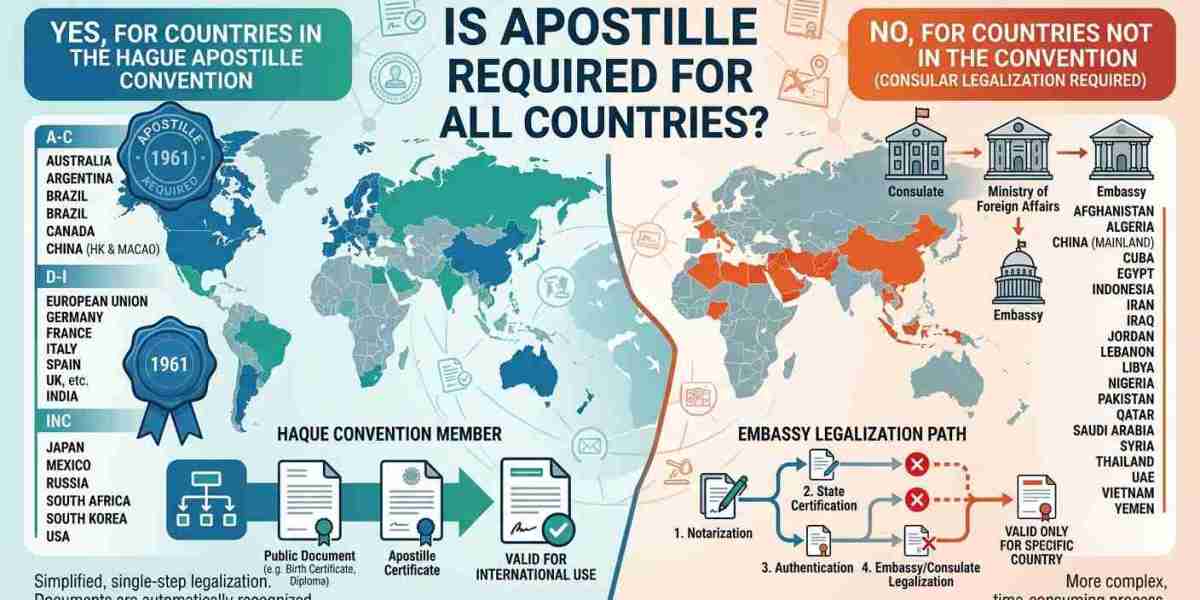
Is Apostille Required for Every Country?
No. Apostille is not required for all countries.
The requirement depends on whether the country where you intend to use your document is a party to the Hague Apostille Convention and whether that country's receiving authority specifically requests an apostille.
For Hague Convention countries, an apostille generally replaces the traditional legalization process. This can make international document authentication considerably simpler because embassy legalization is generally not required after apostille.
For countries that are not part of the Hague Convention, a different legalization or attestation process may apply.
Countries That Commonly Accept Apostilled Documents
The Hague Apostille Convention has a large number of participating countries and jurisdictions. Some commonly encountered destinations include:
- United States
- United Kingdom
- Germany
- France
- Italy
- Spain
- Netherlands
- Portugal
- Switzerland
- Belgium
- Austria
- Ireland
- Australia
- New Zealand
- Japan
- South Korea
- South Africa
- Brazil
- Mexico
- Argentina
The exact document requirements can vary even between countries that accept apostilles. A university, immigration authority, court, employer, or government department may have additional requirements concerning translations, document age, notarization, or certification.
What About Countries That Do Not Accept Apostille?
If the destination country is not a party to the Hague Apostille Convention, the document may need to go through a legalization or attestation procedure instead.
For example, documents intended for countries such as the UAE, Qatar, Kuwait, and certain other non-Hague destinations may require multiple authentication stages. Depending on the document, these can include notarization, state-level authentication, MEA authentication, and legalization by the relevant embassy or consulate.
This is why it is important to identify the destination country before starting the process. Applying for the wrong type of authentication can result in unnecessary expenses and delays.
Does Every Document Need Apostille?
Not necessarily. The requirement depends on the purpose of the document and the authority requesting it.
Educational documents such as degrees, diplomas, transcripts, and certificates are frequently required for overseas education and employment. Personal documents such as birth certificates, marriage certificates, divorce decrees, and PCCs may be requested for immigration, family visas, residency, or marriage registration.
Commercial documents can also require authentication when companies conduct business internationally. These may include powers of attorney, certificates of incorporation, board resolutions, agreements, invoices, and other corporate documents.
Before processing any document, it is advisable to confirm the requirements of the organization receiving it.
Does an Apostille Have an Expiry Date?
An apostille itself generally does not have a standard expiry period. However, this does not necessarily mean that the underlying document will always be accepted.
The receiving authority may require a recently issued document. This is particularly relevant for documents such as police clearance certificates, civil status certificates, or other records where current information is important.
For this reason, applicants should check the requirements of the foreign authority before obtaining authentication.
Do Indian Documents Need Verification Before Apostille?
Depending on the document type, preliminary authentication may be required before the MEA apostille can be issued.
Educational documents may require verification through the appropriate state authority or HRD process. Personal documents can have different authentication requirements depending on how and where they were issued. Commercial documents may require notarization or Chamber of Commerce-related procedures.
The correct route therefore depends on the document, issuing authority, and destination country.
Common Documents That May Require Apostille
A wide range of Indian documents can be used internationally after the appropriate authentication process. Common examples include:
Personal documents:
Birth certificates, marriage certificates, death certificates, affidavits, divorce documents, and single-status certificates.
Educational documents:
Degree certificates, diplomas, transcripts, mark sheets, and other academic records.
Police and legal documents:
Police Clearance Certificates, court documents, powers of attorney, and declarations.
Commercial documents:
Certificates of incorporation, board resolutions, commercial agreements, invoices, and business powers of attorney.
The exact requirements should always be checked according to the intended use.
Apostille for Study, Employment and Immigration
Apostille is frequently needed when documents are submitted to foreign universities, employers, immigration departments, or government authorities.
Students may need authenticated academic documents for admission or enrollment. Professionals may require educational certificates for employment or professional registration. Families relocating abroad may need authenticated birth or marriage certificates for visa and residency procedures.
Because each application has different deadlines, preparing documents early can help avoid last-minute problems.
Why Choose Professional Apostille Assistance?
The authentication process can become complicated when documents require preliminary verification or when the destination country has specific requirements.
Secure Apostille Services assists customers with document review, processing coordination, authentication, and delivery. Professional assistance can help identify missing requirements before submission and reduce the possibility of avoidable delays.
For customers in Bangalore, we provide assistance for different types of documents intended for international use. Customers can also receive guidance based on their destination country and document category.
Final Checklist Before Apostille
Before submitting your document, check:
- Confirm whether the destination country accepts apostille.
- Identify exactly which documents are required.
- Check whether the original document is required.
- Verify names, dates, seals, and other important details.
- Determine whether state-level authentication or other preliminary verification is necessary.
- Check whether a translation is required.
- Confirm whether the receiving authority has any document-age requirements.
- Allow sufficient time for processing and delivery.
Conclusion
Apostille is not required for every country. It is primarily used for countries that participate in the Hague Apostille Convention, while documents intended for non-Hague countries may require a different legalization or attestation procedure.
The most important step is to determine the requirements of the destination country and the authority receiving your documents before beginning the process. With the right authentication route, you can reduce unnecessary delays and ensure that your documents are prepared correctly for international use.
Secure Apostille Services provides professional assistance for personal, educational, legal, and commercial documents, helping applicants navigate the authentication process with greater convenience and confidence.