
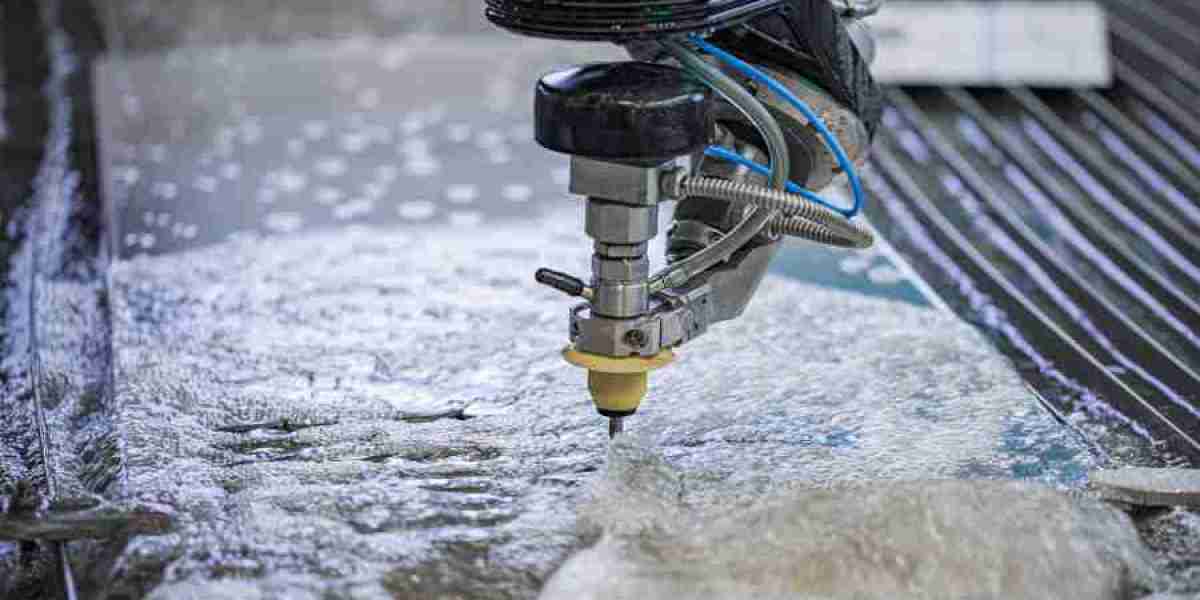
Waterjet cutting machines have become an important precision-manufacturing technology because they can cut a wide range of materials without generating the heat associated with conventional thermal cutting. By using a high-pressure stream of water, often combined with abrasive particles, these systems can process metals, stone, glass, composites and other difficult materials while maintaining tight dimensional control.
The global waterjet cutting machines market was valued at approximately USD 1.38 billion in 2025 and is projected to reach USD 2.54 billion by 2035, expanding at a 6.30% CAGR between 2026 and 2035, according to the market figures supplied for this analysis. Growth is being supported by demand for precision manufacturing, increasing use of advanced materials, automation and the need to minimize heat-affected zones and secondary finishing.
Waterjet cutting is particularly valuable when manufacturers need to preserve material properties. Unlike plasma, laser or oxy-fuel cutting, the process does not rely on a heat source to melt or burn the workpiece. This makes waterjet technology attractive for applications where thermal distortion, metallurgical changes or damage to sensitive materials could compromise the finished component.
What Is Driving Growth in the Waterjet Cutting Machines Market?
The waterjet cutting machines market is growing because manufacturers increasingly need versatile, precise and thermally neutral cutting processes. Demand from aerospace, automotive, electronics, construction and advanced manufacturing is encouraging companies to adopt equipment capable of processing diverse materials without extensive secondary operations.
One of the technology's strongest advantages is material flexibility. Abrasive waterjets can cut steel, aluminum, titanium, stone, ceramics, composites and other hard materials, while pure-water systems are suitable for softer materials such as rubber, foam, food products and certain plastics.
This versatility becomes particularly valuable in job shops and contract manufacturing environments, where a single machine may need to process different materials and thicknesses during the same production period. Rather than investing in separate equipment for every material category, manufacturers can use waterjet systems as a flexible cutting platform.
The process also avoids many of the thermal effects associated with laser and plasma cutting. When heat-sensitive composites or hardened metals are being processed, this can reduce distortion and preserve material characteristics around the cut.
Manufacturers are also increasingly focused on reducing material waste. Modern waterjet systems can use sophisticated nesting software to arrange parts efficiently on sheets, while narrow kerfs allow components to be positioned relatively close together. For expensive materials such as titanium, aerospace composites or engineered stone, improved material utilization can have a meaningful impact on production economics.
Automation is another growth factor. CNC-controlled machines, robotic waterjets and increasingly sophisticated software allow manufacturers to produce complex geometries with limited manual intervention. These developments are helping waterjet technology move beyond conventional flat-sheet cutting toward more specialized three-dimensional and automated applications.
How Do Abrasive and Non-Abrasive Waterjets Differ?
Abrasive and non-abrasive waterjet systems serve different cutting requirements. Abrasive waterjets add a granular cutting medium to high-pressure water and are used for hard materials, while non-abrasive systems rely solely on water and are generally suited to softer materials.
In an abrasive waterjet, a high-pressure water stream passes through a specialized nozzle and creates a vacuum that draws abrasive particles into the cutting stream. The resulting mixture exits at extremely high velocity and erodes the workpiece along a programmed path.
Garnet is one of the most widely used abrasive materials because it offers a useful combination of hardness, cutting performance and relatively predictable wear characteristics. The abrasive is particularly effective for metals, ceramics, stone and composite materials.
Abrasive systems are widely used in aerospace and automotive manufacturing because they can cut materials that are difficult to process using conventional mechanical methods. Titanium, for example, is strong and heat-resistant but can be challenging to machine. A waterjet can cut it without introducing the same thermal effects associated with some competing technologies.
Non-abrasive waterjets, by contrast, use high-pressure water without abrasive particles. They are appropriate for softer materials and specialized applications where contamination from abrasive particles would be undesirable.
The distinction is commercially important because operating costs, cutting speeds, pump requirements and maintenance needs differ between the two approaches. Manufacturers selecting equipment must therefore consider not only the material being cut but also thickness, required edge quality, production volume and the downstream finishing process.
Why Is Cold Cutting Important for Advanced Materials?
Cold cutting is important because it minimizes thermal damage to materials and reduces the risk of heat-affected zones, warping, discoloration and changes to material properties. This makes waterjet technology especially useful for composites, aerospace alloys and other materials where preserving the original characteristics is critical.
A laser can provide exceptional speed and precision, but its heat can affect certain materials. Plasma and oxy-fuel processes face similar limitations when heat-sensitive components or very precise edges are required.
Waterjet cutting removes this concern by mechanically eroding the material rather than melting it. This makes it attractive for laminated materials and composites, where excessive heat can damage resin systems or create undesirable delamination.
The benefit is also relevant to manufacturers seeking to reduce post-processing. A properly configured waterjet can produce a finished edge that requires little additional machining, depending on the material, thickness, abrasive quality and cutting parameters.
Which Industries Are Creating the Strongest Demand?
Waterjet cutting machines are used across electronics, aerospace, automotive, construction and other industrial applications, with demand particularly strong where manufacturers need precision cutting of hard, thick or heat-sensitive materials.
The aerospace industry is one of the most important application areas. Aircraft manufacturers and suppliers work with expensive materials such as titanium alloys, aluminum and advanced composites. Waterjet cutting can produce complex profiles without introducing substantial thermal distortion, making it useful for structural components, panels and other aerospace parts.
In the automotive industry, waterjet systems support prototype development, component manufacturing and the processing of metals, composites, glass and interior materials. As vehicles incorporate more lightweight materials and EV-specific components, manufacturers require flexible cutting processes that can accommodate changing material combinations.
The electronics sector represents another specialized opportunity. Precision waterjet systems can process certain ceramics, composites and delicate materials while limiting thermal damage. Micro-waterjet technology is particularly relevant where small features and high dimensional accuracy are required.
The construction sector uses waterjet cutting extensively for stone, ceramic, tile and architectural materials. Decorative patterns, intricate floor designs, countertops and custom architectural elements can be produced with a level of geometric flexibility that conventional cutting methods may not easily achieve.
Beyond these industries, waterjet cutting is used in industrial machinery, energy, marine applications, metal fabrication and custom manufacturing. Its broad material compatibility allows it to serve both high-value specialized production and general-purpose fabrication.
How Are Robotic, Micro and 3D Waterjet Systems Expanding the Market?
Robotic, micro and 3D waterjet technologies are extending the capabilities of conventional CNC cutting. These systems allow manufacturers to move beyond flat two-dimensional profiles toward complex geometries, small features and automated multi-axis production.
Robotic waterjet cutting combines waterjet technology with industrial robotic arms. This configuration is particularly useful when components have complex shapes or when cutting must occur from different orientations. Instead of moving only the workpiece beneath a fixed cutting head, the robot can manipulate the cutting tool around the component.
This capability is attractive for automotive components, aerospace structures and large or irregular parts. Robotic systems can also support automated production environments where flexibility and access to difficult-to-reach surfaces are important.
Micro waterjet cutting addresses applications requiring very small kerfs and precise features. It can be valuable in electronics, medical-device manufacturing and other industries where conventional waterjet systems may be too large for the required geometry.
3D waterjet cutting expands the process into multi-axis machining. By controlling the cutting head and accounting for the three-dimensional geometry of the workpiece, manufacturers can produce complex profiles and compensate for phenomena such as jet lag and taper.
These technologies represent an important evolution in the market because they increase the range of applications that can justify waterjet investment. Instead of competing only as a sheet-cutting method, waterjet technology is increasingly becoming a flexible digital manufacturing process.
How Are Automation and Digital Technologies Changing Waterjet Cutting?
Automation is improving waterjet cutting by making machines easier to program, more consistent in operation and better integrated with modern manufacturing systems. CNC controls, CAD/CAM software, automated nesting, sensors and robotic handling are collectively reducing manual intervention.
Modern waterjet machines can translate digital designs into cutting paths with increasingly sophisticated compensation for kerf width, material thickness and cutting behavior. This helps manufacturers maintain accuracy while reducing programming time.
Nesting software can also improve material utilization by arranging multiple parts efficiently on a sheet. This is particularly valuable when processing costly materials. Reducing scrap can sometimes have a greater economic impact than increasing cutting speed because the raw material may represent a significant share of the finished component's cost.
Automation is also helping address one of waterjet technology's traditional limitations: relatively high operating complexity. Abrasive flow, pump pressure, nozzle condition and cutting speed all influence performance. Sensors and machine-control systems can increasingly monitor operating conditions and help operators maintain consistent results.
Integration with broader manufacturing systems is another important trend. As factories adopt connected production environments, waterjet machines can become part of digitally coordinated workflows involving CAD, ERP, production scheduling and quality systems.
The result is a gradual transition from standalone cutting equipment toward connected manufacturing assets that generate useful production data and can be incorporated into broader automation strategies.
Which Regions Are Leading the Waterjet Cutting Machines Market?
North America and Europe have established waterjet markets supported by advanced manufacturing, while Asia Pacific is becoming an increasingly important growth center because of its expanding industrial base and investment in automated production.
North America benefits from strong aerospace, automotive, defense and precision-manufacturing industries. The region also has a mature ecosystem of waterjet equipment manufacturers and technology providers. Demand is supported by manufacturers looking for flexible cutting solutions for metals, composites and other advanced materials.
Europe has similarly strong demand, particularly across automotive, aerospace, industrial machinery and construction. European manufacturers' emphasis on efficiency, sustainability and advanced production technologies supports adoption of precision cutting systems. Waterjet technology's ability to process diverse materials without thermal damage also fits well with the region's growing use of lightweight and engineered materials.
Asia Pacific represents an important growth opportunity. China, Japan, South Korea and India have large manufacturing sectors covering automotive, electronics, aerospace, construction and general metal fabrication. Increasing automation and the expansion of high-value manufacturing are creating opportunities for advanced waterjet systems.
Latin America is supported by automotive production, construction and industrial manufacturing. Market expansion is likely to depend on capital investment, industrial modernization and the adoption of automated cutting equipment.
In the Middle East and Africa, demand is emerging across construction, stone processing, energy and industrial applications. As infrastructure development and manufacturing capabilities expand, waterjet cutting can benefit from the need for precise processing of architectural and industrial materials.
Who Are the Leading Waterjet Cutting Machine Companies?
The competitive landscape includes established waterjet specialists alongside broader industrial equipment and cutting-technology companies. Competition is increasingly focused on pump efficiency, cutting precision, automation, software, service support and the ability to provide complete production solutions.
OMAX Corporation is a prominent waterjet equipment provider with a broad range of abrasive waterjet systems and software. Its position reflects the continuing importance of integrated machine-and-software solutions.
Flow International, now part of Shape Technologies Group, has a long-established presence in high-pressure waterjet technology and serves a wide range of industrial applications. KMT Waterjet Systems is another major participant, particularly recognized for high-pressure pumps, cutting systems and components.
Bystronic competes across sheet-processing technologies and has expanded its portfolio to include waterjet solutions alongside laser and other cutting technologies. This diversified positioning allows manufacturers to evaluate waterjet alongside competing processes within a broader production environment.
Hypertherm is well known for industrial cutting technologies and offers waterjet-related solutions through its broader portfolio. Koike Aronson, Jekran and Jet Edge also participate in the global market, with capabilities spanning cutting equipment, pumps, CNC systems and specialized waterjet applications.
Competitive differentiation increasingly depends on the total cost of ownership rather than the initial machine price. Pump efficiency, abrasive consumption, nozzle life, service availability, software capabilities and operator training can all affect the economics of a waterjet installation.
What Challenges Could Restrain Market Expansion?
The main challenges include relatively high equipment and operating costs, abrasive consumption, pump maintenance, cutting speed limitations and the availability of skilled operators.
Abrasive waterjet systems require a continuous supply of abrasive material, which creates an ongoing operating expense and generates spent abrasive waste. For high-volume applications, manufacturers must carefully compare abrasive consumption and cutting speed against alternative technologies.
High-pressure pumps are another critical component. They operate under demanding conditions and require regular maintenance. Pump efficiency and reliability can therefore have a direct effect on machine uptime and operating economics.
Waterjet cutting can also be slower than laser cutting for certain thin-sheet applications. This means manufacturers must select the technology based on the entire production requirement rather than assuming that maximum material versatility automatically translates into the lowest cost per part.
The process also requires specialized knowledge. Cutting parameters vary according to material, thickness, abrasive flow, pressure and desired edge quality. Inexperienced operation can increase costs through excessive abrasive use, poor edge quality or unnecessary cutting time.
Environmental considerations are becoming more relevant as well. Although waterjet cutting does not produce the same thermal emissions as some conventional processes, manufacturers must manage water consumption, abrasive waste and wastewater responsibly.
What Is the Long-Term Outlook for the Waterjet Cutting Machines Market?
The waterjet cutting machines market is expected to maintain steady growth as manufacturers prioritize precision, material flexibility, automation and reduced thermal damage. The supplied forecast indicates expansion from USD 1.38 billion in 2025 to USD 2.54 billion by 2035, representing a 6.30% CAGR.
The strongest opportunities will likely come from industries using advanced materials and complex geometries. Aerospace and automotive manufacturers are increasingly working with lightweight alloys and composites, while electronics and precision engineering require smaller and more accurate cutting capabilities.
Robotic, micro and 3D waterjet systems could broaden the addressable market further by allowing manufacturers to process complex components that conventional two-dimensional equipment cannot easily handle. At the same time, cloud-connected software, automated nesting, digital controls and intelligent process monitoring should improve machine productivity.
Waterjet cutting is unlikely to replace lasers, plasma or mechanical machining across all applications. Instead, its competitive strength lies in the situations where material flexibility, cold cutting, complex geometry and edge quality outweigh the speed advantages of other technologies.
The market's future will therefore depend on how effectively manufacturers and equipment suppliers improve productivity while controlling abrasive, energy, maintenance and labor costs. Companies that can combine high-pressure performance with automation, software intelligence and dependable after-sales support will be well positioned to capture the next stage of growth.