


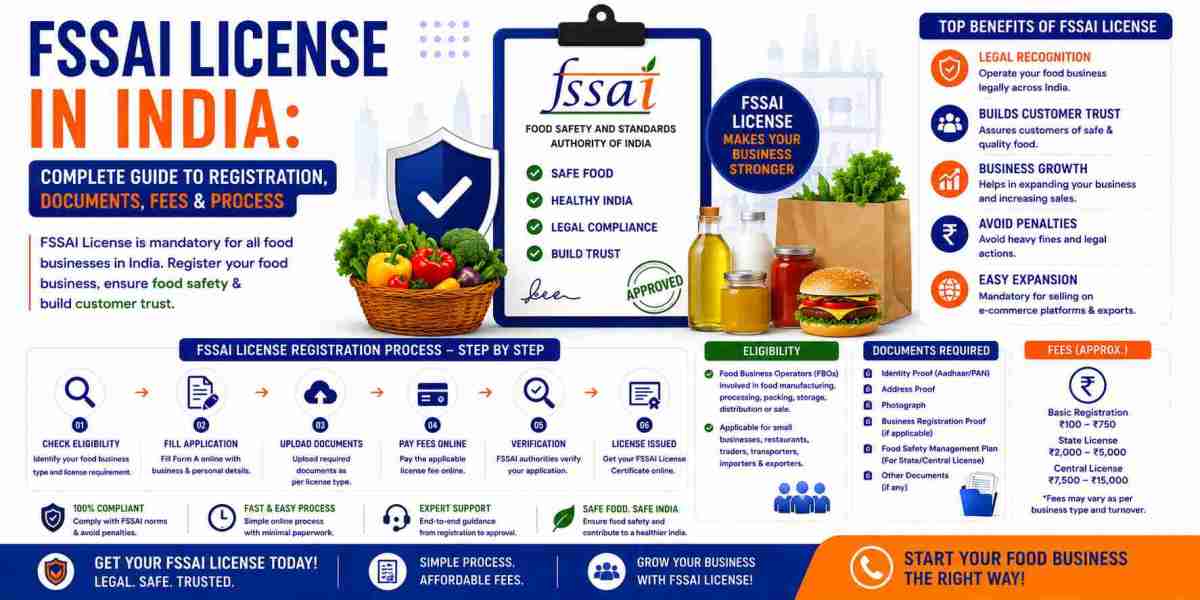
If you are planning to start a food business in India, getting an FSSAI License is one of the first things you should think about. Whether you want to open a restaurant, food shop, bakery, cloud kitchen, food manufacturing unit, or online food business, FSSAI registration helps show that your food business follows food safety rules.
FSSAI stands for the Food Safety and Standards Authority of India. It works to make sure that food sold to people is safe and meets the required quality standards.
In this simple guide, let us understand what an FSSAI License is, who needs it, what documents are required, the fees, and how the registration process works.
What Is an FSSAI License?
An FSSAI License is an official approval for businesses involved in food-related activities. It is issued under India's food safety laws.
The license gives your customers more confidence because they know your business is registered with the food safety authority.
Depending on the size and nature of the business, you may need:
- FSSAI Basic Registration
- FSSAI State License
- FSSAI Central License
The right category depends mainly on your business type, scale, location, and food activities.
Who Needs FSSAI Registration?
Almost every food business operator may need FSSAI registration or a license. Some common examples include:
- Restaurants and cafés
- Bakeries and sweet shops
- Food manufacturers
- Cloud kitchens
- Food wholesalers and distributors
- Grocery and food stores
- Food importers and exporters
- Caterers
- Online food businesses
- Storage and transportation businesses dealing with food
So, even if you are running a small food business from home, you should check which type of FSSAI registration applies to you.
Documents Required for FSSAI License
The documents can change depending on your business type and license category. Generally, applicants may need:
- PAN card
- Identity and address proof
- Passport-size photograph
- Business address proof
- Proof of possession of the premises
- Partnership deed or company incorporation documents, if applicable
- Details of the food business
- List of food products
- Information about machinery and equipment, where applicable
- Other documents requested by the authority
It is important to provide correct information because mistakes in the application can cause delays.
FSSAI Registration Fees
The FSSAI government fee depends on the type of registration or license and the nature of the food business.
A small food business may require only basic registration, while a larger business may need a State or Central License. Apart from the government fee, professional service charges may also apply if you take help from a consultant.
Therefore, it is better to check the applicable fee for your exact business before applying.
How to Apply for an FSSAI License?
The process is fairly simple when you have the required information and documents ready.
Step 1: Identify the Correct License
First, understand whether your business needs Basic Registration, State License, or Central License.
Step 2: Prepare the Documents
Collect your identity proof, business address proof, business details, and other required documents.
Step 3: Submit the Application
Fill in the FSSAI application with accurate business and food-related information and submit the required documents.
Step 4: Verification
The application and documents may be checked by the concerned food safety authority. In some cases, an inspection of the business premises may also be required.
Step 5: Get Your FSSAI Certificate
Once the application is approved, the FSSAI registration or license is issued. You can then follow the applicable food safety requirements for your business.
FSSAI License vs Other Business Registrations
Many new business owners get confused between different registrations. They are not the same.
For example, a Shop Establishment Certificate generally relates to the operation of a commercial establishment under applicable state rules, while an FSSAI License is specifically connected with food safety.
Similarly, a PSARA Licence is related to private security agencies and is not a substitute for FSSAI registration.
Trademark Registration is also different. It helps protect a business name, brand name, logo, or other trademark, while FSSAI registration deals with food business compliance.
A business may need more than one registration depending on what it does.
Benefits of Having an FSSAI License
Having the appropriate FSSAI registration can offer several benefits:
- Helps meet food safety compliance requirements
- Builds trust among customers
- Makes your food business look more professional
- Supports business expansion
- Helps with certain business opportunities and partnerships
- Provides legal recognition for your food business
Final Words
Starting a food business can be exciting, but food safety should never be ignored. Getting the correct FSSAI License is an important step toward running your business properly.
Before applying, understand your business activity, select the correct license category, keep your documents ready, and provide accurate information.
If you are unsure about the process, Corpbiz can help you understand the applicable registration requirements and make the process easier.
Author Profile
Gaurav Sharma is a Legal Consultant and business compliance expert with over 10 years of experience helping startups, entrepreneurs, and companies with legal registrations and regulatory requirements in India. He focuses on simplifying complex compliance processes and providing practical guidance to businesses. At Corpbiz, Gaurav helps business owners understand registrations, licenses, and compliance requirements so they can focus on growing their businesses.



