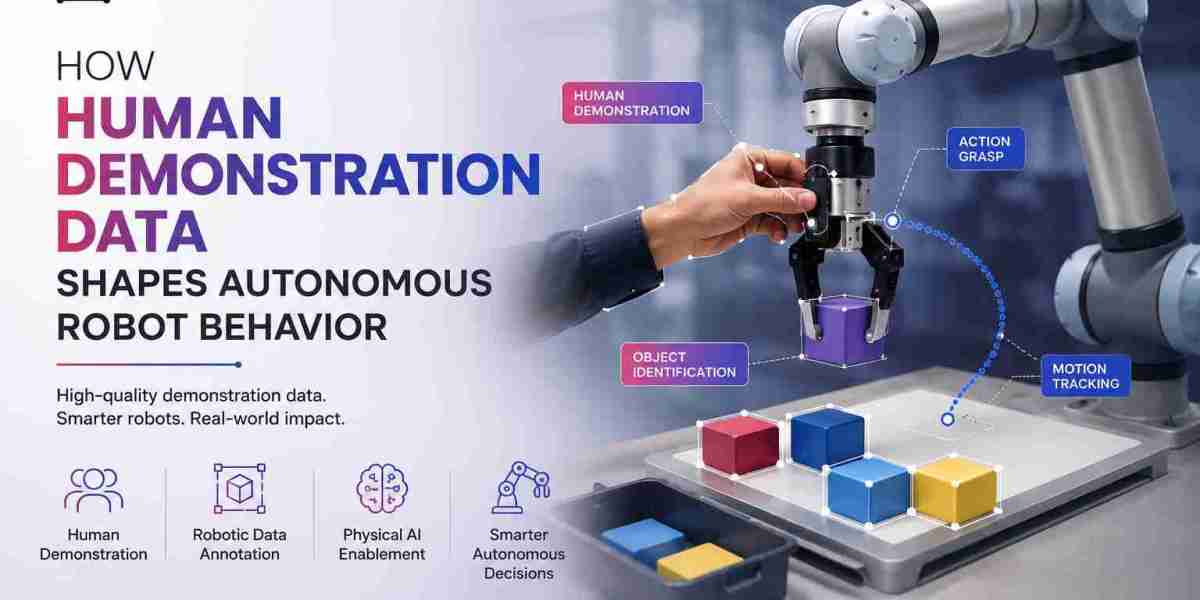
As robotics systems become increasingly capable of operating in dynamic environments, one challenge remains constant: teaching robots how to make intelligent decisions in the real world. While advances in machine learning, sensor technologies, and computing power have accelerated robotic innovation, autonomous systems still depend heavily on one foundational ingredient—high-quality human demonstration data.
From warehouse automation and industrial robotics to service robots and autonomous vehicles, robots learn complex tasks by observing and replicating human actions. This process, often referred to as Learning from Demonstration (LfD) or Imitation Learning, has emerged as one of the most effective approaches for training robots to perform real-world tasks safely and efficiently.
At Annotera, we understand that the quality of training data directly influences robotic performance. Through specialized robotic data annotation services, organizations can transform raw demonstration data into structured datasets that power the next generation of autonomous systems and physical AI applications.
Understanding Human Demonstration Data
Human demonstration data consists of recorded human actions, decisions, and interactions that robots use as learning examples. These demonstrations can be collected through various methods, including:
Teleoperation systems
Motion capture technology
Wearable sensors
VR and AR interfaces
Video recordings
Human-controlled robotic systems
The goal is simple: allow robots to observe how humans complete tasks and learn the sequence of actions required to achieve desired outcomes.
For example, if a warehouse robot needs to learn how to pick and place fragile objects, human operators first perform the task while sensors and cameras record every movement, decision point, and environmental condition. These recordings become valuable training data that robots later use to develop autonomous behaviors.
Why Human Demonstration Data Matters
Traditional robotic programming requires engineers to explicitly define every rule and action a robot should take. This approach becomes impractical when robots must operate in unpredictable environments.
Human demonstration data provides a more scalable alternative.
According to research from the Stanford Artificial Intelligence Laboratory, imitation learning significantly reduces the amount of manual programming required for complex robotic tasks while improving adaptability in changing environments.
Human demonstrations help robots learn:
Object manipulation strategies
Navigation behaviors
Task sequencing
Error recovery techniques
Human-like decision-making patterns
Context-aware responses
Instead of coding thousands of possible scenarios, developers can leverage demonstration datasets to teach robots through examples.
The Role of Annotation in Human Demonstration Learning
Raw demonstration data alone is not enough. Robots cannot effectively learn from unstructured videos, sensor logs, or motion recordings without proper labeling and contextualization.
This is where robotic data annotation becomes critical.
Annotation transforms raw demonstrations into machine-readable datasets by identifying and labeling key elements such as:
Object Identification
Annotators label tools, products, obstacles, and environmental objects that appear during demonstrations.
Action Segmentation
Human activities are broken down into distinct actions such as:
Reach
Grasp
Lift
Rotate
Place
These action labels help robots understand task sequences.
Pose and Motion Tracking
Joint positions, hand trajectories, and body movements are annotated to provide detailed motion intelligence.
Environmental Context
Robots must understand surrounding conditions. Annotators label factors such as:
Workspace layouts
Object locations
Dynamic obstacles
Human interactions
Without accurate annotations, robots may struggle to understand why specific actions were performed and under what circumstances.
Human Demonstrations and the Rise of Physical AI
The emergence of physical AI is creating new opportunities for robotics training.
Unlike traditional AI systems that primarily process digital information, physical AI enables machines to interact directly with the physical world. These systems must understand movement, force, spatial awareness, and environmental context simultaneously.
Recent industry reports indicate that the global robotics market is expected to surpass $200 billion by the end of the decade, driven largely by advancements in AI-powered automation and embodied intelligence systems.
Human demonstration datasets provide the behavioral foundation needed to train these sophisticated models.
Companies developing humanoid robots, warehouse automation systems, and autonomous mobile robots increasingly rely on demonstration-based learning pipelines to accelerate deployment and improve operational safety.
How Demonstration Data Improves Robot Decision-Making
Human experts naturally incorporate years of experience into every action they perform. When robots learn from demonstrations, they inherit valuable behavioral patterns that would be difficult to program manually.
Faster Learning
Demonstration-based learning significantly reduces training time by providing robots with successful task examples from the start.
Improved Safety
Human operators demonstrate safe operating procedures, helping robots avoid hazardous actions during autonomous operation.
Better Generalization
Exposure to diverse demonstrations allows robots to handle variations in objects, environments, and task conditions.
Enhanced Adaptability
Robots learn how humans adjust to unexpected situations, enabling more resilient autonomous behavior.
As roboticist and AI pioneer Richard Sutton famously stated:
"The biggest breakthroughs often come from systems that learn from experience rather than relying solely on hand-crafted knowledge."
Human demonstration data embodies this principle by providing robots with experiential learning opportunities.
Challenges in Human Demonstration Annotation
While demonstration-based learning offers significant advantages, creating high-quality datasets presents several challenges.
Data Volume
Complex robotic systems require thousands of demonstrations covering numerous task variations.
Annotation Consistency
Different annotators may interpret actions differently unless strict guidelines and quality controls are implemented.
Temporal Labeling Complexity
Human actions occur continuously, making it difficult to define precise action boundaries.
Multimodal Data Integration
Modern robotic systems often combine:
Video data
LiDAR scans
Sensor outputs
Telemetry logs
Force measurements
Synchronizing and annotating these diverse data sources requires specialized expertise.
This is why many robotics companies partner with an experienced data annotation company capable of managing large-scale annotation workflows while maintaining quality standards.
Why Data Annotation Outsourcing Benefits Robotics Companies
Building in-house annotation teams can be expensive and resource-intensive, especially for organizations developing advanced robotics solutions.
Data annotation outsourcing offers several advantages:
Access to Specialized Expertise
Professional annotation teams understand robotics workflows, computer vision requirements, and AI training methodologies.
Faster Dataset Production
Dedicated annotation resources accelerate project timelines.
Scalable Operations
Organizations can rapidly expand annotation efforts as training data requirements grow.
Quality Assurance
Established annotation providers implement multi-stage review processes that improve dataset accuracy.
For robotics developers seeking competitive advantages, outsourcing annotation functions allows engineering teams to focus on model development while data specialists handle dataset creation.
The Future of Autonomous Robot Training
The future of robotics will be increasingly shaped by human-guided learning systems.
As autonomous robots become more sophisticated, they will require larger and more detailed demonstration datasets covering a wider range of real-world scenarios. Advances in simulation environments, teleoperation systems, and multimodal AI models will further expand the role of demonstration-based learning.
However, success will continue to depend on one critical factor: data quality.
High-quality robotic data annotation ensures that robots not only observe human behavior but truly understand the context, intent, and decision-making processes behind those actions.
Conclusion
Human demonstration data serves as the bridge between human expertise and autonomous robotic intelligence. By capturing and annotating real-world behaviors, organizations can train robots that are safer, smarter, and more adaptable.
As the adoption of physical AI accelerates across industries, the demand for accurately labeled demonstration datasets will continue to grow. Partnering with an experienced data annotation company enables robotics organizations to build the high-quality training datasets necessary for successful autonomous systems.
At Annotera, we specialize in delivering scalable robotic data annotation solutions that help organizations transform raw demonstration data into actionable intelligence. Through expert annotation workflows and flexible data annotation outsourcing services, we support the development of next-generation robotics and autonomous technologies.