


Introduction
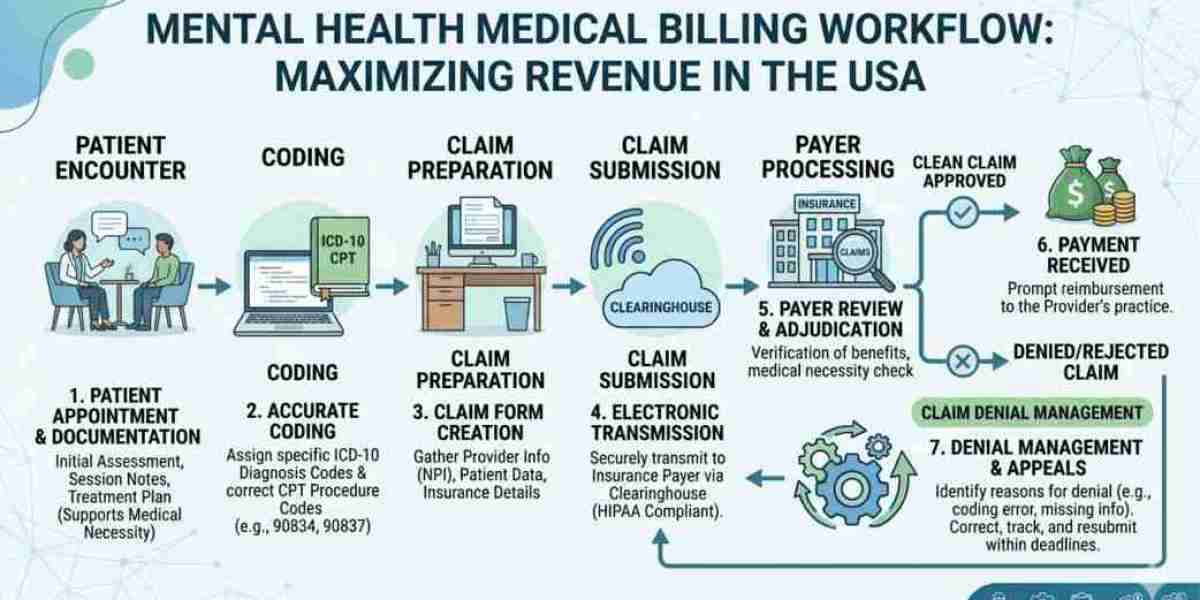
The demand for mental health services across the USA has grown significantly over the last decade, driven by rising awareness, reduced stigma, and increased access to behavioral healthcare. However, behind every successful therapy session or psychiatric consultation lies a complex administrative process—billing, coding, insurance verification, and credentialing.
For many providers, these back-end operations become overwhelming, often leading to delayed reimbursements, claim denials, and revenue leakage. This is where mental health billing and credentialing services play a crucial role. By streamlining administrative workflows, these services allow mental health professionals to focus more on patient care rather than paperwork.
Today, whether it is a solo therapist practice or a multi-location behavioral health clinic, efficient billing and credentialing systems are essential for financial stability and compliance in the ever-changing healthcare landscape.
Understanding Mental Health Billing and Credentialing Services
Mental health billing is not the same as general medical billing. It involves specific CPT codes, session-based reimbursement structures, and strict insurance guidelines that vary across payers. On the other hand, credentialing ensures that mental health providers are properly enrolled with insurance networks to receive payments for services rendered.
Together, mental health billing and credentialing services help providers manage:
- Insurance verification and eligibility checks
- Accurate coding of therapy sessions and psychiatric evaluations
- Claim submission and follow-ups
- Denial management and appeals
- Provider enrollment with insurance networks
- Compliance with payer regulations
Without these systems in place, even the most skilled clinicians can experience revenue disruptions.
Why Mental Health Billing Is More Complex Than General Billing
Mental health billing involves unique challenges that make it more demanding than standard healthcare billing:
1. Time-Based Billing Structures
Unlike procedural medicine, mental health services are billed based on session duration—30, 45, 60 minutes, etc. Small errors in time documentation can lead to claim rejections.
2. Frequent Use of Specific CPT Codes
Codes like 90832, 90834, and 90837 are widely used in therapy billing, and incorrect usage can trigger audits.
3. Insurance Limitations
Many insurance plans limit the number of therapy sessions covered per year, requiring constant eligibility tracking.
4. Prior Authorization Requirements
Some behavioral health services require approval before treatment begins, adding administrative burden.
5. Documentation Sensitivity
Mental health records require strict confidentiality and detailed clinical notes for reimbursement.
These complexities make outsourcing mental health billing a practical solution for most practices.
Role of Mental Health Insurance Billing in Practice Efficiency
Mental health insurance billing ensures providers receive timely reimbursement from commercial insurers, Medicare, and Medicaid. It involves verifying patient coverage, submitting claims correctly, and managing denials effectively.
When handled professionally, insurance billing can significantly improve cash flow and reduce administrative stress.
Key benefits include:
- Faster claim approvals
- Reduced billing errors
- Improved payer communication
- Higher reimbursement rates
- Better financial forecasting
For many clinics, outsourcing this function has become a strategic decision rather than just an operational one.
Importance of Mental Health Provider Billing Accuracy
Accurate mental health provider billing is essential to maintain compliance and avoid revenue loss. Even small documentation mistakes can lead to claim delays or audits.
A professional billing system ensures:
- Correct CPT and ICD-10 code usage
- Proper session documentation alignment
- Timely submission of claims
- Reduced denial rates
- Compliance with payer-specific guidelines
When providers rely on expert billing teams, they can focus more on therapy outcomes rather than administrative challenges.
Outsourced Billing for Mental Health: A Growing Trend in the USA
In recent years, outsourced billing for mental health has become increasingly popular among clinics and private practices. The shift is driven by the need for efficiency, scalability, and cost control.
Instead of hiring in-house billing staff, providers now partner with specialized billing companies that handle end-to-end revenue cycle operations.
Advantages of outsourcing include:
- Reduced operational costs
- Access to expert billing professionals
- Improved claim acceptance rates
- Scalable services for growing practices
- Advanced billing technology and automation
Outsourcing also helps small and mid-sized practices compete with larger healthcare organizations.
Regional Demand for Mental Health Billing Services
Across the USA, demand for specialized billing services varies by state due to differences in insurance policies and provider density.
Outsourcing Mental Health Billing Texas
Texas has seen a surge in behavioral health practices, leading to increased demand for outsourcing mental health billing Texas solutions. Clinics here often require support for Medicaid-heavy billing and large patient volumes.
Top Mental Health Billing Company Ohio
Ohio-based practices frequently look for the top mental health billing company Ohio due to strict payer rules and frequent insurance audits.
Best Mental Health Billing Company New York
In high-volume urban areas, finding the best mental health billing company New York is essential for managing complex insurance networks and multi-specialty behavioral clinics.
Best Mental Health Billing Company North Carolina
North Carolina providers prioritize compliance-driven billing services due to evolving Medicaid expansion programs.
Best Mental Health Billing Company South Carolina
South Carolina clinics often seek cost-effective billing partners to improve reimbursement rates while maintaining compliance.
Each region has its own billing challenges, making localized expertise extremely valuable.
Behavioral and Mental Health Billing Services Explained
Behavioral and mental health billing services cover a wide range of administrative functions designed specifically for psychiatry, psychology, counseling, and therapy practices.
These include:
- Patient intake and eligibility verification
- Insurance claim submission
- Behavioral health coding accuracy
- Payment posting and reconciliation
- Denial management and appeals
- Monthly reporting and analytics
Such services are designed to reduce administrative burden while improving revenue consistency.
What Makes the Best Mental Health Billing Agency?
Choosing the best mental health billing agency is critical for long-term practice success. Not all billing companies understand the nuances of behavioral healthcare.
A reliable agency should offer:
- Deep expertise in mental health CPT coding
- Strong payer relationships
- Transparent reporting systems
- High claim acceptance rates
- Dedicated credentialing support
- HIPAA-compliant operations
The best mental health billing services company will also provide customized solutions tailored to each practice size and specialty.
Credentialing: The Foundation of Mental Health Revenue
Credentialing services are essential for ensuring that mental health providers are recognized by insurance networks. Without proper credentialing, providers cannot bill insurance companies.
This process includes:
- CAQH profile setup and maintenance
- Insurance enrollment applications
- Re-credentialing and renewals
- License verification
- Contract negotiation support
Delayed credentialing can result in significant revenue loss, especially for new practices trying to enter insurance networks.
How Credentialing and Billing Work Together
Billing and credentialing are interconnected processes. Even the most accurate billing system cannot function effectively if providers are not properly credentialed.
Together, they ensure:
- Smooth insurance participation
- Faster claim approvals
- Reduced administrative delays
- Stable revenue flow
- Improved patient access to care
This integration is why many providers now prefer comprehensive mental health billing and credentialing services under one roof.
Revenue Cycle Management in Mental Health Practices
Effective revenue cycle management services are the backbone of financial stability for behavioral health clinics. It covers everything from patient intake to final payment collection.
A strong RCM system ensures:
- Clean claim submissions
- Faster reimbursements
- Reduced claim rejections
- Efficient payment posting
- Better financial tracking
For mental health practices, strong RCM directly translates into sustainable growth and operational efficiency.
Medical Billing and Coding in Mental Health Practices
While mental health billing is specialized, it still relies on core healthcare processes like medical billing services, medical coding services, and medical billing and coding services.
These services ensure that:
- Every therapy session is properly coded
- Insurance claims are accurately submitted
- Compliance standards are maintained
- Revenue cycles remain uninterrupted
When combined with behavioral health expertise, these services form the foundation of a profitable mental health practice.
Why Outsourcing Is the Future of Mental Health Billing
The healthcare industry in the USA is rapidly evolving. Administrative complexity is increasing, while reimbursement rules are becoming stricter. In this environment, outsourcing has become a strategic necessity.
Key reasons include:
- Rising operational costs in in-house billing
- Need for specialized mental health expertise
- Increasing insurance claim complexities
- Demand for faster reimbursements
- Technology-driven billing automation
Practices that adopt outsourcing early tend to experience stronger financial stability and reduced administrative stress.
Conclusion
Mental health practices today require more than just clinical expertise—they need strong financial and administrative systems to survive and grow. From insurance verification to claim submission and credentialing, every step in the revenue cycle plays a vital role in ensuring steady income.
Professional mental health billing and credentialing services help providers eliminate inefficiencies, reduce claim denials, and improve reimbursement cycles. With increasing demand for behavioral healthcare across the USA, outsourcing billing functions has become a practical and strategic move.
Organizations like 247 Medical Billing Services support practices with end-to-end solutions including medical billing services, medical coding services, medical billing and coding services, revenue cycle management services, and credentialing services. By integrating these services, mental health providers can focus entirely on patient care while maintaining financial health and operational efficiency.
FAQs
1. What are mental health billing and credentialing services?
These services manage insurance billing, coding, claim submission, and provider enrollment with insurance networks for mental health practices.
2. Why is mental health billing more complex than general medical billing?
It involves time-based sessions, specific CPT codes, insurance limitations, and strict documentation requirements.
3. What is outsourced billing for mental health practices?
It is when clinics hire third-party billing companies to handle their entire revenue cycle and insurance billing processes.
4. How do credentialing services help mental health providers?
Credentialing ensures providers are enrolled with insurance companies so they can receive reimbursements for services.
5. What is the benefit of revenue cycle management services?
They improve cash flow, reduce claim denials, and ensure faster payment processing for healthcare practices.
6. How do I choose the best mental health billing company?
Look for experience in behavioral health, high claim success rates, strong compliance systems, and transparent reporting.



