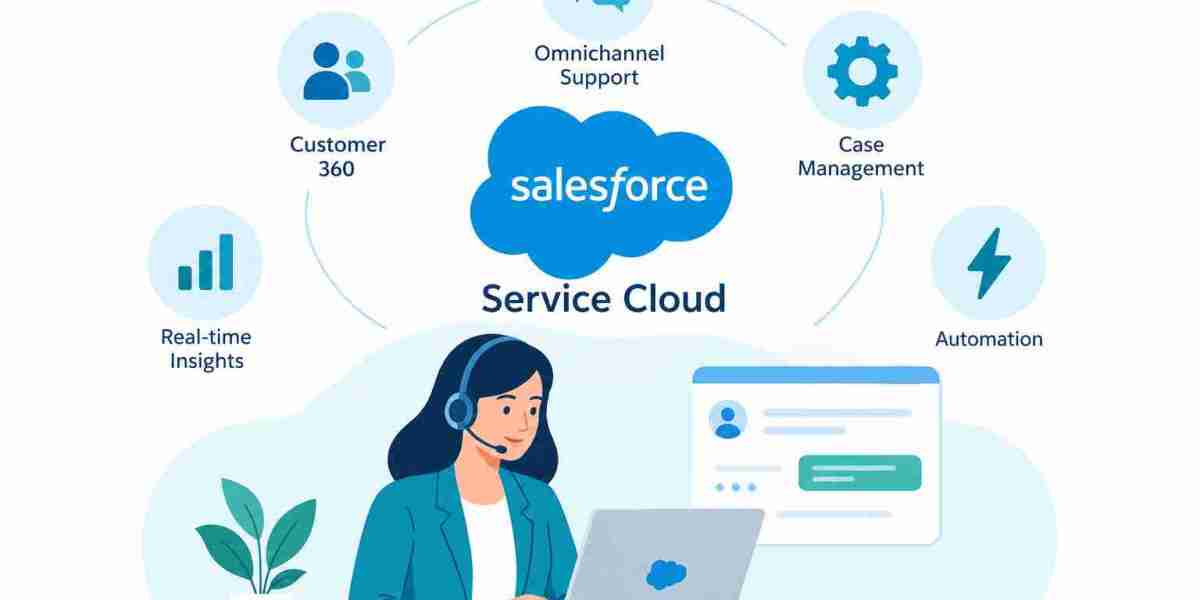
Customer service problems rarely come from one issue. A business may have high case volumes, disconnected systems, slow response times, repetitive tasks, and limited visibility at the same time.
Salesforce Service Cloud can provide a centralized platform for addressing many of these operational challenges.
Challenge 1: Customer Data Is Scattered Across Systems
Agents often need customer information from multiple applications.
This creates unnecessary delays and can make it difficult to understand the complete customer history.
Service Cloud Approach
Customer records, cases, interactions, knowledge, and related information can be connected within Salesforce.
This gives agents a more centralized view of customer activity.
Challenge 2: Case Backlogs Keep Growing
When service requests are assigned manually, cases can remain in queues longer than expected.
Service Cloud Approach
Case management and automation can help organizations establish rules for categorization, assignment, prioritization, escalation, and follow-up.
This creates a more structured case lifecycle.
Challenge 3: Agents Repeat the Same Tasks
Service teams frequently handle repetitive activities.
Examples include:
- Sending standard responses
- Updating case fields
- Assigning requests
- Sending notifications
- Searching for common answers
Service Cloud Approach
Workflow automation, knowledge resources, and AI capabilities can support appropriate repetitive activities.
Agents can then spend more time on cases requiring judgment and direct customer interaction.
Challenge 4: Customers Use Multiple Channels
A customer might start with chat, continue through email, and later contact the call center.
Without connected processes, the customer may need to repeat information.
Service Cloud Approach
Omnichannel capabilities can help organizations design connected service journeys across supported channels.
Challenge 5: Customers Ask Questions That Already Have Answers
Many service teams spend considerable time responding to recurring questions.
Service Cloud Approach
Knowledge management and self-service resources can give customers and agents access to approved information.
This can reduce unnecessary support interactions.
Challenge 6: Managers Lack Service Visibility
A service manager needs to know more than the number of open tickets.
They may need to understand:
- Case volume
- Response patterns
- Resolution activity
- Agent workload
- Escalations
- Customer service trends
Service Cloud Approach
Reports and dashboards can organize service information into measurable operational insights.
Challenge 7: Legacy Systems Complicate Service Operations
Many organizations rely on older applications that still contain important customer or product information.
Replacing every system may not be practical.
Service Cloud Approach
Integration can connect Salesforce with relevant enterprise applications so information can move between systems according to defined requirements.
Challenge 8: Service Processes Differ by Business Unit
A global organization may have different teams, products, customer groups, and service rules.
A single generic workflow may not work everywhere.
Service Cloud Approach
Salesforce can be configured around different service processes, permissions, routing rules, automation requirements, and customer experiences.
Building a Service Cloud Roadmap
Before implementation, businesses should identify:
- Current service processes
- Major customer pain points
- Existing systems
- Data requirements
- Service channels
- Automation opportunities
- Reporting requirements
- Integration dependencies
- Security requirements
- Future scalability needs
This creates a practical roadmap instead of starting with technology alone.
Conclusion
Salesforce Service Cloud can address many common customer service challenges when the platform is configured around actual business processes. The goal should be to create a service environment that is connected, measurable, and practical for agents and customers.