Most businesses running Meta Ads start with a single campaign, targeting a single audience, with a single objective: generate leads. This works, to a point, but it treats every prospect identically regardless of whether they've never heard of the business before or have visited the website three times without converting. A genuine lead generation funnel structures campaigns deliberately around where a prospect actually sits in their decision journey, using different objectives, audiences, and creative at each stage, rather than running one undifferentiated campaign and hoping it performs equally well for everyone it reaches.
This article walks through how to build that structure from the ground up — mapping Meta's campaign types and audience tools to each stage of a genuine funnel, rather than treating "running ads" as a single, flat activity.
Why a Single-Stage Campaign Leaves Performance on the Table
A single campaign targeting a broad cold audience, asking for a lead immediately, forces every prospect through the same high-commitment action regardless of how much trust and interest has actually been established. Some portion of that broad audience is genuinely ready to enquire immediately, but a larger portion likely needs more context, more trust-building, or simply more exposure to the business before they're ready to take that step — and a single-stage campaign has no mechanism for nurturing that larger group toward eventual conversion.
A proper funnel addresses this by meeting prospects where they actually are: introducing the business to people with no prior awareness, building deeper interest and trust with those who've shown some initial engagement, and directly asking for the lead from those who've demonstrated enough interest and familiarity to be genuinely ready for that request.
Mapping the Three Core Funnel Stages
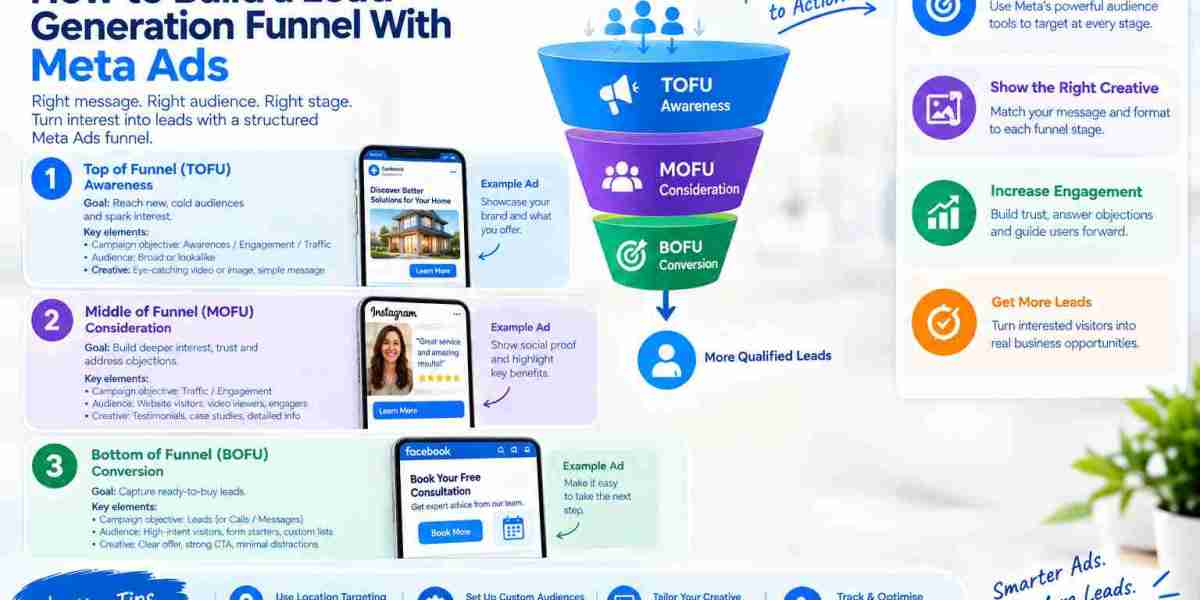
A lead generation funnel is typically structured around three broad stages, each with a different objective. The top of the funnel (TOFU) focuses on reaching new, cold audiences and generating initial awareness and interest, without directly asking for a lead at this stage. The middle of the funnel (MOFU) targets people who've engaged with top-of-funnel content but haven't yet converted, building deeper interest, trust, and consideration through more specific, persuasive content. The bottom of the funnel (BOFU) directly targets people who've shown strong engagement signals — multiple visits, significant time on site, engagement with middle-funnel content — with a direct, clear lead generation offer and call to action.
Each stage uses different Meta Ads campaign objectives, different audiences, and different creative, working together as a connected system rather than operating as isolated, unrelated campaigns.
Structuring the Top-of-Funnel Stage
Top-of-funnel campaigns typically use broader core or lookalike audiences, since the goal here is reaching new people with no prior relationship to the business. Campaign objectives suited to this stage include awareness or engagement-focused objectives, or in some cases, traffic campaigns designed to drive initial website visits without yet asking for a significant commitment.
Creative at this stage should focus on capturing attention and building initial interest — genuinely engaging video or imagery, a clear but low-commitment message about what the business offers, and content that feels native to the platform rather than overtly salesy. The goal isn't converting this audience immediately; it's building enough initial awareness and interest to make the next stage of engagement — visiting the website, watching more content, engaging with a follow-up ad — a natural next step rather than a significant leap for someone who's never encountered the business before.
Structuring the Middle-of-Funnel Stage
Middle-of-funnel campaigns target people who've engaged with top-of-funnel content in some way — website visitors who didn't convert, people who watched a significant portion of a video ad, or those who engaged with previous content through likes, comments, or shares. This requires building the relevant custom audiences in advance, using the Pixel for website engagement and Meta's native engagement custom audience options for people who've interacted with ads or content directly on the platform.
Creative at this stage can afford to go deeper than top-of-funnel content, since the audience already has some baseline familiarity. This is an effective stage for addressing common objections directly, showcasing social proof such as testimonials or case studies, providing more detailed information about the specific offer, or using slightly longer-form video content that builds genuine trust and understanding in a way a single top-of-funnel impression couldn't achieve on its own.
Structuring the Bottom-of-Funnel Stage
Bottom-of-funnel campaigns target the audience showing the strongest engagement signals — people who've visited high-intent pages like pricing or a specific service, engaged significantly with middle-funnel content, or started but didn't complete a lead form. This is where the Leads objective, with either instant forms or a dedicated landing page, becomes the primary focus, since this audience has demonstrated enough genuine interest to warrant a direct, clear ask.
Creative at this stage should be straightforward and action-oriented, clearly communicating the specific offer and next step, often with an additional incentive or urgency element to encourage a prospect who's already shown strong interest to finally take that last step and submit an enquiry.
Allocating Budget Across the Three Stages
There's no single universally correct budget split across funnel stages, since the right allocation depends on factors including how much existing website traffic and audience data a business already has, the typical length of its sales cycle, and overall campaign maturity. A business just beginning to build a funnel, with little existing custom audience data, often needs to invest more heavily in top-of-funnel activity initially, simply to build the audience base that middle and bottom-funnel campaigns will eventually draw from.
As a funnel matures and accumulates meaningful audience data at each stage, budget can shift to reflect genuine performance — often with top-of-funnel continuing to represent the largest share of spend simply due to the larger audience size involved, but middle and bottom-funnel campaigns frequently delivering a meaningfully lower cost per lead, justifying continued, deliberate investment in nurturing engaged audiences rather than relying purely on cold acquisition.
Following a Single Prospect Through the Funnel
It's useful to visualise how an individual prospect might actually move through this structure. A new prospect first encounters a top-of-funnel awareness or engagement ad, perhaps watching a short video about the business without taking any further action immediately. Days later, having been added to a middle-funnel custom audience based on that video engagement, they see a follow-up ad featuring a customer testimonial addressing a common concern relevant to their situation, prompting them to visit the website and browse a specific service page.
That website visit then qualifies them for a bottom-of-funnel retargeting audience, where they subsequently see a direct ad with a clear offer and a strong call to action, this time resulting in a submitted lead form. This entire sequence — awareness, consideration, conversion — happened across multiple touchpoints over what might be days or weeks, rather than expecting a single ad exposure to carry a prospect from complete unfamiliarity through to a completed lead form in one step.
Measuring Performance at Each Stage
A properly structured funnel requires tracking different metrics at each stage, rather than judging the entire structure purely by final lead volume and cost. Top-of-funnel performance is best measured through engagement metrics, video view rates, and the growth of the custom audiences it feeds into — the people who'll become eligible for middle-funnel retargeting. Middle-funnel performance is measured through click-through rate, website engagement depth, and progression into bottom-funnel audiences. Bottom-funnel performance is measured through the traditional lead generation metrics — cost per lead and downstream conversion rate into genuine sales.
Judging only the bottom-of-funnel campaign's direct cost per lead, without accounting for the top and middle-funnel activity that built the audience it's drawing from, can understate the overall value of the full funnel structure, since a strong bottom-funnel cost per lead is often only possible because of the awareness and trust-building work happening at the earlier stages feeding into it.
Avoiding Common Funnel-Building Mistakes
A frequent mistake is building a funnel structure in name only, without actually connecting the stages through proper custom audience configuration — running what's labelled as three separate "funnel stages" but each targeting entirely disconnected, independent audiences rather than genuinely flowing people from one stage into the next based on real engagement data. Another common mistake is moving prospects toward bottom-funnel, high-commitment offers too quickly, before they've had genuine exposure to the trust-building content that middle-funnel campaigns are meant to provide, effectively skipping a stage that was meant to do real work in the overall conversion process.
Regularly auditing that custom audiences are actually configured correctly — confirming that middle-funnel audiences genuinely reflect top-funnel engagement, and bottom-funnel audiences genuinely reflect middle-funnel engagement — ensures the funnel is functioning as a connected system, rather than three isolated campaigns loosely labelled according to a funnel framework without the underlying audience connections actually supporting it.
Final Thoughts
Building a genuine lead generation funnel with Meta Ads means moving beyond a single, undifferentiated campaign asking every prospect for the same commitment regardless of where they actually sit in their decision journey. Structuring campaigns deliberately around awareness, consideration, and conversion stages — each with matched objectives, audiences, and creative, genuinely connected through properly configured custom audiences — allows a business to nurture prospects who aren't yet ready to convert immediately, rather than losing them entirely after a single missed opportunity.
Businesses that build and maintain this kind of connected funnel structure consistently generate stronger overall results from their Meta Ads investment than those running a single, flat campaign, since the funnel approach captures and nurtures the much larger pool of prospects who were never going to convert on their very first exposure to the business, but who remain genuinely recoverable with the right sequence of follow-up engagement.