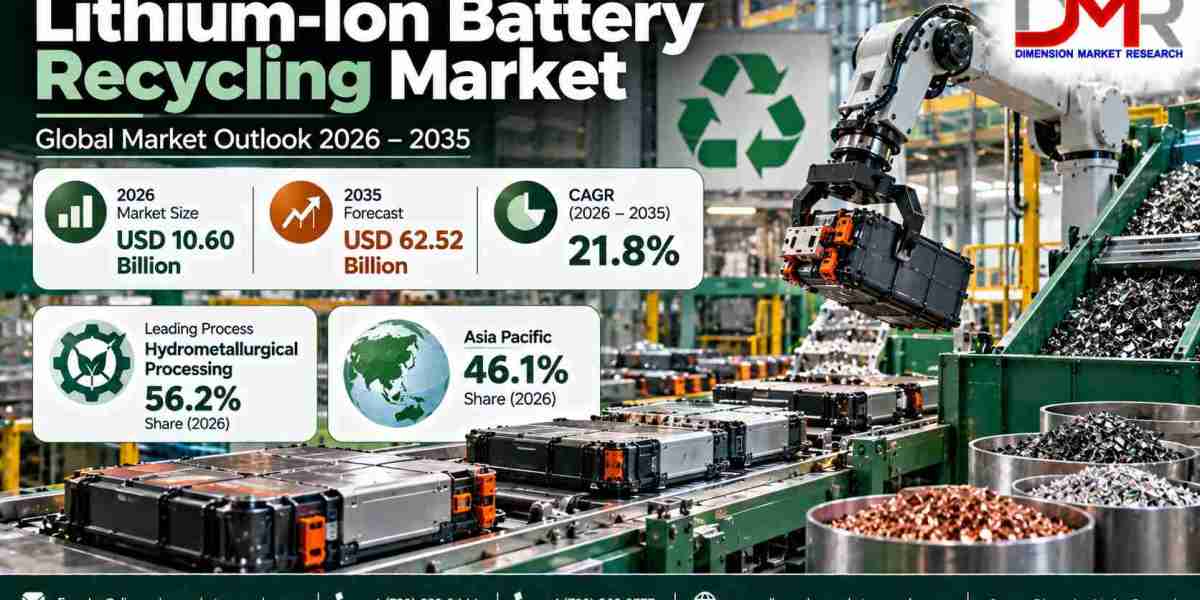
The global Lithium-Ion Battery Recycling Market is undergoing significant transformation as electric vehicle adoption, energy storage expansion, and critical mineral supply concerns accelerate demand for advanced recycling technologies. According to Dimension Market Research, the market is projected to reach USD 10.60 billion in 2026 and expand to USD 62.52 billion by 2035, registering a CAGR of 21.8%.
Growing volumes of used EV batteries, regulatory requirements for recycled materials, and increasing demand for lithium, nickel, and cobalt are strengthening the importance of battery recycling.
Manufacturers and recycling companies are investing in hydrometallurgical processing, automated sorting, and closed-loop recovery systems to improve material recovery efficiency and reduce dependence on primary mineral extraction.
What Is the Lithium-Ion Battery Recycling Market?
The Lithium-Ion Battery Recycling Market includes the collection, dismantling, processing, and recovery of valuable materials from used lithium-ion batteries and manufacturing scrap.
Recycling technologies recover materials such as lithium, nickel, cobalt, copper, aluminum, and graphite for potential reuse in batteries and other industrial applications.
The recycling process includes battery collection, discharge, shredding, black mass production, metal refining, and purification.
Major waste sources include electric vehicles, consumer electronics, stationary energy storage systems, and industrial equipment.
Lithium-Ion Battery Recycling Market Size and Key Statistics
The DMR report identifies the following 2026 market indicators:
● 2026 Market Size: USD 10.60 Billion
● 2035 Market Forecast: USD 62.52 Billion
● Forecast CAGR: 21.8%
● Asia-Pacific Revenue Share: 46.1%
● NMC Batteries Share: 51.4%
● Hydrometallurgical Processing: 56.2%
● Shredding and Sorting: 35.7%
● Battery-Grade Lithium: 44.0%
● Electric Vehicles Waste Source: 68.7%
These figures demonstrate the growing economic importance of material recovery within the global battery supply chain.
Why Is the Lithium-Ion Battery Recycling Market Growing?
Increasing End-of-Life Electric Vehicle Batteries
The rapid expansion of electric mobility is creating a growing pipeline of batteries requiring recycling.
Electric vehicles account for 68.7% of waste-source demand in 2026, reflecting the importance of automotive battery recovery.
As earlier generations of EV batteries reach the end of their useful lives, recycling companies are developing processing facilities capable of handling larger volumes.
Battery manufacturers and automakers are also exploring closed-loop recycling agreements to recover materials for new battery production.
Critical Mineral Supply Chain Security
Lithium, cobalt, nickel, and other battery materials remain important to electric vehicle manufacturing and stationary energy storage.
Recovering these materials can diversify supply chains and reduce reliance on newly mined resources.
Governments and manufacturers increasingly view recycling as part of broader critical mineral security strategies.
European battery regulations are also strengthening demand for recycled content and improved end-of-life battery management.
Get a Free Sample of the Lithium-Ion Battery Recycling Market Report
Explore detailed market forecasts, recovery technology analysis, battery chemistry segmentation, regional opportunities, and competitive intelligence through the Dimension Market Research study.
https://dimensionmarketresearch.com/request-sample/lithium-ion-battery-recycling-market/
How AI and Advanced Technologies Are Transforming Battery Recycling
Technological innovation is improving the efficiency of battery collection, sorting, and material recovery.
Artificial intelligence and machine vision systems can help identify battery chemistries and improve automated sorting.
Robotic disassembly technologies are also being developed to reduce manual intervention during hazardous battery handling.
Important technology developments include:
● AI-powered battery chemistry identification
● Automated battery disassembly systems
● Advanced hydrometallurgical recovery processes
● Direct cathode material recycling
Direct recycling is an emerging opportunity because it seeks to preserve valuable cathode materials for reuse rather than completely breaking them down into individual metals.
However, commercial scalability, material purity, and processing economics remain important challenges.
Lithium-Ion Battery Recycling Market Segmentation Analysis
NMC Batteries Lead Feedstock Chemistry
Nickel Manganese Cobalt batteries account for 51.4% of feedstock chemistry revenue in 2026.
Their leadership reflects historical adoption across electric vehicles and the commercial value of recovering nickel and cobalt.
Lithium Iron Phosphate batteries represent a rapidly growing category, requiring recycling processes suited to their different material composition.
Hydrometallurgical Processing Dominates Recovery Technology
Hydrometallurgical processing holds 56.2% market share in 2026.
The technology uses chemical processes to recover valuable metals from battery materials.
Its ability to produce high-purity recovered compounds supports demand from battery manufacturers.
Pyrometallurgical and direct recycling approaches remain important alternatives for different battery chemistries and processing requirements.
Battery-Grade Lithium Leads Recovered Products
Battery-grade lithium represents 44.0% of the recovered product segment.
Lithium recovery is strategically important because manufacturers require reliable sources of battery materials.
Nickel and cobalt compounds, copper, aluminum, graphite, and cathode active materials represent additional recovery opportunities.
Shredding and Sorting Lead Processing Stages
Shredding and sorting account for 35.7% of processing-stage demand in 2026.
This stage prepares batteries for downstream recovery through controlled material separation.
Its operational efficiency directly influences recycling throughput, safety, and subsequent refining processes.
Regional Outlook: Asia-Pacific Leads Battery Recycling
Asia-Pacific accounts for 46.1% of global market revenue in 2026, making it the leading region.
China benefits from extensive battery production capabilities, established recycling infrastructure, and strong electric vehicle manufacturing activity.
Japan, South Korea, and India are also developing recycling capabilities to support battery manufacturing and critical mineral recovery.
North America is identified as the fastest-growing regional market, supported by investments in domestic battery recycling facilities and critical mineral supply chains.
Europe benefits from regulatory requirements, recycling infrastructure investment, and initiatives supporting circular battery manufacturing.
Competitive Landscape and Leading Companies
The Lithium-Ion Battery Recycling Market includes specialized recyclers, metals processors, battery manufacturers, and integrated material recovery companies.
Prominent companies identified by DMR include Umicore, Glencore, Redwood Materials, Li-Cycle, Ecobat, Ganfeng Lithium, GEM Co. Ltd., Brunp Recycling, Ascend Elements, and Cirba Solutions.
Other participants include Fortum Battery Recycling, RecycLiCo Battery Materials, CATL, SK tes, and American Battery Technology Company.
Competition focuses on recovery efficiency, material purity, processing capacity, feedstock availability, and long-term agreements with automotive manufacturers.
Companies capable of supplying battery-grade recovered materials are positioned to strengthen their role in circular battery supply chains.
Challenges and Future Growth Opportunities
Commodity price volatility, high capital investment, and battery collection logistics remain major market challenges.
Differences in battery chemistries also require specialized processing technologies.
However, opportunities are emerging in LFP recycling, stationary energy storage battery recovery, direct recycling, and regional collection networks.
Long-term agreements with automakers and battery manufacturers may also improve feedstock availability and investment confidence.
Explore the Complete Lithium-Ion Battery Recycling Market Analysis
Access detailed revenue forecasts, recycling technology comparisons, regional market analysis, company profiles, and investment opportunities through the complete Dimension Market Research report.
https://dimensionmarketresearch.com/checkout/lithium-ion-battery-recycling-market/
Frequently Asked Questions
1. What is the Lithium-Ion Battery Recycling Market size?
The global Lithium-Ion Battery Recycling Market is projected to reach USD 10.60 billion in 2026 and USD 62.52 billion by 2035.
2. What is the CAGR of the Lithium-Ion Battery Recycling Market?
The market is forecast to grow at a CAGR of 21.8% from 2026 to 2035.
3. Which recycling technology dominates the market?
Hydrometallurgical processing leads with approximately 56.2% market share in 2026.
4. Which region leads the Lithium-Ion Battery Recycling Market?
Asia-Pacific leads with approximately 46.1% of global market revenue in 2026.
5. What are the major future growth opportunities?
EV battery recovery, direct recycling, LFP processing, stationary energy storage recycling, and battery-grade material recovery represent important opportunities.
Conclusion
The Lithium-Ion Battery Recycling Market is positioned for substantial expansion as electric vehicles, energy storage systems, and critical mineral requirements reshape global battery supply chains.
Hydrometallurgical processing, NMC batteries, and EV-related waste remain major contributors to market demand.
Advancements in automated sorting, direct recycling, and high-purity metal recovery are creating opportunities for recyclers and battery manufacturers.
Companies investing in scalable technologies, reliable feedstock networks, and circular material supply chains may benefit from market growth through 2035.
Related Battery and Recycling Market Insights
The Lithium-ion Battery Market Size is projected to increase from USD 84.3 billion in 2024 to USD 470.5 billion by 2033, registering a CAGR of 21.0%. Lithium cobalt oxide accounts for 32.7% of the product segment, while consumer electronics represent 33.2% of applications in 2024. Electric vehicle adoption, energy storage expansion, and battery performance improvements support market development.
The Battery Market Share analysis projects global revenue increasing from USD 158.3 billion in 2025 to USD 650.9 billion by 2034, at a CAGR of 17.0%. Asia-Pacific leads with a 51.3% share in 2025. Growing demand for electric vehicles, renewable energy storage, industrial batteries, and next-generation battery technologies supports long-term expansion.
The Waste Recycling Services Market Growth study estimates the global market at USD 62.7 billion in 2023, with a reported CAGR of 5.7% through 2032. Paper and paperboard lead the product category, while municipal applications account for the largest share. Increasing environmental awareness, waste management regulations, and advanced recycling technologies are supporting development across the broader recycling industry.