Large businesses often manage invoices across multiple departments, subsidiaries, suppliers and customers. Their finance teams must maintain accurate transaction records while coordinating with procurement, sales, accounting and IT departments. When these activities depend on disconnected systems or manual data transfers, invoice processing can become difficult to manage consistently.
For enterprises operating in the UAE, electronic invoicing adds another consideration: existing financial systems must support the applicable requirements for structured invoice exchange. A suitable UAE e-invoicing solution for enterprises should fit the organization's technology environment, support its invoicing workflows and provide a clear implementation process.
Choosing the right solution requires businesses to look beyond basic invoice generation. Integration, data accuracy, transaction monitoring and ongoing technical support all influence how well the system performs in daily operations.
Why Enterprise E-Invoicing Requires Careful Planning
An enterprise may process invoices through several systems, with different departments responsible for creating, approving and recording transactions. A manufacturer, for example, could generate sales invoices through its ERP while maintaining supplier records and payment information in connected financial applications.
Introducing electronic invoicing without reviewing these workflows can create integration problems. Invoice data may need to be mapped between systems, existing approval processes may require adjustments, and employees must understand how to manage errors or rejected transactions.
The UAE's e-invoicing framework uses structured electronic invoices exchanged through accredited service providers, with relevant tax data reported electronically to the Federal Tax Authority. A PDF invoice sent by email alone does not meet the framework's definition of a structured e-invoice.
Enterprises should therefore assess their existing systems, confirm their applicable obligations and identify the technical changes required before implementation begins.
What Should Enterprises Evaluate When Selecting a Solution?
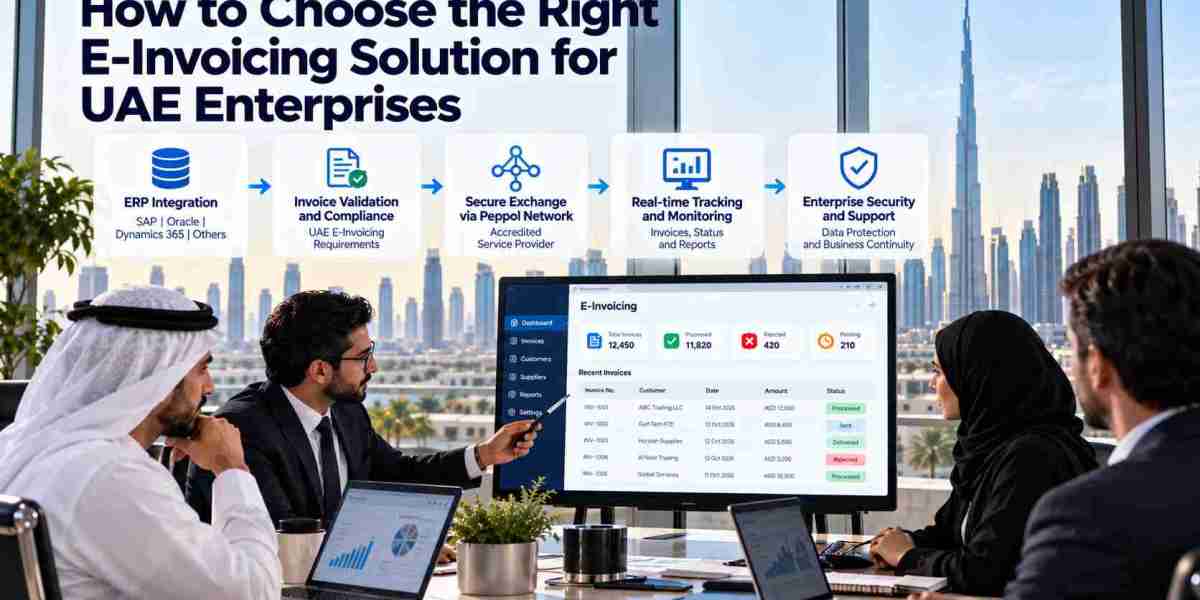
1. Compatibility With Existing ERP Systems
Large organizations often use ERP platforms such as SAP, Oracle or Microsoft Dynamics to manage financial and operational data. Replacing these systems solely to introduce electronic invoicing may be unnecessary if a suitable integration can connect the existing environment with the required workflow.
Before selecting a provider, enterprises should examine supported ERP versions, integration methods, data mapping requirements and any custom development needed.
For example, an enterprise with several business units may use different invoice templates or approval processes across departments. The integration should account for these differences while ensuring that the required invoice information is transferred accurately.
2. Support for UAE Compliance Requirements
Enterprises should confirm that the proposed solution supports the applicable UAE e-invoicing specifications and reporting workflow. They should also verify the provider's current accreditation status using the official Ministry of Finance list.
The evaluation should cover invoice validation, electronic exchange, tax data reporting and the handling of processing errors. Businesses should ask how technical updates are managed when official specifications change.
It is also important to distinguish between the provider's responsibilities and the company's own compliance obligations. Selecting software does not remove the need to maintain accurate records or follow the applicable rules.
3. Data Validation and Error Management
Large invoice volumes can make manual error detection difficult. Incorrect tax information, missing customer details or inconsistent invoice values may interrupt processing and require investigation by finance teams.
A suitable solution should explain how invoice data is validated and how users are notified when a transaction needs attention. Enterprises should also assess whether invoice statuses can be tracked centrally and whether unresolved issues can be assigned to the appropriate team.
These capabilities become especially useful when several departments need visibility into the same invoicing workflow.
4. Security, Access and Business Continuity
Enterprise invoicing systems handle sensitive financial and commercial information. Businesses should review access controls, data encryption, security monitoring and incident response arrangements as part of the selection process.
They should also understand what happens when a system becomes unavailable. Questions about service disruption notifications, pending transactions and recovery procedures can help establish whether the proposed solution fits the organization's operational requirements.
5. Implementation and Ongoing Support
Implementation may involve finance teams, IT specialists, external consultants and the selected service provider. Clear responsibilities are necessary to keep configuration, testing and onboarding activities organized.
Enterprises should request a defined implementation plan that explains the required data preparation, integration work, testing stages and support arrangements. They should also review setup costs, recurring charges and expenses associated with customization or additional integrations.
How ERP Integration Supports Enterprise E-Invoicing
ERP integration connects the organization's existing financial processes with the electronic invoicing workflow. Invoice information can be transferred from the business system, validated and processed through the prescribed exchange process without requiring employees to recreate each transaction manually.
For example, a company operating across multiple locations may generate invoices through a central ERP while different departments manage customer accounts. The integration must ensure that the necessary invoice fields are transferred correctly and that relevant processing information reaches the employees responsible for monitoring transactions.
Enterprises evaluating implementation options can review Webtel's UAE e-invoicing solution to learn more about its stated offering and approach to electronic invoicing.
Before proceeding, businesses should test representative invoices, confirm how exceptions are handled and establish how processing statuses will be monitored. Integration should be assessed against the organization's current workflows rather than a generic demonstration.
Preparing for Enterprise E-Invoicing Implementation
A structured preparation process helps businesses identify technical gaps before they affect live transactions.
Start with a system assessment. Document the ERP platforms, accounting applications and other systems involved in invoice creation and processing. Identify manual steps and potential integration requirements.
Review invoice data. Check customer records, tax information, invoice identifiers and other relevant fields. Inconsistent data should be addressed before testing begins.
Confirm provider eligibility. Verify the provider's current accreditation status through the UAE Ministry of Finance and review the services included in its proposed solution.
Test end-to-end workflows. Check invoice creation, data mapping, validation, electronic exchange and status reporting. Include relevant error scenarios to understand how the system behaves when information is incomplete or invalid.
Prepare internal teams. Assign responsibilities for data correction, technical troubleshooting, transaction monitoring and communication with the provider. Employees should understand the revised workflow before the system goes live.
Enterprises should also confirm their applicable implementation deadlines through official UAE guidance and coordinate the technical plan with their compliance responsibilities.
Making the Right Enterprise E-Invoicing Decision
Choosing an enterprise e-invoicing solution involves balancing compliance requirements with the organization's existing technology and operational needs. ERP compatibility, reliable data handling, security and implementation support should all influence the decision.
By reviewing these areas before committing to a provider, enterprises can identify integration challenges early and develop a clearer implementation plan. The aim is to establish an electronic invoicing workflow that supports accurate data exchange and fits the organization's day-to-day financial operations.