


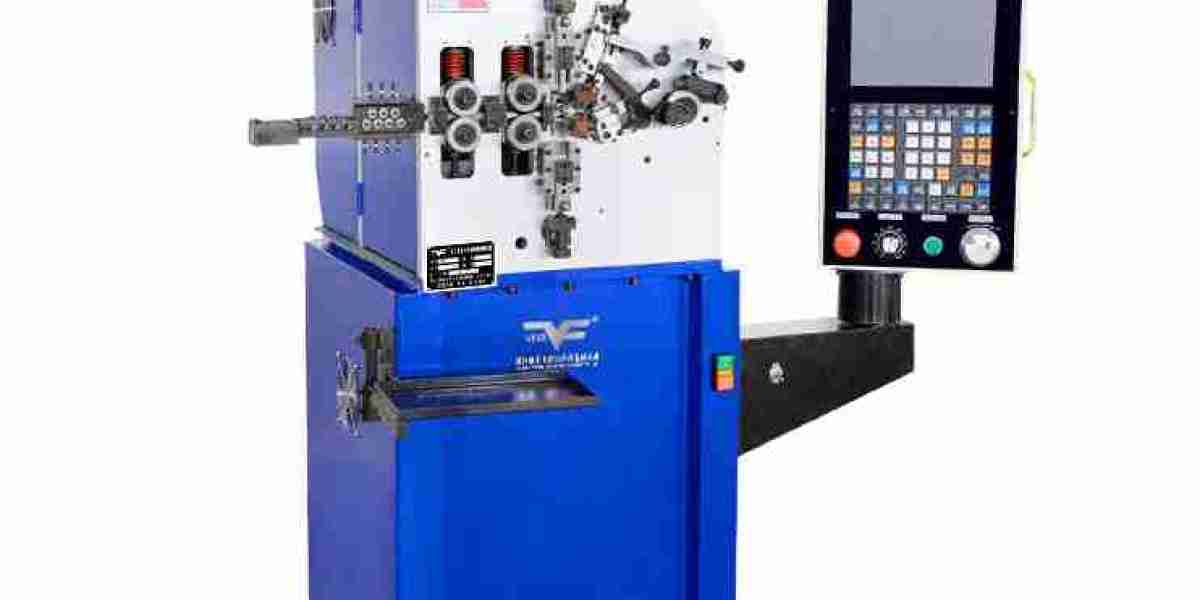
Spring manufacturing requires careful coordination between material feeding, wire forming, and dimensional inspection. A Coil Spring Machine brings these operations together, allowing manufacturers to produce springs according to defined technical drawings. It is commonly used in factories that supply components for vehicles, machinery, electronic devices, furniture, and various mechanical assemblies.
Different spring applications require different physical characteristics. Compression springs must respond to axial loads, extension springs need suitable end configurations, and torsion springs are designed to resist rotational movement. Each design places specific demands on wire forming and tooling. Selecting the correct machine configuration helps manufacturers achieve the required geometry without relying on excessive manual correction.
A CNC Coil Spring Machine can simplify the production of repeated designs by storing forming programs. Operators can enter or adjust parameters such as wire feed length, forming angle, spring diameter, and pitch according to the machine's available functions. These settings provide a repeatable starting point for production, although trial runs and inspections remain necessary when changing materials or introducing a new design.
Material selection also deserves attention. Carbon steel, stainless steel, and other spring wires may behave differently during forming. Their mechanical properties influence how the wire bends and how the finished spring responds after release. Manufacturers should confirm that the selected machine can process the required material and wire dimensions. Incorrect settings may cause deformation, inconsistent coils, or unnecessary scrap.
Production planning can further affect equipment performance. Grouping similar spring designs into the same production schedule may reduce tooling changes and setup time. For factories handling frequent specification changes, clear job records help operators identify the correct program, material batch, and inspection requirements. This approach also supports communication between engineering, production, and quality control teams.
Maintenance should be part of the daily operating routine. Feeding rollers, guide components, forming tools, and moving parts need regular checks for wear or contamination. If the wire moves unevenly, the resulting spring dimensions may become inconsistent. Timely adjustments can prevent minor mechanical issues from developing into longer production interruptions.
When choosing a Coil Spring Machine, buyers should compare its technical range with their intended product portfolio. Control functions, adjustment methods, tooling availability, and operator training all influence practical usability. Matching these factors to real manufacturing needs allows a spring production line to handle different orders with better process control and more predictable output.
https://www.spring-machine.net/product/spring-coiling-machines/



