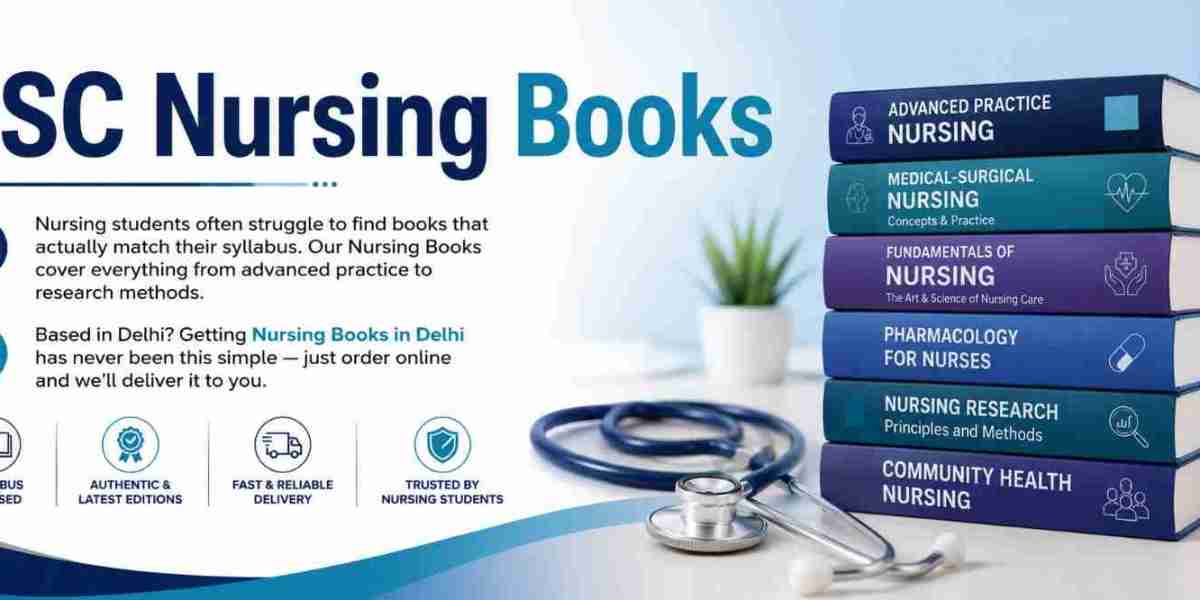
BSC Nursing Books for Students and Academic Preparation
Every BSc Nursing student reaches a point, usually a few weeks into the first semester, when the syllabus suddenly feels enormous. Anatomy, microbiology, nursing foundations, nutrition: each subject arrives with its own vocabulary and its own list of things to remember. At that moment, the study material you hold in your hands matters more than most people expect.
Choosing the right BSC Nursing Books will not do the studying for you, but it can make the work clearer and far less stressful. A well-written textbook explains a topic in a logical order, shows you diagrams when words are not enough, and gives you something reliable to revise from when exams come around.
This guide explains what these books cover, how to pick them for each academic year, and how to use them well.
What Are BSC Nursing Books?
BSC Nursing Books are textbooks and study resources written for the four-year Bachelor of Science in Nursing programme. They cover the basic medical sciences, core nursing subjects, and the community, research, and management topics that appear in later years.
Unlike general medical books, they are written with nursing practice in mind. A chapter on a heart condition, for example, does not stop at the disease. It moves on to patient assessment, nursing care, and what you should teach the patient and family. That focus on care is what makes nursing textbooks different, and it is why students are usually better off with books written specifically for their course.
Importance of Choosing the Right Nursing Textbooks
Many students pick a book because a friend has it or because it looks thorough. That can work out, but it can also leave you with a heavy book that does not match your syllabus. Here is what the right choice gives you:
- Clear understanding. Good books explain how one idea connects to another, which is how nursing knowledge actually works.
- Stronger theory. Reading regularly from a reliable source builds the base you need for written exams.
- Practical support. Reading about a procedure before you see it in the ward helps you understand what your instructor is doing and why.
- Exam readiness. Books that follow the syllabus point you toward topics that are likely to be asked.
- Clinical confidence. When you know the reason behind a nursing action, performing it feels less nerve-wracking.
Essential Subjects Covered in BSc Nursing
The exact subjects and their order depend on your university and its curriculum, so always check your own syllabus. In general, the course includes the following.
- Anatomy and Physiology: how the body is built and how its systems work.
- Fundamentals of Nursing: basic patient care, hygiene, vital signs, documentation, and professional responsibilities.
- Microbiology: the study of microorganisms and how infections spread and are controlled.
- Nutrition and Biochemistry: how food and body chemistry affect health and recovery.
- Pharmacology: how medicines work, their uses, and safe administration.
- Medical-Surgical Nursing: care of adults with medical and surgical conditions.
- Community Health Nursing: prevention, health promotion, and care outside the hospital.
- Child Health Nursing: growth, development, and care of sick children.
- Mental Health Nursing: understanding mental illness and communicating therapeutically.
- Obstetric and Gynaecological Nursing: pregnancy, childbirth, newborn care, and women's health.
- Nursing Research and Statistics: reading studies, collecting data, and applying evidence to practice.
Each of these subjects benefits from a dedicated textbook, so you can study one area at a time without flipping through unrelated material.
How to Select Books for Different Academic Years
One of the smartest things you can do is buy books year by year. Your needs change as the course moves forward, and your budget will thank you.
First-Year Nursing Books
The first year is about building a foundation. You are learning how the human body works, how infections spread, and how to carry out basic nursing care. Books for this stage should use simple language, clear diagrams, and step-by-step procedures.
Anatomy, physiology, and nursing foundations are usually the heaviest subjects in this year. Look for books that break big topics into small sections. If a chapter feels easy to follow on the first read, that is a good sign.
Second-Year Nursing Books
By the second year, you move from basics toward core nursing concepts. Subjects such as medical-surgical nursing begin to take shape, along with pharmacology and related medical sciences.
Now you need books that link theory to patient care. Look for clear explanations of disease processes and well-organised sections on nursing management. A book that lists causes, symptoms, treatment, and nursing care in a consistent pattern makes revision much easier.
Third-Year Nursing Books
The third year usually brings deeper clinical learning. You spend more time in wards and handle more complex patient situations. Subjects such as child health, mental health, and obstetrics often become central.
At this stage, choose books that include care plans, case examples, and practical guidance. They help you connect what you read with what you see during postings. Remember, though, that textbooks support your learning. They do not replace your instructor's guidance or professional supervision in the clinical area.
Fourth-Year Nursing Books
The final year often focuses on advanced practice, community health, research, and management, depending on your university's curriculum. You are preparing to work independently, so the content becomes more analytical.
Books for this year should help you think about planning, leadership, evidence-based practice, and public health. This is also a good time to add a few reference books on topics you want to understand more deeply, and to start revising earlier subjects for final exams.
How to Choose the Best Nursing Books
With so many titles around, a few simple checks make the decision easier.
- Follow your syllabus. Compare the contents page with your syllabus units. Every unit should be covered.
- Check university recommendations. Your teachers and college usually know which books suit your exam pattern.
- Look at the edition. Healthcare guidelines change, so a recent edition is often worth choosing, especially for community health and medical-surgical nursing.
- Test the explanations. Read one page from a topic you find difficult. If it makes sense, the book is probably a good fit.
- Look for diagrams and examples. Visuals and clinical examples make abstract ideas easier to remember.
- Check for practice questions. End-of-chapter questions help you test yourself as you go.
When you are comparing options by subject and year, browsing a well-organised range of BSC Nursing Books can help you see what is available for each stage of the course before you decide.
Tips for Studying Nursing Textbooks Effectively
Owning the right book is only the first step. These habits help you get the most from it.
- Make a timetable you can follow. Plan around your classes and clinical postings, not an ideal day that never happens.
- Read one subject at a time. Constant switching splits your attention and slows learning.
- Write short notes in your own words. Notes made from memory help you remember more than highlighting whole pages.
- Learn medical terms gradually. Keep a small list of new words and review it a few times a week.
- Revise regularly. Returning to a topic after a day, a week, and a month helps it stay in memory.
- Practise questions. Short answers, long answers, and objective questions all show you where you are weak.
- Connect theory with practice. When you study a procedure, try to see or practise it in the lab or ward under supervision.
Half an hour of focused study every day will serve you better than a long, exhausting session the night before an exam.
Common Mistakes to Avoid When Buying Nursing Books
Careful students slip up too. Here are the usual traps.
- Buying without checking the syllabus. A popular book may miss topics your exam covers.
- Using outdated editions. Older books may not reflect current practice or recent syllabus changes.
- Collecting too many reference books. A pile of extra books can distract you from the main ones you actually need.
- Ignoring recommended textbooks. Your teachers suggest certain books for a reason, usually because they match the exam pattern.
- Buying for the whole course at once. Needs change from year to year, so buy what you need now.
- Choosing only by price. A cheaper book you cannot understand is not a saving.
Benefits of Using the Right Study Materials
When your books match your course, the effect shows up in many ways.
Your subject knowledge becomes more solid because you learn from a clear, organised source. Revision gets faster because you know where to find what you need. Your confidence grows, since you are not guessing what to study. And your understanding of patient care deepens, because good textbooks keep linking facts to real nursing situations.
One honest note: no book can promise exam success on its own. Results depend on understanding, regular practice, and steady effort. A good textbook simply makes that effort count for more. If you would like to see how books are grouped by subject and year, exploring the full range of BSC Nursing Books is a practical place to start.
Conclusion
BSc Nursing is a long course, and it asks a lot of you. The knowledge you build in these four years will one day help you care for real patients, so it is worth building on solid material.
Begin with your syllabus. Choose books that suit your year, check the edition, and compare more than one option before you buy. Then study in small, regular steps, revise often, and practise your clinical skills under proper supervision.
When you are ready to build your study shelf, take a look at the available BSC Nursing Books and pick the ones that fit your year and your learning style. The right books, used consistently, can make your nursing education feel more manageable and a lot more rewarding.