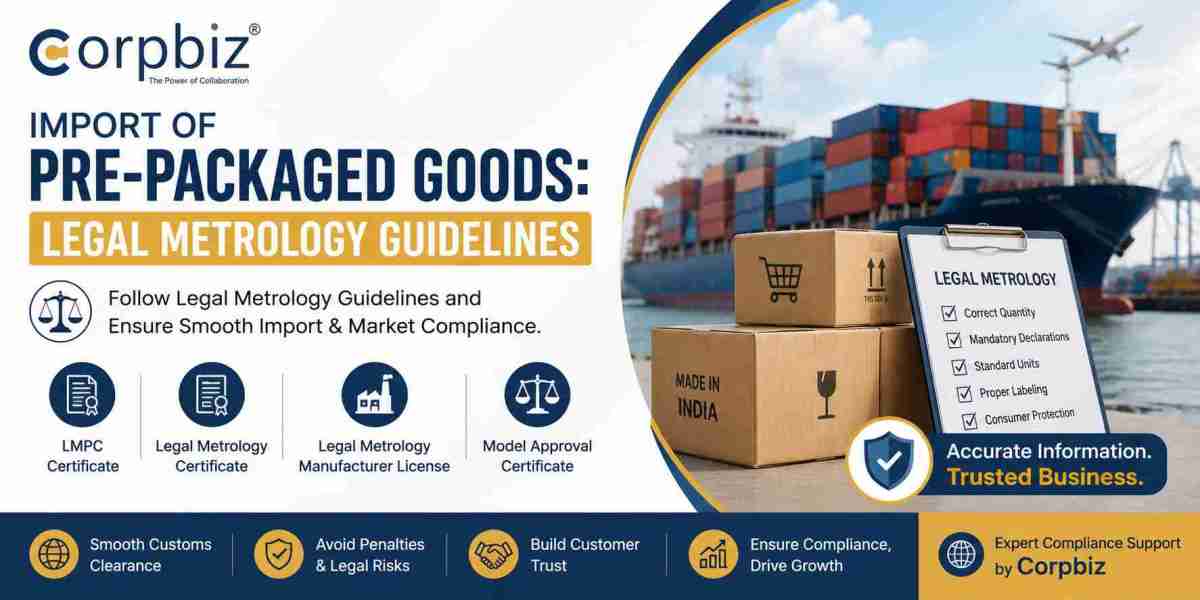
Importing pre-packaged goods into India offers excellent business opportunities. However, every importer must follow the rules under the Legal Metrology Act, 2009, and the Legal Metrology (Packaged Commodities) Rules, 2011. These laws ensure that consumers receive accurate information about the products they purchase.
If you import packaged products without following Legal Metrology guidelines, your goods may be held at customs, penalties may be imposed, or your products may even be prohibited from being sold in the Indian market.
In this blog, we will explain the Legal Metrology guidelines for importing pre-packaged goods, the required registrations, compliance requirements, and how Corpbiz can help.
What is Legal Metrology?
Legal Metrology is the branch of law that regulates weights, measures, and packaged commodities. It ensures that businesses sell products with accurate quantity and proper labeling.
The Legal Metrology Department monitors manufacturers, importers, and packers to protect consumers from misleading information and unfair trade practices.
What are Pre-Packaged Goods?
Pre-packaged goods are products packed before being offered for sale, where the quantity cannot be changed without opening or altering the package.
Examples include:
- Food products
- Cosmetics
- Medicines
- Electrical appliances
- Toys
- Household products
- Imported consumer goods
These products must meet Legal Metrology packaging requirements before entering the Indian market.
Why is Legal Metrology Compliance Important for Importers?
Importers must ensure that every packaged product carries the required declarations.
Proper compliance helps:
- Avoid customs delays
- Prevent legal penalties
- Build customer trust
- Ensure transparent product information
- Enable smooth business operations
Legal Metrology Guidelines for Import of Pre-Packaged Goods
Importers should follow these important guidelines.
Obtain an LMPC Certificate
One of the most important requirements for importers is obtaining an LMPC certificate.
The LMPC (Legal Metrology Packaged Commodities) Certificate is mandatory for importers dealing with pre-packaged commodities.
Without this certificate, customs authorities may stop product clearance.
Display Mandatory Product Information
Every imported package must clearly display:
- Name and address of importer
- Country of origin
- Generic name of product
- Net quantity
- Maximum Retail Price (MRP)
- Manufacturing date (where applicable)
- Import date (if required)
- Customer care details
The information should be clear, readable, and permanent.
Ensure Correct Units of Measurement
All quantities should be declared using standard metric units such as:
- Gram (g)
- Kilogram (kg)
- Millilitre (ml)
- Litre (L)
- Metre (m)
- Centimetre (cm)
Incorrect units may lead to non-compliance.
Verify Package Accuracy
The actual quantity inside the package must match the quantity printed on the label.
Authorities may conduct inspections to verify compliance.
Follow Labeling Rules Before Sale
Imported goods must carry all required declarations before being sold in India.
If labels are missing, they should be corrected before products enter the retail market.
Who Needs an LMPC Certificate?
An Lmpc Certificate is generally required by:
- Importers of packaged goods
- Foreign product distributors
- E-commerce importers
- Retail import businesses
- FMCG importers
- Electronics importers
- Cosmetic importers
Documents Required for LMPC Certificate
Generally, the following documents are required:
- PAN Card
- Aadhaar Card
- GST Registration
- IEC (Import Export Code)
- Business registration proof
- Address proof
- Product details
- Import documents
- Passport-size photographs
Additional documents may be requested depending on the business type.
Steps to Obtain an LMPC Certificate
Step 1: Prepare Required Documents
Collect all business and importer documents.
Step 2: Submit Application
Apply before the appropriate Legal Metrology Authority.
Step 3: Document Verification
Officials verify the submitted documents.
Step 4: Inspection (if applicable)
Authorities may inspect business premises.
Step 5: Certificate Issuance
After successful verification, the LMPC Certificate is issued.
Common Mistakes Made by Importers
Many importers face compliance issues because of:
- Missing importer details
- Incorrect MRP declaration
- Wrong net quantity
- Improper labeling
- Delayed LMPC registration
- Using non-standard measurement units
- Missing country of origin declaration
Avoiding these mistakes helps ensure faster customs clearance.
Penalties for Non-Compliance
Failure to comply with Legal Metrology rules may result in:
- Monetary penalties
- Product seizure
- Customs clearance delays
- Suspension of business activities
- Legal proceedings
- Product recall from the market
Timely compliance reduces these risks.
Difference Between LMPC Certificate and Legal Metrology Certificate
Many businesses confuse these two terms.
LMPC Certificate | Legal Metrology Certificate |
Required for importers and packers of packaged commodities | A general term covering different Legal Metrology registrations |
Focuses on packaged goods compliance | Covers various licenses and registrations under Legal Metrology |
Mandatory for import of pre-packaged goods | May include manufacturer, dealer, repairer, or importer registrations |
Businesses should understand which registration applies to their operations.
Importance of Legal Metrology Manufacturer License
A Legal Metrology Manufacturer License is required for businesses that manufacture weighing or measuring instruments.
Although importers of packaged goods may not always require this license, companies involved in manufacturing measuring equipment must obtain it before starting operations.
Role of Model Approval Certificate
A Model Approval Certificate is required for manufacturers or importers of certain weighing and measuring instruments before those instruments can be sold in India.
It confirms that the instrument meets prescribed standards for accuracy and performance.
Businesses importing weighing instruments should check whether Model Approval is applicable to their products.
Benefits of Following Legal Metrology Guidelines
Complying with Legal Metrology requirements offers several benefits.
- Smooth customs clearance
- Better customer confidence
- Reduced legal risks
- Easy market entry
- Improved business reputation
- Better regulatory compliance
- Long-term business growth
How Corpbiz Helps with Legal Metrology Compliance
Corpbiz offers complete assistance for Legal Metrology registrations and compliance.
Our services include:
- LMPC Certificate registration
- Legal Metrology Certificate assistance
- Legal Metrology Manufacturer License support
- Model Approval Certificate guidance
- Documentation support
- Application filing
- Compliance consultation
- Renewal assistance
Our experts simplify the registration process and help businesses meet all regulatory requirements.
Why Choose Corpbiz?
Businesses choose Corpbiz because we provide:
- Experienced compliance professionals
- End-to-end documentation support
- Quick application processing
- Transparent pricing
- PAN India services
- Dedicated customer support
Whether you are importing packaged goods for the first time or expanding your business, Corpbiz can help ensure smooth Legal Metrology compliance.
Conclusion
Importing pre-packaged goods into India requires strict compliance with Legal Metrology regulations. Obtaining the Lmpc Certificate, following proper labeling requirements, and understanding related registrations like the Legal Metrology Certificate, Legal Metrology Manufacturer License, and Model Approval Certificate can help businesses avoid penalties and ensure smooth customs clearance.
Working with experienced professionals like Corpbiz makes the compliance process faster, easier, and more reliable.
Frequently Asked Questions (FAQs)
1. Is an LMPC Certificate mandatory for importing pre-packaged goods?
Yes. In most cases, importers of pre-packaged commodities must obtain an Lmpc Certificate before selling their products in India.
2. What is a Legal Metrology Certificate?
A Legal Metrology Certificate generally refers to registrations or certificates issued under the Legal Metrology laws for manufacturers, importers, dealers, repairers, or packers.
3. Who needs a Legal Metrology Manufacturer License?
Businesses manufacturing weighing or measuring instruments must obtain a Legal Metrology Manufacturer License before commencing operations.
4. What is a Model Approval Certificate?
A Model Approval Certificate certifies that a weighing or measuring instrument complies with the prescribed standards before it is manufactured, imported, or sold.
5. What information must appear on imported packaged goods?
The package should generally include the product name, importer details, country of origin, net quantity, MRP, customer care details, and other declarations required under the Legal Metrology (Packaged Commodities) Rules.
6. What happens if Legal Metrology rules are not followed?
Non-compliance may lead to penalties, seizure of goods, customs delays, legal action, or restrictions on selling the products.
7. Can Corpbiz help with Legal Metrology registrations?
Yes. Corpbiz provides complete support for LMPC registration, Legal Metrology compliance, documentation, filing, renewals, and advisory services.
Author Profile
Atul Shukla
Atul Shukla Team consists of experienced legal, regulatory, and compliance professionals dedicated to helping businesses navigate India's regulatory framework. From Legal Metrology and BIS certification to CDSCO registration, company incorporation, and various business licenses, the team delivers practical guidance and end-to-end compliance support. Through informative articles and expert assistance, Corpbiz helps businesses stay compliant, reduce regulatory risks, and grow with confidence.