Introduction
Generative AI is transforming how businesses create content, analyse information, automate workflows, and improve customer experiences. However, the performance of generative AI applications depends heavily on the quality, accuracy, and freshness of the data they use. This is where a Generative AI Data Pipeline becomes essential.
A well-designed data pipeline collects information from multiple sources, processes it efficiently, and delivers relevant data to AI models when needed. Real-time data processing helps businesses reduce outdated information, improve AI-generated responses, and build more reliable enterprise AI applications.
What Is a Generative AI Data Pipeline?
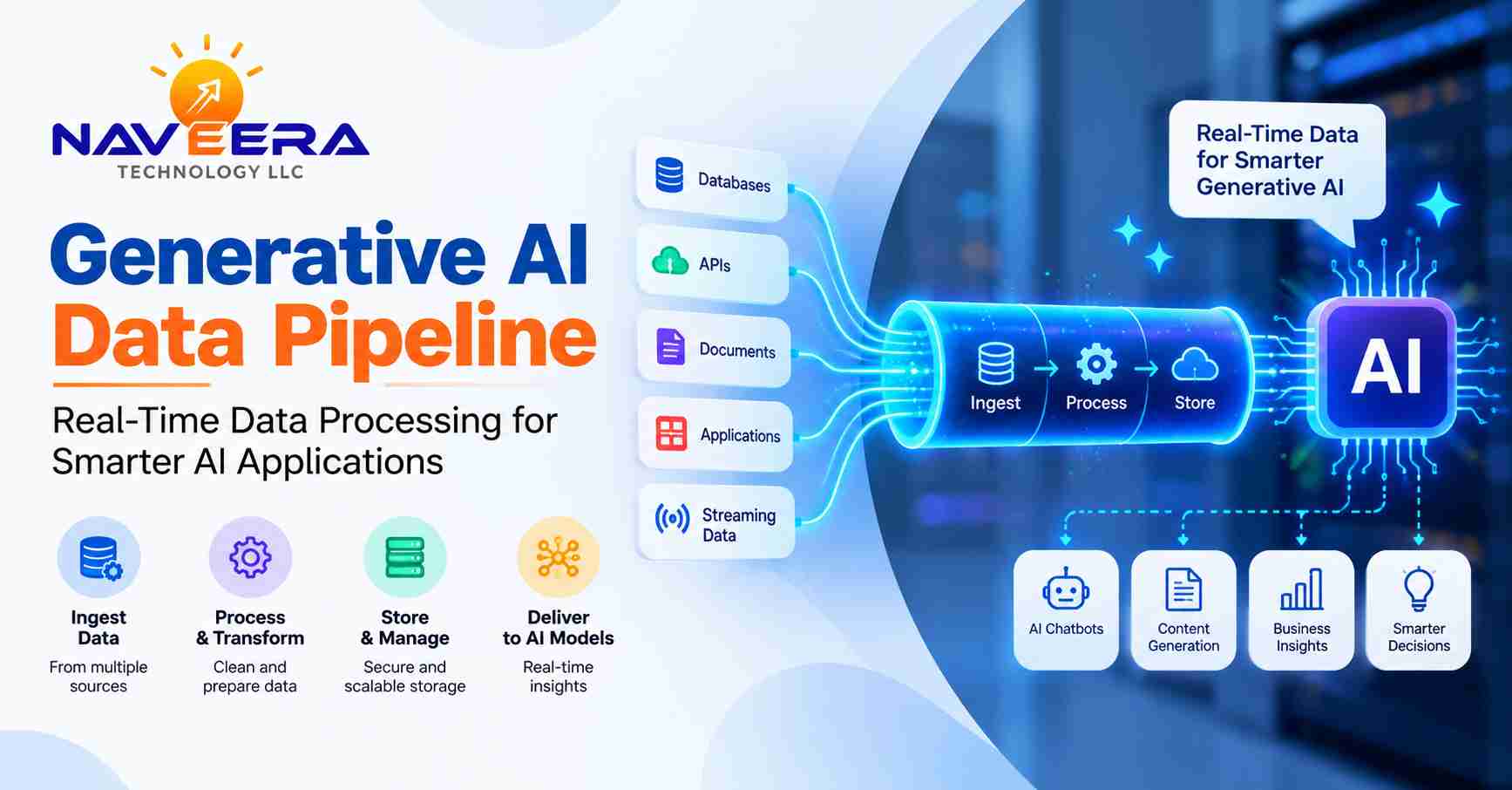
A Generative AI Data Pipeline is a system that collects, transforms, validates, and delivers data to generative AI applications. It ensures that AI models and related systems can access relevant information from databases, documents, business applications, APIs, and streaming platforms.
Unlike traditional data pipelines that primarily support reporting and analytics, generative AI pipelines may also prepare data for retrieval-augmented generation (RAG), AI agents, chatbots, and other applications that require up-to-date context.
A modern pipeline can combine batch processing with real-time data streaming to provide the right information at the right time.
Why Real-Time Data Processing Matters for Generative AI
Outdated information can reduce the usefulness of AI-generated responses. For example, an AI customer support assistant using old product information may provide incorrect details about availability, pricing, or delivery schedules.
Real-time data processing helps address this challenge by updating relevant information as business data changes.
Key benefits include:
- Improved response accuracy: AI applications can retrieve more current and relevant information.
- Reduced data delays: Updates can become available without waiting for scheduled batch jobs.
- Better customer experiences: AI assistants can respond using current business information.
- Faster decision-making: Teams can use fresh data to support operational decisions.
- Greater adaptability: Data systems can respond more quickly to changing business conditions.
Real-time processing does not automatically guarantee accurate AI responses, but it helps provide a more reliable foundation for them.
Key Components of a Generative AI Data Pipeline
- Data Ingestion
Data ingestion collects information from sources such as enterprise databases, cloud storage, CRM platforms, business applications, APIs, and event streams. Depending on the use case, ingestion can happen continuously or at scheduled intervals.
- Data Cleaning and Transformation
Raw data often contains duplicates, inconsistent formats, missing values, or irrelevant information. Cleaning and transformation help standardise the data before it reaches downstream AI systems.
For document-based AI applications, this stage may include text extraction, document parsing, metadata enrichment, and content segmentation.
- Data Validation and Governance
Data validation checks whether information meets defined quality requirements. Governance processes help manage access permissions, sensitive information, data lineage, and compliance requirements.
These controls are important when AI applications process confidential customer records or internal business documents.
- Real-Time Data Processing
Streaming technologies can process incoming events and updates as they occur. Businesses can use this approach when applications need timely information, such as inventory changes, transaction events, customer interactions, or operational alerts.
Not every generative AI application requires continuous streaming. The appropriate processing method depends on how frequently its underlying information changes.
- Data Storage and Retrieval
Processed information may be stored in databases, data warehouses, data lakes, search indexes, or vector databases. For retrieval-augmented generation, relevant document content and metadata can be indexed so an application can retrieve useful context for a user query.
- Integration with Generative AI Models
The final stage connects prepared data to AI applications. A retrieval system, orchestration layer, or application service supplies relevant context to the model before it generates a response.
This architecture helps businesses ground AI outputs in available information rather than relying entirely on the model's previously learned knowledge.
How a Generative AI Data Pipeline Works
A typical workflow follows these steps:
- Collect data: Gather information from databases, documents, APIs, and business systems.
- Process data: Clean, transform, classify, and organise the incoming information.
- Validate data: Apply quality checks, access controls, and governance policies.
- Update storage and indexes: Make new or changed information available for retrieval.
- Retrieve relevant context: Identify information that relates to the user's request.
- Generate an AI response: Provide the retrieved context to the generative AI model.
- Monitor performance: Track data freshness, pipeline reliability, retrieval quality, and response accuracy.
The exact architecture varies according to the application's latency requirements, data sources, security needs, and expected workload.
Common Use Cases Across Industries
A Generative AI Data Pipeline supports several business applications.
Customer support: AI assistants can retrieve current product documentation, service policies, and troubleshooting information.
Financial services: Internal AI tools can analyse authorised financial documents and updated business information, subject to appropriate governance and compliance controls.
Healthcare administration: AI systems can retrieve approved operational documents and administrative information while following strict privacy and access requirements.
Retail and e-commerce: AI assistants can use updated catalogue details, product descriptions, and inventory information.
Enterprise knowledge management: Employees can search internal policies, technical documentation, project files, and company knowledge through AI-powered interfaces.
Business analytics: Generative AI applications can summarise current operational data and help teams explore business questions.
Best Practices for Building an Effective Pipeline
Organisations should consider the following practices when developing a generative AI data architecture:
- Define data freshness requirements: Determine whether information needs second-by-second updates, frequent refreshes, or scheduled processing.
- Choose suitable technologies: Select ingestion, streaming, storage, and orchestration tools based on the workload.
- Maintain data quality: Introduce validation rules, deduplication, and error-handling procedures.
- Secure sensitive information: Apply authentication, role-based permissions, encryption, and appropriate data-retention policies.
- Optimise retrieval quality: Use relevant metadata, effective chunking, suitable embedding strategies, and retrieval evaluation.
- Monitor the entire workflow: Track processing delays, failed jobs, stale indexes, and retrieval performance.
- Plan for scalability: Design the architecture to handle changing data volumes and growing AI usage.
A successful pipeline balances freshness, reliability, security, operational cost, and the needs of the AI application.
Challenges in Real-Time Generative AI Data Processing
Building a real-time pipeline can introduce challenges. Data may arrive in inconsistent formats, upstream systems may become unavailable, and processing delays can prevent updates from reaching AI applications promptly.
Other challenges include managing duplicate events, controlling cloud infrastructure costs, protecting sensitive information, and ensuring that retrieval systems use the latest approved content.
Businesses can address these issues through automated monitoring, retry mechanisms, data quality checks, versioned indexes, access controls, and regular testing. They should also measure end-to-end data freshness rather than assuming that a successful ingestion job means every downstream system is current.
How Naveera Tech Supports Modern Data Engineering
Naveera Tech provides technology services focused on data engineering, cloud solutions, and AI initiatives. A strong data engineering foundation can help organisations connect different data sources, streamline processing workflows, improve data accessibility, and prepare information for analytics and generative AI applications.
When planning a Generative AI Data Pipeline, businesses should assess their current data architecture, integration requirements, security controls, and AI use cases before choosing an implementation approach.
With appropriate planning and engineering, organisations can develop data infrastructure that supports reliable information delivery and scalable AI adoption.
Conclusion
A Generative AI Data Pipeline is an important part of building useful, data-driven AI applications. By combining efficient data ingestion, real-time processing, data quality controls, secure storage, and relevant information retrieval, businesses can reduce data delays and provide generative AI systems with more current context.
The right architecture depends on business requirements, data complexity, and the expected speed of updates. By prioritising data freshness, governance, monitoring, and retrieval quality, organisations can create a stronger foundation for enterprise generative AI solutions.