


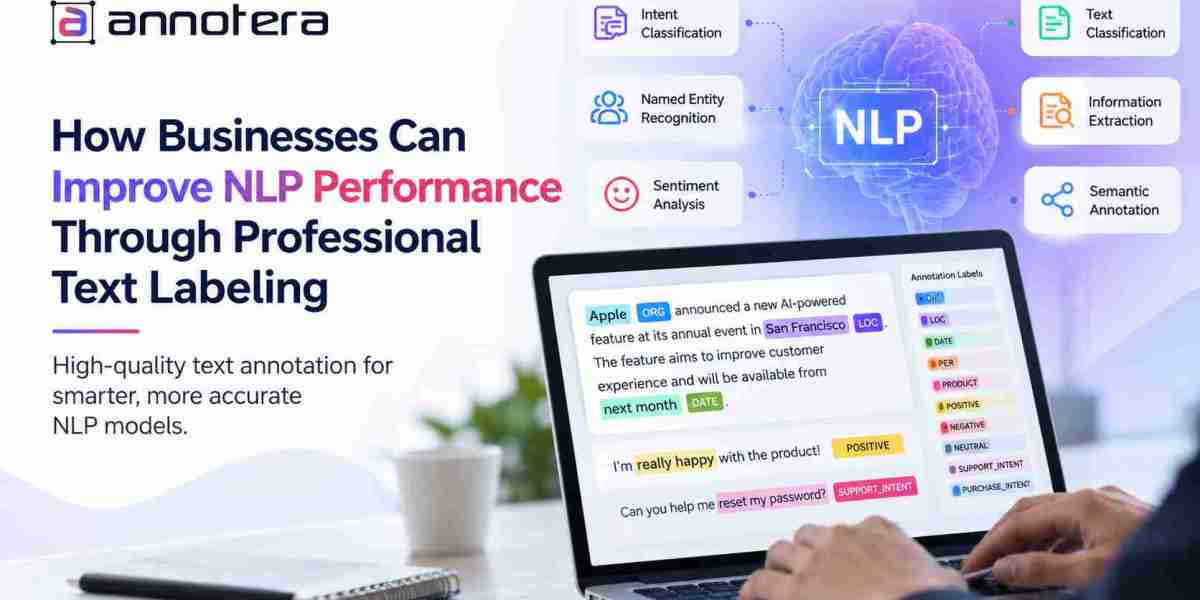
Natural Language Processing (NLP) has become an essential technology for businesses seeking to understand human language, automate communication, and extract meaningful insights from large volumes of textual data. From customer support chatbots and sentiment analysis tools to intelligent search engines and document processing systems, NLP enables organizations to transform unstructured text into actionable information.
However, the performance of an NLP model depends heavily on the quality of the data used to train and evaluate it. Even advanced algorithms can struggle when training datasets contain inconsistent labels, ambiguous categories, or insufficient linguistic diversity. This is where professional text labeling becomes valuable.
By implementing structured annotation workflows and rigorous quality assurance, businesses can develop more accurate, reliable, and scalable language models. Partnering with an experienced text annotation company also helps organizations access specialized linguistic expertise and accelerate AI development without placing excessive demands on internal teams.
What Is Professional Text Labeling in NLP?
Professional text labeling is the process of assigning predefined tags, categories, or attributes to textual data so that machine learning models can recognize language patterns and interpret information correctly.
Depending on the intended application, text labeling may involve identifying entities, classifying customer intent, detecting sentiment, categorizing documents, or labeling relationships between words and phrases.
Common text annotation techniques include:
Named Entity Recognition (NER): Identifying people, organizations, locations, dates, product names, and other relevant entities.
Intent Classification: Categorizing user messages according to their purpose, such as requesting information, reporting a problem, or initiating a transaction.
Sentiment Annotation: Labeling text as positive, negative, neutral, or according to more detailed emotional categories.
Text Classification: Organizing documents, reviews, emails, and messages into predefined categories.
Semantic Annotation: Labeling words, phrases, or relationships to help models interpret meaning within context.
Linguistic Annotation: Identifying grammatical structures, parts of speech, and other linguistic characteristics.
When these annotations follow consistent guidelines, they provide NLP systems with clearer examples of how language relates to specific meanings, tasks, and business objectives.
1. Improve Training Data Quality and Consistency
High-quality training data is fundamental to NLP performance. If a dataset contains contradictory labels or poorly defined categories, models may learn unreliable patterns that negatively affect predictions.
For example, a customer message stating, "I cannot access my account" could be labeled as a login issue, an account access problem, or a technical support request. All three categories might appear reasonable, but inconsistent labeling can make the model less predictable.
Professional text labeling addresses this challenge through standardized annotation guidelines, clearly defined categories, and structured review procedures.
Annotators follow established rules for handling ambiguous expressions, overlapping categories, abbreviations, and context-dependent meanings. Quality checks identify discrepancies before they become widespread across the dataset.
As a result, businesses can build more consistent training datasets that support better model learning and more dependable NLP outputs.
2. Enhance Intent Recognition and Customer Experience
Businesses increasingly use conversational AI to manage customer inquiries, recommend products, resolve common problems, and automate support interactions. These applications rely on accurately identifying what a user intends to communicate.
Intent classification helps NLP models distinguish between messages such as "Track my order," "Cancel my purchase," and "Change my delivery address."
However, customers rarely express identical intentions using the same words. They may use informal language, spelling mistakes, regional expressions, or indirect requests.
Professional text labeling helps address this variability by including diverse examples of the same intent across different communication styles. Annotators can also identify distinctions between similar intents and establish rules for classifying unclear messages.
This enables businesses to develop conversational systems that route requests more accurately, reduce unnecessary escalations, and deliver more relevant responses.
3. Strengthen Sentiment Analysis and Customer Insights
Customer reviews, social media conversations, surveys, and support tickets contain valuable information about customer expectations and brand perception.
Sentiment analysis enables businesses to identify opinions and emotional signals within this information. However, sentiment is not always straightforward. A statement such as "The product works, but the service was disappointing" contains both positive and negative sentiment.
Without carefully labeled examples, a model may overlook this distinction or assign an inaccurate overall classification.
Professional text annotation helps businesses capture sentiment at the document, sentence, or aspect level. Aspect-based sentiment annotation, for example, can distinguish customer satisfaction with product quality from dissatisfaction with delivery speed or customer service.
These labeled datasets help organizations develop more informative sentiment analysis systems, identify recurring customer concerns, and support data-driven decisions across marketing, product development, and customer experience management.
4. Improve Named Entity Recognition and Information Extraction
Many organizations process large volumes of unstructured documents, including contracts, invoices, insurance claims, medical records, and business correspondence.
NLP-powered information extraction systems can identify important details, such as names, dates, monetary values, addresses, and contractual references. Their effectiveness depends on whether training data accurately represents the entities and contexts encountered in real documents.
Professional NER annotation establishes consistent rules for identifying entity boundaries, handling abbreviations, and distinguishing between similar terms.
For instance, a company name might also appear as part of a product name or address. Annotators must use contextual information and established guidelines to determine the appropriate label.
By improving entity-level annotation quality, businesses can strengthen information extraction workflows, reduce manual document review, and make unstructured data easier to search and analyze.
5. Use Diverse and Representative Language Data
An NLP model trained on a narrow dataset may perform well in controlled testing but struggle with real-world language variations.
Differences in dialects, writing styles, industry terminology, regional expressions, and communication channels can affect how language is interpreted. Customer support conversations, for example, often differ significantly from formal business documents.
Professional annotation workflows can incorporate representative examples from the environments in which the model will operate. Annotators can label informal expressions, multilingual content, domain-specific terminology, and difficult edge cases according to the project's requirements.
Businesses should also review whether their datasets adequately represent relevant user groups and operational scenarios.
This approach can help reduce performance gaps across different types of input. However, representative annotation should be combined with appropriate dataset sampling, model evaluation, and ongoing monitoring rather than treated as a standalone solution.
6. Establish a Reliable Quality Assurance Process
Annotation quality should be measured systematically rather than assumed. Without appropriate validation, labeling errors can accumulate and affect downstream model performance.
A robust text labeling workflow may include:
Clear annotation guidelines: Define label categories, boundary rules, and procedures for ambiguous examples.
Annotator training: Ensure that team members understand the task, terminology, and expected output.
Inter-annotator agreement: Measure consistency between annotators using suitable agreement metrics.
Expert adjudication: Resolve disagreements through qualified reviewers and document the final decisions.
Sampling and audits: Review annotated records regularly to identify recurring errors and areas requiring additional training.
Dataset validation: Check label distributions, missing values, duplicate records, and formatting issues.
These measures create a repeatable quality management process. Businesses can use the findings to refine annotation guidelines, improve team consistency, and prepare more reliable datasets for model training and evaluation.
7. Scale NLP Development With Professional Annotation Services
As NLP projects expand, businesses often need more annotated data, additional language coverage, and specialized expertise. Managing these requirements internally can create resource constraints, particularly when annotation volumes fluctuate or project complexity increases.
Working with a specialized text annotation company can help organizations establish scalable annotation operations while maintaining defined quality standards.
Professional providers can support multiple tasks, including text classification, intent labeling, NER, sentiment analysis, and domain-specific annotation. They may also offer dedicated quality assurance processes, trained annotators, and project management support.
For organizations with changing workloads, text annotation outsourcing services can provide access to additional annotation capacity without requiring the immediate expansion of permanent internal teams.
When selecting a provider, businesses should evaluate annotation expertise, data security practices, quality control procedures, scalability, turnaround expectations, and experience with relevant NLP applications.
Outsourcing is most effective when the provider works closely with internal machine learning teams to establish clear requirements, review sample annotations, and incorporate feedback throughout the project.
8. Connect Annotation Quality With Model Evaluation
High-quality labels are important, but businesses must also determine whether they improve the performance of the intended NLP application.
Teams should establish baseline metrics before introducing a revised dataset or annotation workflow. Depending on the task, useful measures may include precision, recall, F1-score, classification accuracy, and task-specific error rates.
For example, an intent classification system might be evaluated on its ability to distinguish closely related customer requests, while an NER model could be assessed on its accuracy in identifying entity boundaries and categories.
A carefully maintained evaluation dataset helps teams identify weaknesses that training data improvements alone may not resolve.
Businesses should use evaluation results to refine labeling guidelines, add difficult examples, address underrepresented categories, and repeat testing. This feedback loop makes text annotation a continuous component of NLP improvement rather than a one-time data preparation activity.
Conclusion
Professional text labeling plays a critical role in helping businesses build more accurate and dependable NLP systems. By improving training data consistency, strengthening intent recognition, refining sentiment analysis, and supporting reliable information extraction, structured annotation can address several common sources of model error.
However, successful NLP development requires more than collecting labeled data. Organizations must combine clear annotation guidelines, representative datasets, systematic quality assurance, and ongoing model evaluation.
For businesses seeking to scale these efforts, partnering with an experienced text annotation company can provide the expertise and operational capacity needed to support evolving AI requirements.
Annotera helps businesses prepare high-quality annotated datasets for AI and machine learning applications. Through structured annotation workflows and quality-focused processes, organizations can build a stronger data foundation for NLP development and pursue more reliable language-driven automation.
Ready to improve your NLP data pipeline? Connect with Annotera to explore text annotation solutions aligned with your business objectives and AI development requirements.



