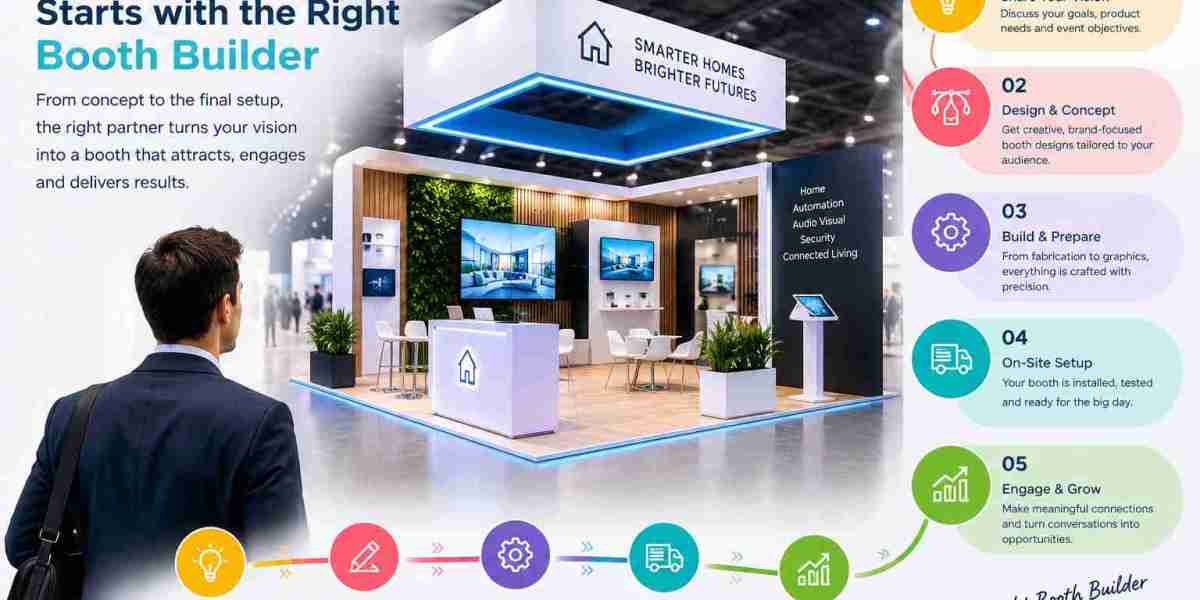
Participating in CEDIA Expo is a valuable opportunity for businesses in smart home technology, residential audiovisual systems, home automation, and connected living solutions to showcase their products and connect with industry professionals. However, simply exhibiting at the event does not guarantee business success. Companies need a well-planned strategy that attracts the right visitors, communicates their value, generates qualified leads, and supports long-term business growth. One of the most important decisions in this process is selecting the right Booth builders for CEDIA Expo. A professional booth builder can help transform your marketing objectives into a functional exhibition space that improves visitor engagement and supports measurable results. By investing in the right design, construction, technology, and visitor experience, exhibitors can maximize their exhibition return on investment (ROI) and make better use of their event budget.
Understanding Exhibition ROI at CEDIA Expo
Exhibition ROI measures the value a business receives from its participation compared with the resources invested. Although revenue is an important consideration, the benefits of exhibiting can extend beyond immediate sales.
For businesses attending CEDIA Expo, potential returns include qualified leads, product demonstrations, distributor relationships, new partnerships, increased brand awareness, and opportunities to reconnect with existing customers.
A useful starting point is to define what success looks like before designing the booth. A company launching a new smart home platform may prioritize product demonstrations and industry awareness. An established manufacturer may focus on meeting integrators, strengthening channel relationships, and generating sales opportunities.
Your objectives should influence every major booth decision, including layout, messaging, technology, staffing, and budget allocation.
A simple financial ROI formula is:
ROI = (Financial return − Total investment) ÷ Total investment × 100
For example, if an exhibition generates $60,000 in attributable financial return from a total investment of $20,000, the ROI would be 200%.
However, calculating exhibition returns can be more complicated because some leads may convert into sales months after the event. Businesses should establish a consistent method for tracking attributable revenue and distinguish between projected opportunities and confirmed financial results.
1. Set Clear and Measurable Exhibition Goals
The first step toward maximizing ROI is identifying the outcomes your business wants to achieve at CEDIA Expo.
Without clear objectives, exhibitors may spend heavily on booth features that look impressive but do not contribute meaningfully to business performance.
Start by defining two or three primary goals. These might include:
Generating qualified leads from residential technology integrators.
Launching a new product or service.
Scheduling meetings with distributors and strategic partners.
Demonstrating a new automation or audiovisual solution.
Increasing awareness among a specific professional audience.
Strengthening relationships with existing customers.
Once the goals are established, assign measurable targets to each one. For example, a company could aim to schedule 25 meetings, conduct 80 product demonstrations, or collect 100 qualified leads.
These targets help your team evaluate whether the booth design and event strategy are working.
Your booth builder should understand these objectives from the beginning. A lead-generation booth may need an open reception area and accessible product displays, while a demonstration-focused booth may require dedicated technical zones and space for small groups.
Aligning the design with business goals helps prevent unnecessary spending and makes it easier to evaluate the final results.
2. Choose a Booth Builder Who Understands CEDIA Expo
Selecting an experienced booth construction partner is an important investment decision. The right provider should understand exhibition design, event logistics, technical installations, and the needs of businesses showcasing connected home technology.
CEDIA Expo exhibitors may need to demonstrate products that depend on reliable networking, audio and video equipment, control interfaces, lighting, sensors, and integrated systems. These requirements make technical planning particularly important.
When evaluating potential booth builders, consider their experience with technology-focused exhibitions, examples of previous work, project management process, communication practices, and ability to coordinate installation.
Ask prospective providers questions such as:
Have you designed booths for technology or audiovisual brands?
Can you accommodate live demonstrations and connected equipment?
How do you manage venue rules and technical requirements?
What services are included in your proposal?
Who will coordinate the project from design through dismantling?
How do you handle installation problems or last-minute changes?
Request a detailed proposal that explains the design concept, materials, deliverables, timeline, and costs.
The lowest-priced provider is not automatically the best choice. A poorly planned booth can lead to additional expenses, technical problems, and missed business opportunities. Evaluate the overall value of the service rather than focusing exclusively on the initial quotation.
3. Design the Booth Around Your Target Audience
An effective exhibition booth should be designed for the people you want to attract, not simply for the products you want to display.
At CEDIA Expo, different visitors may include residential technology integrators, installers, consultants, designers, distributors, manufacturers, and business decision-makers. Each group may have different priorities.
Integrators may want to understand compatibility, installation requirements, system reliability, and technical support. Designers may be more interested in aesthetics and integration with residential spaces. Distributors may focus on product demand, channel opportunities, and commercial terms.
Understanding these differences helps you create a more relevant visitor experience.
For example, an automation company could build a demonstration area that shows how lighting, shading, security, and entertainment systems work together. A manufacturer targeting professional integrators might provide a dedicated space for technical discussions and product compatibility demonstrations.
Your booth builder can help translate these audience requirements into practical design decisions, including display placement, signage, demonstration zones, seating, and meeting areas.
A relevant booth experience gives visitors a stronger reason to stop, engage, and consider your products.
4. Prioritize Booth Layout and Visitor Flow
A booth can attract attention but still underperform if visitors find it difficult to enter, navigate, or understand.
The layout should make the main message visible from the aisle and provide an intuitive path toward product displays, demonstrations, and conversations.
Begin by identifying the most important areas within the booth. These may include a welcome point, featured product displays, interactive demonstrations, meeting spaces, and storage.
Place high-priority products where they are easy to see. Avoid positioning large counters, furniture, or equipment in ways that block entrances or interrupt movement.
An open layout can encourage visitors to explore without feeling pressured. At the same time, clearly defined demonstration and meeting zones help staff manage engagement more effectively.
Consider how the booth will function during busy periods. If a live demonstration attracts a group, will other visitors still be able to enter? Can staff move between product areas without interrupting conversations? Is there sufficient space for people using mobility aids?
A well-planned layout supports visitor comfort, efficient staffing, and better opportunities for meaningful interactions.
5. Invest in High-Impact Design Without Overspending
An attractive booth can improve visibility, but a larger or more expensive design does not automatically produce a higher ROI.
The goal is to invest in features that support your objectives and provide clear value to visitors.
For example, a well-positioned LED display may communicate your main message effectively, while a working product demonstration may provide more value than multiple decorative screens.
Prioritize design elements according to their expected contribution to the visitor experience.
High-value investments may include:
Clear, professional branding.
Functional product demonstration areas.
Reliable audiovisual and networking infrastructure.
Well-designed lighting that highlights key products.
Comfortable spaces for business discussions.
Durable structures that can be reused at future exhibitions.
Avoid adding technology simply because it is available. Every interactive feature, screen, or special effect should have a clear purpose.
Discuss alternative materials, modular structures, reusable graphics, and different construction methods with your booth builder. These choices may help control costs while maintaining a professional appearance.
A practical design balances visual impact, usability, reliability, and budget discipline.
6. Use Interactive Demonstrations to Increase Engagement
For smart home and audiovisual companies, product demonstrations can be one of the strongest reasons for attendees to visit a booth.
Visitors often understand a solution more quickly when they can experience it in action. A working demonstration can show how products solve real problems, integrate with existing systems, or improve everyday experiences.
For instance, an exhibitor could demonstrate centralized control of lighting, entertainment, climate, and shading. An audio manufacturer might offer a guided listening experience, while a display technology company could showcase image quality under different viewing conditions.
To make demonstrations effective, focus on practical benefits rather than presenting a long list of technical specifications.
Keep each demonstration concise, reliable, and easy to follow. Train staff to explain the problem, show the solution, and invite relevant questions.
Technical preparation is equally important. Test all equipment before the exhibition opens, confirm network requirements, and prepare a backup plan for critical components.
When demonstrations work smoothly, they can increase visitor dwell time, support product understanding, and create more meaningful sales conversations.
7. Make Your Brand Message Easy to Understand
Visitors may pass dozens of booths in a short period. If your main message is unclear, they may continue walking without understanding what your business offers.
Your booth should communicate three things quickly: what your company does, who its solutions are for, and why those solutions matter.
Use a concise headline, consistent branding, and high-quality product imagery. Avoid filling every available surface with technical information, product names, and promotional claims.
For example, rather than presenting a wall of specifications, a smart home brand could highlight how its platform connects multiple residential systems through a single control experience.
Detailed technical information can be available through product specialists, digital catalogs, QR codes, or printed materials for visitors who want to learn more.
Your booth builder should understand your brand guidelines and ensure that graphics are positioned for visibility at realistic viewing distances.
Consistent messaging helps visitors remember your company and makes conversations with booth staff more focused.
8. Integrate Digital Tools That Support Lead Generation
Digital tools can help exhibitors make visitor interactions more useful and easier to track.
Depending on the company's needs, a booth might include QR codes linking to product specifications, interactive catalogs, digital appointment scheduling, demonstration sign-ups, or lead capture systems.
These tools are most effective when they simplify a task for the visitor.
For example, a QR code beside a product could link directly to its technical documentation rather than a general homepage. A digital form could allow visitors to request a demonstration or receive information about a specific solution.
Ensure that the digital experience is fast, mobile-friendly, and easy to use. Provide a clear alternative for attendees who prefer speaking with a representative.
Lead capture should also be handled responsibly. Explain how submitted information will be used and obtain appropriate consent before adding contacts to marketing communications.
Digital tools should complement personal interaction rather than replace it. The strongest results often come from combining useful technology with knowledgeable staff and relevant follow-up.
9. Train Your Booth Staff to Convert Interest Into Opportunities
Even an excellent booth design cannot compensate for an unprepared team.
Booth staff influence whether visitors feel welcome, receive useful information, and understand the next steps for engaging with your company.
Before CEDIA Expo, conduct a briefing that covers the booth's objectives, target audience, key messages, product demonstrations, lead qualification process, and meeting schedule.
Staff should be prepared to ask open-ended questions such as:
What types of residential technology projects do you typically handle?
Which challenges are you currently trying to solve?
Are you evaluating solutions for an upcoming project?
Would a technical demonstration or follow-up discussion be useful?
These questions help identify relevant opportunities without turning every interaction into an aggressive sales pitch.
Assign responsibilities clearly. Some team members may welcome visitors, while others lead demonstrations, answer technical questions, or handle scheduled meetings.
Make sure the team records useful information after each qualified interaction. A business card alone may not capture the visitor's needs, purchasing timeline, or next action.
Well-trained staff can turn booth traffic into more valuable business conversations.
10. Track the Metrics That Matter
Measuring performance helps businesses determine which exhibition activities generated value and which areas need improvement.
Before the event, establish a small set of relevant metrics that reflect your objectives.
| Metric | What it helps measure |
|---|---|
| Total booth visitors | Overall visitor activity |
| Qualified leads | Potential business opportunities |
| Meetings completed | Engagement with target accounts |
| Product demonstrations | Interest in featured solutions |
| Follow-up requests | Intent to continue the conversation |
| Opportunities created | Potential sales pipeline |
| Attributable revenue | Financial return connected to the event |
Avoid treating every interaction as an equally valuable lead. A large number of casual visitors may be less useful than a smaller number of qualified prospects with relevant needs and purchasing authority.
Use a consistent lead qualification method to identify visitors who match your target audience and have a realistic potential to become customers.
Compare actual performance with your initial targets. If the booth attracted many visitors but generated few qualified leads, review the messaging, audience targeting, and staff engagement process.
If demonstrations were popular but few visitors requested follow-up, consider whether the product value proposition or next step was sufficiently clear.
These insights can improve future exhibition planning.
11. Plan Your Budget Beyond Booth Construction
Maximizing ROI requires understanding the full cost of participating in an exhibition.
The booth design and construction quotation is only one part of the overall investment. Businesses may also need to budget for exhibition space, shipping, installation, dismantling, electrical services, connectivity, audiovisual equipment, graphics, travel, accommodation, staffing, promotional materials, and lead management.
Request an itemized quotation from your booth builder and confirm exactly which services are included.
Ask about potential additional costs, including design revisions, overtime, material changes, storage, and special technical requirements.
It is also sensible to reserve part of the budget for unexpected expenses. This can help the team respond to practical problems without compromising essential booth features.
Where possible, identify components that can be reused at future exhibitions. Reusable structures and adaptable graphics may reduce long-term costs when they suit your event schedule.
The objective is not to spend as little as possible. It is to allocate resources where they are most likely to support meaningful results.
12. Follow Up With Leads After CEDIA Expo
Exhibition ROI is determined partly by what happens after the event. A productive booth interaction can lose value if the company fails to follow up promptly and appropriately.
Before the exhibition, develop a follow-up process that defines who will contact leads, how they will be prioritized, and what information will be included in each communication.
Organize leads according to factors such as product interest, project requirements, purchasing timeline, and level of engagement.
A visitor who requested a technical consultation may need a different follow-up from someone who simply downloaded a brochure. Personalizing communication helps keep the discussion relevant.
Where appropriate, follow up with the specific product information, technical documentation, demonstration recording, or meeting invitation that was promised at the booth.
Record the outcomes in your customer relationship management system and track whether leads progress into meetings, proposals, opportunities, and sales.
Reviewing this information over time helps your company understand the longer-term contribution of CEDIA Expo and make more informed decisions about future participation.
13. Work With Your Booth Builder From the Start
Your booth builder should be involved early enough to influence the design, technical planning, and budget before major decisions are finalized.
Share your objectives, audience profile, product requirements, brand guidelines, budget range, and preferred visitor experience. Provide accurate information about equipment dimensions, power consumption, connectivity, sound requirements, and demonstration needs.
Agree on project milestones for concept approval, design development, production, graphics, installation, testing, and dismantling.
Request progress updates and confirm who is responsible for each deliverable. Clear communication helps reduce misunderstandings and gives the team time to address issues before the event.
If your company expects to exhibit regularly, discuss whether the design can be adapted for other exhibitions. A flexible system may support brand consistency while reducing the need for repeated design and construction work.
A strong working relationship with your booth builder can make the process more predictable and help ensure that the finished booth supports your business objectives.
Conclusion
Maximizing exhibition ROI at CEDIA Expo requires more than an impressive booth. It involves setting measurable goals, understanding your audience, choosing the right construction partner, planning visitor flow, demonstrating products effectively, training staff, managing costs, and following up with qualified leads. Every design decision should contribute to a clear business objective, whether that means generating new opportunities, strengthening industry relationships, or introducing innovative technology to the market. By tracking performance and evaluating results after the event, businesses can improve their exhibition strategy over time and make better use of their marketing budget. Partnering with experienced Booth builders for CEDIA Expo can help you develop a professional, functional, and strategically designed booth that attracts the right audience and creates stronger opportunities for long-term business growth.