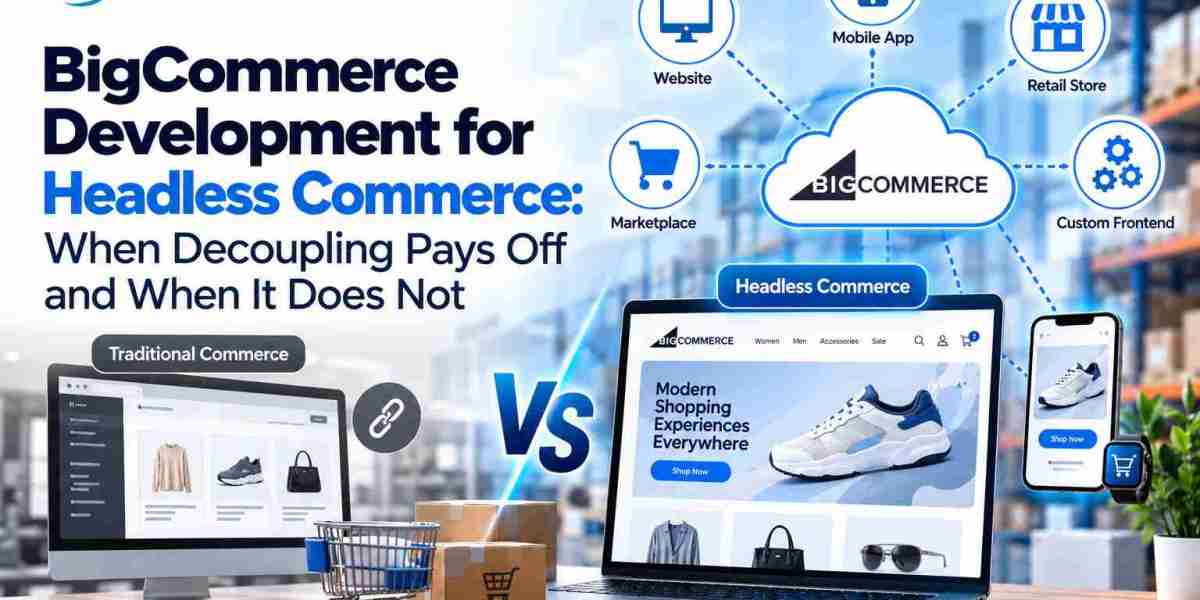
Headless commerce separates an online store’s frontend from its backend, giving businesses more control over customer experiences, design, and digital channels. However, this flexibility comes with additional development costs and maintenance requirements. Before adopting this architecture, businesses should determine whether it solves existing problems and delivers enough value to justify the investment.
What Is Headless Commerce in BigCommerce?
Headless commerce separates the customer-facing storefront from the backend that manages products, inventory, pricing, carts, and orders. BigCommerce APIs connect these layers, allowing businesses to build custom storefronts while retaining the platform’s core commerce functionality.
Unlike traditional theme-based stores, headless implementations allow developers to use frontend frameworks and content management systems that fit specific business requirements. However, this approach also requires careful API integration, testing, and ongoing technical support.
When Does Headless BigCommerce Development Pay Off?
Headless architecture is worth considering when a conventional storefront limits customer experience, performance optimization, or expansion across digital channels. The decision should be based on measurable business needs rather than technical trends.
When Custom Storefront Experiences Matter
Businesses with complex product catalogs, interactive product pages, or specialized shopping journeys may need greater frontend flexibility. Headless architecture allows developers to customize navigation, layouts, and product discovery beyond the limitations of standard themes.
Businesses exploring BigCommerce development services should first target the storefront limitations they need to solve. If a custom experience reduces shopping friction, drives conversions, or supports complex requirements, a headless architecture easily justifies its premium cost.
When Multiple Sales Channels Need a Shared Backend
Retailers selling through websites, mobile applications, and other digital touchpoints can use a shared commerce backend to manage essential operations. This can help maintain consistent product, inventory, and order data across channels.
However, each channel still requires suitable integrations, synchronization, and testing. Headless commerce is most useful when businesses need a consistent commerce foundation but different customer experiences across their sales channels.
When Performance and Content Flexibility Are Priorities
A custom frontend gives developers more control over page rendering, caching, and asset delivery. It can support performance improvements when implemented correctly, but headless architecture does not automatically make a store faster.
Similarly, businesses that publish product guides, editorial content, and campaign landing pages may benefit from connecting a content management system to their commerce platform. This setup is valuable when existing publishing workflows restrict content delivery or merchandising.
When Is Headless Commerce Not Worth the Investment?
Headless commerce is not necessary for every online store. When a traditional storefront already meets business requirements, adopting a more complex architecture may increase costs without producing meaningful improvements.
When Standard Themes Meet Your Requirements
Small and medium-sized stores with straightforward catalogs, conventional checkout processes, and limited customization needs can often operate effectively with standard themes. Theme customization generally requires less development effort and makes routine storefront updates easier to manage.
If the existing store supports the required customer experience, improving its design, navigation, checkout, and performance may be more practical than rebuilding the frontend.
When Budgets and Launch Timelines Are Limited
Headless projects typically require separate frontend development, API integration, testing, and deployment planning. These activities can increase initial costs and extend launch timelines.
Businesses with limited budgets or urgent launch requirements should compare the expected commercial benefits against the additional investment. A conventional storefront may provide a faster route to market without introducing unnecessary technical complexity.
When Technical Resources Are Insufficient
A decoupled storefront requires ongoing management of frontend code, APIs, hosting, integrations, and security updates. Without access to experienced developers, businesses may find troubleshooting and maintenance difficult.
The additional flexibility is useful only when the business can support the architecture over time. Otherwise, a simpler implementation may be easier and more cost-effective to operate.
Headless vs. Traditional BigCommerce: Key Differences
The main difference between these approaches is the balance between flexibility and operational simplicity.
Development costs: Traditional storefronts can use existing themes, while headless projects generally require more frontend engineering and integration work.
Customization: Theme-based stores support customization within their framework. Headless architecture offers greater control over the frontend experience.
Performance and SEO: Both approaches can perform well. Headless implementations require careful rendering, metadata, crawlability, and JavaScript optimization.
Maintenance: Traditional stores typically involve fewer independently managed components. Headless stores require additional monitoring, testing, and technical oversight.
The right choice depends on the complexity of the storefront, available resources, and the business outcomes the architecture is expected to deliver.
How to Evaluate the ROI of Headless Commerce
Before investing in headless commerce, businesses should establish whether the expected benefits justify the total cost.
Identify Existing Storefront Limitations
Determine whether the current store restricts customization, slows content publishing, or creates inconsistent experiences across channels. If targeted improvements can solve these issues, a complete architectural change may be unnecessary.
Calculate Total Ownership Costs
Include initial development, integrations, hosting, monitoring, security updates, and ongoing maintenance. Compare these expenses with the cost of improving the existing storefront to understand the additional financial commitment.
Track Measurable Business Outcomes
Establish baseline metrics such as conversion rate, checkout abandonment, page performance, and time required to launch storefront changes. These indicators help measure whether the new architecture delivers meaningful improvements after launch.
Best Practices for a Successful Headless Implementation
A successful implementation begins with clear requirements and a realistic maintenance plan.
Select suitable frontend technology: Choose a framework based on performance needs, developer expertise, and long-term support rather than popularity.
Plan APIs and checkout early: Map product data, pricing, inventory, customer accounts, payments, shipping, and order processing before development begins.
Protect organic visibility: Implement appropriate metadata, rendering, canonical tags, structured data, XML sitemaps, and redirects where required.
Test and monitor performance: Measure Core Web Vitals, API response times, checkout reliability, and real-user experience.
Document integrations: Maintain clear API contracts, testing procedures, security requirements, and deployment documentation to reduce future maintenance risks.
Is Headless BigCommerce Right for Your Business?
Headless commerce makes sense when a business needs advanced storefront customization, multiple customer-facing channels, or greater frontend control that its existing setup cannot provide efficiently. Its value depends on whether these capabilities solve measurable business problems.
For businesses with straightforward requirements, a traditional storefront may be sufficient. Others can consider a phased approach, introducing a custom frontend for selected customer journeys before expanding the architecture.
With 12+ years of digital product development experience, EmizenTech helps businesses assess commerce requirements, plan integrations, and build tailored eCommerce solutions. Evaluating technical complexity, total ownership costs, and expected returns can help businesses choose an architecture that supports sustainable growth.
Frequently Asked Questions
1. What is headless commerce in BigCommerce?
It separates the frontend storefront from the backend commerce system, using APIs to connect the customer experience with products, inventory, carts, and orders.
2. Is headless BigCommerce better than a traditional storefront?
Not always. Headless offers greater frontend flexibility, while traditional storefronts are generally simpler to implement and maintain. The right choice depends on business requirements and available resources.
3. Does headless commerce improve website performance?
It provides greater control over rendering and caching, but performance improvements depend on implementation quality, API response times, and frontend optimization.
4. How much does headless commerce cost?
Costs depend on storefront complexity, frontend development, integrations, checkout requirements, and ongoing maintenance. A project-specific estimate should account for both initial and recurring expenses.
5. When should a business avoid headless commerce?
Businesses should reconsider it when standard themes meet their needs, budgets are limited, launch timelines are tight, or suitable technical resources are unavailable.