Selecting the right e-invoicing software is about more than replacing paper invoices with digital documents. Businesses in the UAE need a system that can handle structured invoice data, connect with existing accounting platforms and support the country's electronic invoicing framework.
The search for the best e-invoicing software in UAE has become more relevant as businesses prepare to exchange invoices through the country's regulated electronic invoicing network. The software they choose can affect how finance teams create invoices, manage transaction records and handle day-to-day accounting activities.
Before investing in a solution, businesses should understand UAE e-invoicing software requirements and identify the technical capabilities their operations actually need.
What Makes E-Invoicing Software Suitable for UAE Businesses?
Traditional invoicing software generally focuses on creating documents, calculating taxes and recording payments. UAE e-invoicing requires a more structured approach.
Under the UAE framework, an electronic invoice is structured invoice data exchanged electronically between suppliers and buyers and reported to the Federal Tax Authority. A PDF invoice sent through email does not qualify as an electronic invoice under this framework.
The UAE has adopted the Decentralised Continuous Transaction Control and Exchange model, using a five-corner framework and the Peppol network.
This means suitable software must support the technical requirements involved in preparing, validating and exchanging structured invoice information.
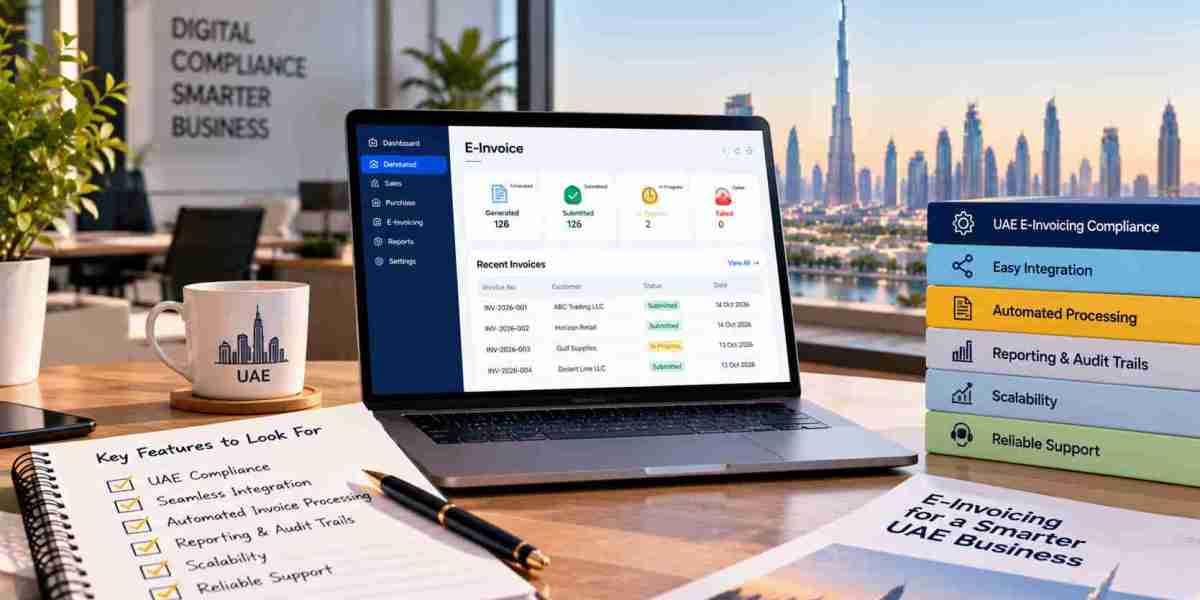
Some important capabilities include:
Structured invoice generation using the applicable UAE specifications.
Data validation before electronic transmission.
Connectivity with an Accredited Service Provider (ASP).
Support for electronic invoice exchange and reporting.
Invoice status tracking and error notifications.
Access to transaction records for accounting and audit purposes.
A software platform may offer many invoicing features, but businesses should confirm that its proposed configuration supports the UAE's applicable technical requirements.
ERP Integration Can Make a Significant Difference
For companies already using enterprise software, integration should be one of the main considerations when selecting an e-invoicing solution.
Imagine a distribution company processing invoices through SAP. Its finance department records sales, customer information, VAT details and transaction values within the ERP system.
If the e-invoicing software operates separately, employees may need to transfer information between platforms. This creates additional work and increases the possibility of inconsistent records.
An integrated solution can help connect invoice data with existing business processes.
Depending on the company's technology environment, relevant integration requirements may include:
SAP Business One and SAP S/4HANA
Oracle ERP
Microsoft Dynamics 365
TallyPrime
Other accounting and legacy ERP systems
Businesses should ask whether the integration uses APIs, direct system connectivity or another supported method. They should also understand how customer records, tax information, invoice references and credit notes are mapped between systems.
A useful demonstration should show the complete journey from creating an invoice in the accounting system to receiving its electronic processing status.
Invoice Validation and Error Management Should Not Be Overlooked
An invoice can contain all the usual commercial information and still fail technical validation.
For example, a business might enter an incorrect buyer identifier, omit a required field or use an invalid data format. If these issues are not identified early, the invoice may require correction and retransmission.
This is why validation capabilities matter.
Good e-invoicing software should help businesses identify missing information, incorrect data and formatting problems before invoices are transmitted.
It should also provide clear error messages rather than simply indicating that an invoice has failed.
Consider a finance team handling invoices from multiple branches. If an invoice fails validation, the team should be able to identify the problem, correct the relevant information and follow its updated processing status.
This becomes particularly useful when businesses handle large transaction volumes or operate across several departments.
Data Management and Reporting Are Part of the Software Decision
Invoice management does not end when an electronic invoice is exchanged.
Businesses also need to maintain records of invoices, credit notes and associated transaction information.
Under the UAE framework, relevant records must be retained for the period prescribed under the Tax Procedures Law and made available to the Federal Tax Authority upon request.
Software selection should therefore include a review of record management and reporting capabilities.
Look at whether the platform provides:
Searchable invoice records.
Access to previous invoice transactions.
Credit note management.
Downloadable reports.
Transaction status histories.
Suitable data retention and retrieval arrangements.
These functions can help finance teams respond to internal reporting requirements and retrieve information when needed.
Businesses operating across different GCC markets may also need to consider how their software handles country-specific invoicing requirements. The GCC e-invoicing framework and solutions provide a useful starting point for understanding the differences between regional electronic invoicing systems.
Evaluate the Software Before Making a Commitment
A software demonstration should reflect your actual business operations rather than a generic presentation.
Before making a decision, ask the provider to demonstrate how the system handles a normal sales invoice, a credit note and an invoice containing incorrect information.
Check whether the proposed software works with your existing ERP, supports the required UAE specifications and provides visibility into invoice processing.
It is also worth examining implementation costs, transaction limits, technical support and future upgrade arrangements.
One important distinction is that software functionality and regulatory accreditation are not the same thing. Businesses should verify that the service provider responsible for delivering the UAE e-invoicing service holds current accreditation from the Ministry of Finance. The official ASP list should be checked before entering into a commercial agreement.
The best e-invoicing software in UAE is ultimately the solution that fits the company's existing systems, handles structured invoice exchange correctly and supports its ongoing operational requirements.
Taking time to evaluate these capabilities can help businesses avoid unnecessary manual work and make the transition to electronic invoicing more manageable.