Introduction
Generative AI has moved from being an experimental technology to becoming a part of everyday work. Businesses use AI to automate customer support, developers rely on it to write code, marketers generate content in minutes, and students use it to simplify research. According to the McKinsey State of AI Report 2024, organizations are increasing investments in generative AI faster than any previous AI technology because of its ability to improve productivity across multiple industries. Yet one question continues to appear in search engines: What does LLM mean, and why is it so important?
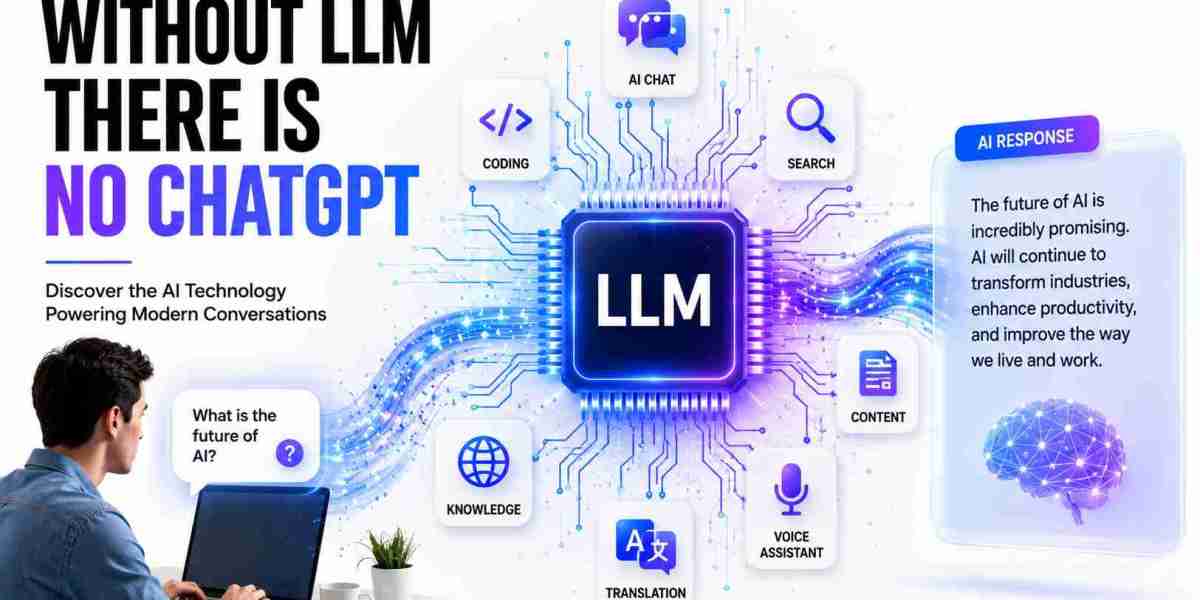
The answer goes beyond the abbreviation Large Language Model. LLM means the core intelligence that allows generative AI to understand language, recognize context, and produce human-like responses. Without Large Language Models, modern AI applications such as ChatGPT, Google Gemini, Claude, and Microsoft Copilot would not function the way they do today. Understanding this technology helps explain why AI has become capable of writing articles, generating software code, translating languages, summarizing documents, and answering complex questions.
What Does LLM Mean?
LLM means Large Language Model, a type of artificial intelligence trained on enormous amounts of text data to understand and generate human language.
Instead of following pre-programmed rules, an LLM learns patterns from books, websites, research papers, articles, technical documents, and other publicly available text. During training, it develops an understanding of grammar, sentence structure, relationships between words, and contextual meaning.
An LLM does not memorize conversations. It predicts the most appropriate response by analyzing patterns learned during training.
Popular examples include:
- ChatGPT
- Google Gemini
- Claude
- Microsoft Copilot
- Meta Llama
Although each model has unique capabilities, all rely on Large Language Model technology.
Why Are LLMs the Missing Piece Behind Generative AI?
Generative AI refers to systems capable of creating new content such as text, images, software code, audio, and videos.
The intelligence responsible for generating natural language comes from the LLM.
Without an LLM, generative AI would struggle to:
- Understand questions
- Interpret context
- Generate meaningful responses
- Maintain conversational flow
- Summarize information
- Translate languages
Large Language Models provide the reasoning and language understanding that make generative AI useful in real-world applications.
How Does a Large Language Model Learn?
The learning process happens in several stages.
Massive Data Training
LLMs process enormous datasets containing billions or even trillions of words.
These datasets include:
- Books
- Research publications
- Technical documentation
- News articles
- Educational content
- Public websites
The model learns language by identifying statistical relationships between words rather than memorizing complete sentences.
Understanding Context
Language contains ambiguity.
For example, the word "apple" could refer to:
- A fruit
- A technology company
The model determines the intended meaning by analyzing surrounding words.
This contextual understanding allows AI to produce much more accurate responses.
Predicting the Next Word
Every response generated by an LLM is essentially a prediction.
The model calculates which word is most likely to appear next based on everything it has learned during training.
This process repeats continuously until the complete response is generated.
Where Are LLMs Used Today?
Large Language Models now support applications across almost every industry.
Customer Service
Businesses use AI assistants to answer customer questions around the clock while reducing response times.
Software Development
Developers use AI coding assistants to:
- Generate code
- Explain programming concepts
- Detect bugs
- Improve productivity
According to the Stack Overflow Developer Survey 2024, AI-assisted development tools continue gaining adoption among software professionals.
Healthcare
Healthcare organizations use LLMs to summarize medical records, assist with research, and improve documentation workflows.
Education
Educational platforms generate personalized explanations, study materials, quizzes, and language translations.
Marketing
Marketing teams use LLMs to create:
- Blog drafts
- Email campaigns
- Product descriptions
- Social media content
- SEO outlines
Benefits of Large Language Models
Organizations implementing LLM-powered solutions often experience measurable improvements.
Major benefits include:
- Faster content generation
- Better customer support
- Improved employee productivity
- Automated repetitive tasks
- Intelligent document analysis
- Multilingual communication
- Smarter business automation
Challenges That Still Exist
Despite their impressive capabilities, LLMs are not perfect.
Current limitations include:
- AI hallucinations that generate incorrect information
- Bias inherited from training data
- High computing requirements
- Privacy concerns
- Limited access to real-time information unless connected to external systems
Because of these limitations, AI-generated responses should always be reviewed before being used in business, legal, financial, or medical decisions.
How LLMs Will Shape the Future of AI?
Large Language Models continue evolving rapidly.
Future improvements are expected to include:
- Better reasoning capabilities
- More accurate responses
- Industry-specific AI assistants
- Real-time personalization
- Multimodal AI that understands text, images, audio, and video together
These advancements will allow AI systems to perform increasingly complex tasks while becoming more reliable and efficient.
Why Understanding LLM Means Matters?
The term LLM means much more than an AI buzzword.
It represents the technology that powers modern conversational AI, intelligent search, automated content creation, coding assistants, and enterprise AI solutions.
Businesses adopting AI successfully are often those that understand how Large Language Models work and where they can create genuine business value rather than simply following technology trends.
Conclusion
LLM means Large Language Model, but its significance extends far beyond the definition itself. It is the technology responsible for enabling generative AI to understand language, generate meaningful responses, automate complex tasks, and improve digital experiences across industries. As AI adoption continues accelerating, Large Language Models will remain at the center of innovation in customer service, software development, education, healthcare, and business operations.
Organizations that understand the capabilities and limitations of LLMs are better prepared to adopt AI responsibly, improve productivity, and create intelligent digital solutions. Rather than replacing human expertise, Large Language Models work best when they support informed decision-making, creativity, and problem-solving.
FAQs
What does LLM mean in AI?
LLM means Large Language Model, an artificial intelligence model trained on massive datasets to understand, process, and generate human language.
Why are LLMs important for generative AI?
Large Language Models provide the language understanding and contextual reasoning that enable generative AI systems to create natural, accurate, and meaningful responses.
What are examples of Large Language Models?
Popular examples include ChatGPT, Google Gemini, Claude, Microsoft Copilot, and Meta Llama. Each uses Large Language Model technology to perform language-based tasks.
How do Large Language Models learn?
LLMs are trained on billions of words collected from books, articles, websites, research papers, and other text sources. They learn patterns and relationships between words rather than memorizing information.
Can LLMs replace human expertise?
No. Large Language Models are powerful productivity tools, but they can generate inaccurate information and should be used alongside human judgment, especially in areas such as healthcare, finance, legal services, and business strategy