

CRM data quality for AI depends on more than complete fields. It depends on what each field means, which event produced it, whether its history survives the export, how records join and what evidence confirms the outcome. A stage label can be accurate without proving a conversation, an approval or a result. Define those meanings before any field becomes an evaluation label.
Accurate data, wrong question
Picture a CRM that marks an account “Contacted” the moment a rep completes an outreach task. Six months later, an analyst building an AI evaluation reads “Contacted” as “we spoke to them.” The field did exactly what it was configured to do. The interpretation is what broke.
This is the most common data quality problem when CRM history moves into AI work. A field can be complete, consistent and correct inside one workflow and quietly misleading in the next. Nobody did anything wrong. The data was simply built to answer a different question than the one you are now asking it.
So start with the task you want to test, then ask two blunt questions of every field: which event wrote this value, and what would a newcomer wrongly assume it means?
The decisions live in the history
A final opportunity stage can hide three reversals. An overwritten field shows the latest value and loses the sequence that explains a decision. A system migration can keep the date and drop the reason.
If the task is “what should the rep do next on day 40,” the final state is close to useless. You need to know what was true on day 40. Describe whether event history is retained and exactly what an extraction would include.
Also separate values a person typed from statuses an automation set. Both are useful. A reviewer just needs to know which is which, because they mean very different things.
Count the thing you actually mean
Accounts, contacts, activities and opportunities are different units. Daily snapshots can turn one event into thirty rows. Duplicates and merged accounts tangle the story further.
State which unit the collection uses and how the units connect. Never report a row count as if it were a count of distinct customer decisions. When a join is uncertain, keep it visible instead of trusting two similar company names.
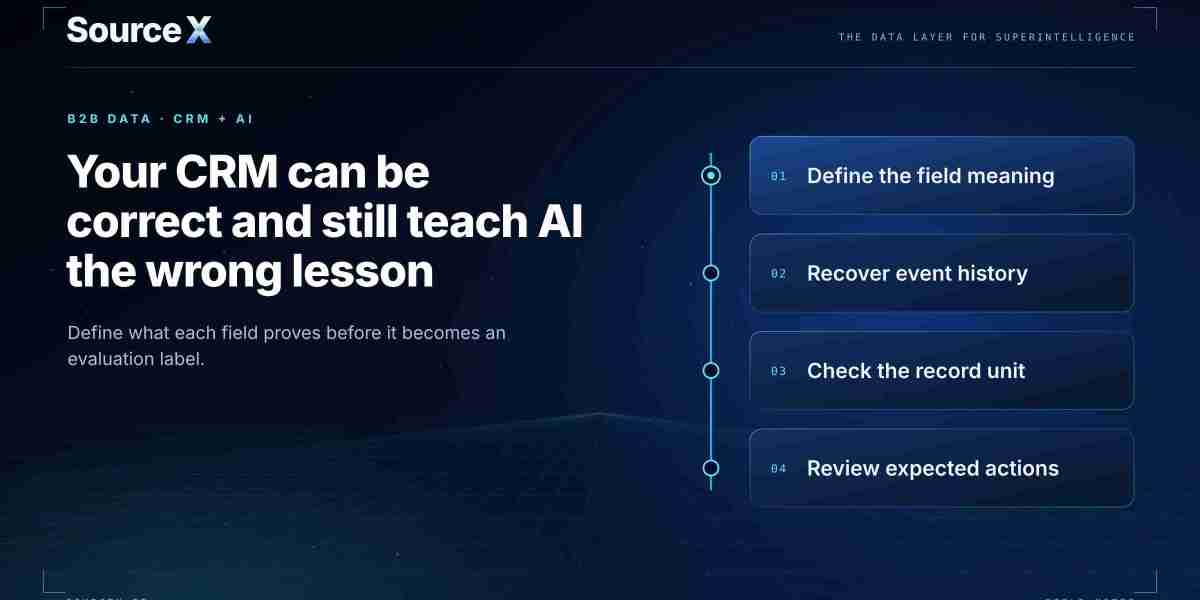
Take a renewal. The real context might include a contract version, an open service issue and an approval email that never touched the CRM. Name those dependencies before calling anything complete. Four questions catch most of the trouble:
- What event creates this field value?
- Does the export keep the earlier states that matter?
- Which record unit is being counted?
- What evidence confirms the outcome we plan to use?
Don't leak the ending
A note written after the deal closed can reveal why the stage changed or which objection was decisive. If an evaluation recreates the earlier decision point, that note cannot be part of the input. Otherwise you are measuring hindsight, not judgment.
Keep development material and final test material apart in a way that fits the task. Related accounts, repeat requests and copied notes can all smuggle the answer across through a neighboring record.
Then have someone who knows the sales motion challenge the expected action. What a rep did is evidence of what happened. It is not automatic proof that it followed policy or was the best move.
Describe it in words your sales team recognizes
Write down the workflow in plain language, including which statuses are administrative and which outcomes are independently checked. Then hand it to the people who live in the system and ask what would surprise them. Their objections are the most valuable review you will get.
Permission is a separate track. Customer commitments, personal information and vendor restrictions still need their own review before any new external use. A cleaned export does not grant that authority.
If your company is weighing whether its CRM history could be licensed for AI training and evaluation, this is also how a first conversation with SourceX begins: with a description of one workflow and its gaps, not with an export. The best next meeting covers one workflow, one uncertain label and the evidence that would make that label mean something.
Questions readers ask
Does complete CRM data automatically make a good AI dataset?
No. Completeness helps, but suitability also depends on what each field means, whether its history is retained, how records relate, the task you are testing and reliable outcome evidence. Rights and privacy need their own separate review.
Can a “Contacted” status be used as a label for a real conversation?
Only if the actual process and evidence support that reading. In many CRMs, “Contacted” records an attempted touch or a completed task, not a conversation. Check how the value is written before you rely on it.
Why keep later CRM notes out of AI evaluation inputs?
A later note can reveal an outcome or explanation that was not available at the original decision point. Including it makes the test measure hindsight instead of the capability you meant to evaluate.
Years of CRM and sales history can be valuable AI training and evaluation data when it is described honestly. Check your company's fit with SourceX using company information, with no record uploads.
About the founder
Noah Loul is the founder and CEO of SourceX, which licenses business data directly from companies for AI training and evaluation. A four-time founder, he previously built B2B Rocket, which was acquired by Blackpearl Group. His work focuses on permission-based data infrastructure for AI.