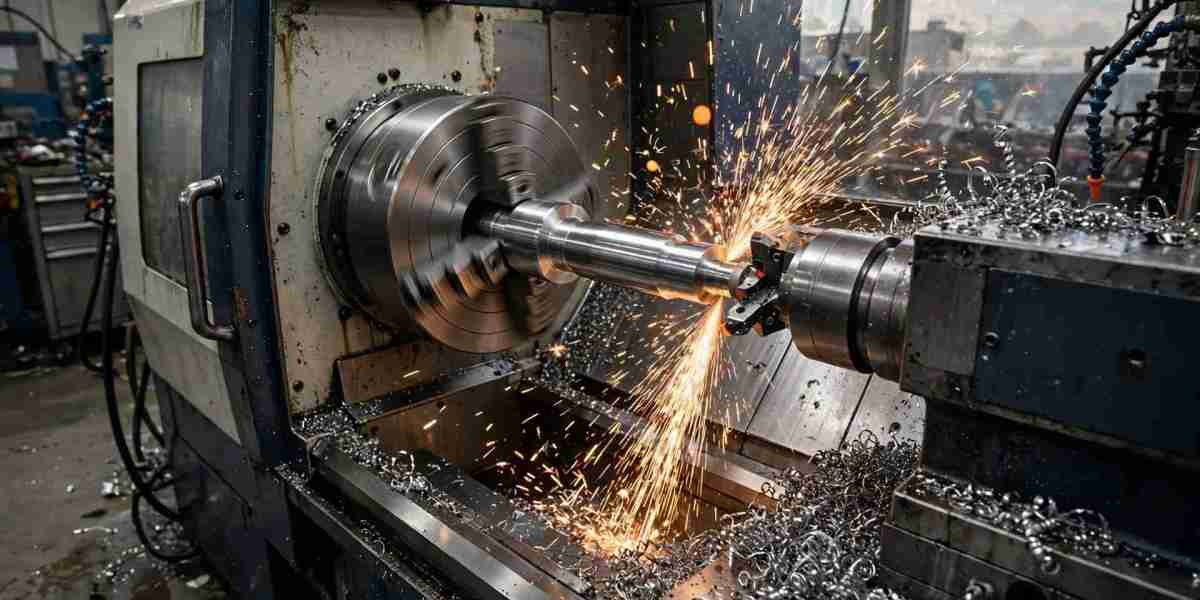
Manufacturing a component is not simply about removing material until the required shape appears. Its dimensions, surface finish, geometry and compatibility with other parts must all meet the intended specifications. Precision machining services in Sharjah support this requirement by using computer-controlled equipment and carefully planned machining operations to produce custom components with accurate measurements.
Why Dimensional Accuracy Matters in Custom Machining
Dimensional accuracy determines whether a manufactured component matches its engineering drawing and performs its intended function. Even a small difference in a critical measurement can affect assembly, alignment or the relationship between connected components.
Consider a machined shaft designed to fit inside a bearing. If its external diameter does not match the specified measurement, the connection may become too tight or too loose. Similarly, incorrectly positioned holes on a mounting plate can make installation difficult.
These examples demonstrate why machining requirements should be established before production begins. A manufacturing team needs clear information about dimensions, tolerances, material grades and surface requirements.
CNC machining uses programmed instructions to control cutting operations. The machine follows a defined toolpath, allowing the same design to be reproduced across multiple parts. This repeatability is particularly useful when customers require several components with matching dimensions.
However, programming alone does not guarantee a successful result. The accuracy of the finished part also depends on machine capability, tool selection, material behaviour and the way the workpiece is secured.
A practical approach begins with identifying the dimensions that directly influence component performance. Critical diameters, mounting positions, mating surfaces and threaded features should receive particular attention during engineering review.
Selecting Machining Methods for Different Geometries
Different component designs require different machining operations. Selecting a suitable process helps manufacturers produce the required shape without introducing unnecessary operations.
CNC Milling for Detailed Component Features
CNC milling uses rotating cutting tools to remove material from a workpiece. It can produce flat surfaces, slots, pockets, holes, grooves and complex contours.
Three-axis milling is commonly used for components with features accessible from conventional directions. Five-axis machining provides additional rotary movement, allowing the cutting tool to reach more complex surfaces.
For example, a valve body may contain several openings, machined faces and internal features. A suitable multi-axis machining strategy can help manufacture these details while reducing repeated repositioning.
Other examples of milled components include:
Industrial housings and enclosures.
Mounting plates and brackets.
Flanges and adaptor plates.
Manifolds and custom tooling.
CNC Turning for Round Components
Turning is suitable for parts where cylindrical geometry is the main requirement. During this process, the workpiece rotates while a cutting tool removes material.
Common examples include shafts, bushings, sleeves, pins, spindles and threaded components.
Turning operations can create external diameters, internal bores, grooves and tapers. These features are important when components must fit accurately with bearings, connectors or other mechanical assemblies.
Some designs contain both cylindrical and flat features. Such components may require a combination of milling and turning to achieve their complete geometry.
Genesis-MFG provides both machining capabilities, allowing manufacturing requirements to be assessed according to the actual component design rather than relying on a single process.
Material Properties and Surface Finish Requirements
Material selection influences how a component behaves during machining and how it performs in its intended application. The correct material should be selected according to mechanical requirements, environmental exposure and design specifications.
Genesis-MFG's machining capabilities include aluminium, carbon steel, stainless steel, titanium, brass, copper, Inconel and engineering plastics.
Each material offers different characteristics. Aluminium is useful for applications where weight and machinability are important. Stainless steel provides corrosion resistance, while carbon and alloy steels offer different mechanical properties.
Engineering plastics such as POM, nylon, PTFE and HDPE provide additional options for components that require non-metallic materials.
Surface finish is another important consideration. It describes the texture of a machined surface and can influence how two components interact.
A mating surface may require a finer finish than an external area that does not contact another part. Specifying the required finish on the engineering drawing helps the manufacturing team select suitable cutting and finishing operations.
Before approving a design, customers should identify:
The material grade and required properties.
Important dimensions and tolerance limits.
Surface finish requirements for functional areas.
Features requiring special machining attention.
The expected component quantity.
Providing this information reduces uncertainty during quotation and engineering review. It also helps prevent unnecessary finishing operations or misunderstandings about the final specification.
Inspection and Manufacturing Quality Management
Inspection confirms whether a finished component meets the requirements established in its engineering documentation. Without appropriate checks, dimensional deviations may remain unnoticed until the part reaches assembly or installation.
A structured inspection process should consider critical dimensions, hole positions, diameters and relevant surface characteristics. The inspection method should be suitable for the feature being measured.
For example, a turned shaft may require diameter measurements at specified locations. A milled mounting plate may need checks for thickness, hole spacing and flatness.
Genesis-MFG operates with ISO 9001 and API Spec Q1 certifications. These certifications support its quality management approach and manufacturing activities.
Businesses comparing CNC machining companies in Sharjah should examine more than the machines available. They should also consider engineering support, material options, inspection practices and the ability to manufacture according to customer drawings.
Clear communication is equally important. A complete drawing, CAD model, material specification and quantity requirement allow the manufacturing team to understand the project before production starts.
Conclusion
Dimensional accuracy depends on the relationship between engineering design, machining methods, material properties and inspection. Milling and turning provide different ways to manufacture custom components, while appropriate documentation helps maintain consistency throughout production.
When evaluating CNC machining companies in Sharjah, businesses should consider their technical capabilities, quality management and ability to meet specified manufacturing requirements.
Genesis-MFG offers custom precision machining solutions for components designed according to customer drawings and specifications. Sharing the technical requirements with its manufacturing team can help establish a suitable production approach.
FAQs
What is dimensional accuracy in machining?
Dimensional accuracy describes how closely a finished component matches the measurements specified in its engineering drawing.
Which machining process is suitable for cylindrical parts?
CNC turning is generally suitable for cylindrical components such as shafts, pins, bushings and sleeves.
What materials can be used for precision machining?
Available material options include aluminium, carbon steel, stainless steel, titanium, brass, copper, Inconel and engineering plastics.
Why is surface finish important?
Surface finish affects the texture of a component and can influence how it fits, contacts or interacts with other parts.
How does inspection improve manufacturing quality?
Inspection checks important component dimensions and features against the specified requirements, helping identify deviations before delivery.