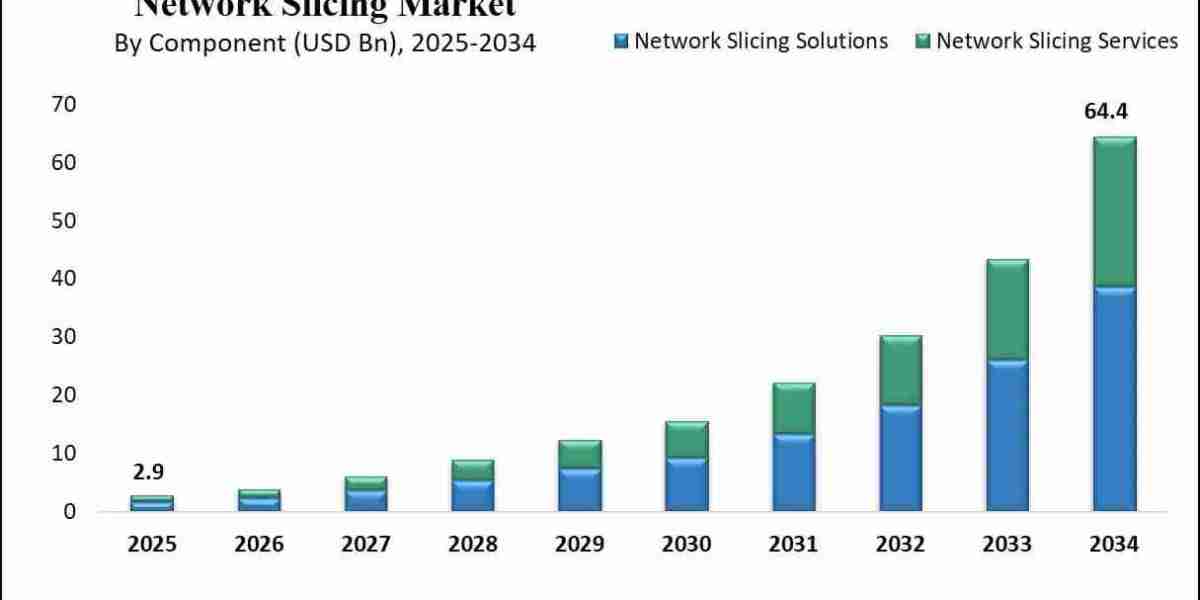
The global Network Slicing Market is experiencing significant transformation as telecommunications operators adopt 5G standalone infrastructure, cloud-native networking, and advanced network virtualization. Network slicing enables providers to offer customized connectivity services while operating multiple virtual networks over shared physical infrastructure.
According to Dimension Market Research, the global market is projected to reach USD 2.9 billion in 2025 and expand to USD 64.4 billion by 2034, registering a CAGR of 41.4%.
This growth reflects rising demand for low-latency communication, enterprise private networks, connected industrial systems, and differentiated telecommunications services. As digital applications require increasingly specific performance characteristics, network slicing is emerging as an important capability for modern mobile networks.
What Is the Network Slicing Market?
The Network Slicing Market comprises technologies, software platforms, orchestration solutions, and services that allow telecommunications operators to divide shared network infrastructure into multiple independent logical networks.
Each virtual network slice can be configured to support particular requirements relating to bandwidth, latency, reliability, capacity, and security.
For example, an industrial manufacturing facility may require highly reliable communication for automated machinery, while a media platform may prioritize high bandwidth for video streaming.
Network slicing allows these applications to receive differentiated network capabilities without requiring completely separate physical infrastructure.
The technology relies on software-defined networking, network function virtualization, cloud-native architecture, and automated orchestration to create and manage individual network slices.
Why Is the Network Slicing Market Expanding?
The adoption of 5G standalone networks is a primary growth driver.
Unlike conventional mobile network architectures, 5G standalone infrastructure enables operators to deliver advanced services supported by flexible core networks and virtualized resources.
This capability is particularly valuable for applications requiring predictable performance and dedicated network capacity.
Industrial digitalization represents another major opportunity. Manufacturing companies, logistics providers, healthcare institutions, and transportation operators increasingly require specialized connectivity for connected equipment and real-time applications.
Network slicing allows telecommunications providers to address these requirements through purpose-built service offerings.
The expansion of edge computing also supports demand because applications can combine dedicated network resources with processing capabilities closer to connected devices.
In addition, operators are exploring commercial opportunities through enterprise connectivity agreements, private network services, and flexible subscription-based offerings.
These developments are gradually shifting telecommunications business models toward more differentiated and application-specific connectivity services.
Get a Free Sample of the Network Slicing Market Report
Explore market forecasts, technology adoption, competitive strategies, regional opportunities, and revenue segmentation in Dimension Market Research's comprehensive industry report.
https://dimensionmarketresearch.com/request-sample/network-slicing-market/
Network Slicing Market Statistics
- 2025 Market Size: USD 2.9 billion
- 2034 Market Forecast: USD 64.4 billion
- Forecast CAGR: 41.4%
- Leading Component: Network Slicing Solutions, 60.0%
- Leading Technology Layer: Core Network Slicing, 35.0%
- Leading Slice Type: Enhanced Mobile Broadband Slice, 35.0%
- Leading Deployment Model: Cloud-Native Deployment, 50.0%
- Leading Region: Asia-Pacific, 40.0% market share
All listed segment and regional shares refer to 2025 estimates in the DMR report.
Market Segmentation and Key Opportunities
Network Slicing Solutions Maintain Leadership
Network Slicing Solutions are projected to account for 60.0% of market revenue in 2025.
These solutions include orchestration platforms, network virtualization software, resource allocation technologies, and tools for managing network slices throughout their operational lifecycle.
Their importance is growing as operators deploy more complex 5G networks and offer customized services to enterprise customers.
Services also play a critical role by supporting deployment, system integration, maintenance, and technical management.
Core Network Slicing Leads Technology Adoption
Core Network Slicing is estimated to hold 35.0% of market revenue within the technology layer segment in 2025.
The core network manages essential functions relating to connectivity, subscriber services, policies, and traffic control.
Advanced slicing capabilities allow operators to allocate resources and maintain differentiated service conditions for individual applications.
Radio access network slicing, transport network slicing, and orchestration technologies complement these capabilities.
Enhanced Mobile Broadband Creates Demand
Enhanced Mobile Broadband Slice is projected to capture 35.0% of the slice type segment.
This category supports bandwidth-intensive applications, including high-quality video streaming, immersive experiences, and demanding mobile data services.
Ultra-reliable low-latency slices, enterprise private network slices, and massive machine-type communication slices address other important requirements.
Together, these capabilities expand the commercial potential of advanced mobile connectivity.
Regional Outlook
Asia-Pacific is anticipated to lead the global market with a 40.0% revenue share in 2025.
China, Japan, South Korea, and India are important markets due to substantial telecommunications infrastructure development, industrial digitalization, and investment in next-generation connectivity.
North America represents another significant opportunity as operators commercialize 5G standalone networks and expand enterprise-focused wireless services.
Europe is also advancing network slicing through telecommunications modernization, private network initiatives, and increasing industrial connectivity requirements.
The regional outlook highlights opportunities for telecommunications operators, cloud providers, and enterprise technology vendors.
Competitive Landscape
The competitive landscape includes established telecommunications equipment suppliers, network software developers, and service orchestration companies.
Prominent participants listed in the report include Huawei Technologies Co., Ltd., Nokia Corporation, Ericsson AB, Samsung Electronics Co., Ltd., ZTE Corporation, Cisco Systems, Inc., NEC Corporation, Mavenir Systems, Inc., Juniper Networks, Inc., Amdocs Inc., and Oracle Corporation.
These companies compete through virtualization technologies, 5G infrastructure solutions, network management capabilities, and software-based service delivery.
An important competitive priority is enabling network slices to operate effectively across multiple infrastructure domains and vendor environments.
Challenges and Future Outlook
Network slicing deployment requires significant coordination between telecommunications infrastructure, orchestration software, and enterprise applications.
Interoperability, security, performance assurance, and integration costs remain important implementation considerations.
Nevertheless, increasing demand for customized enterprise connectivity is creating opportunities for network technology developers and service providers.
AI-driven orchestration and automated slice lifecycle management are expected to become increasingly relevant as operators scale commercial deployments.
Explore the Complete Network Slicing Market Analysis
Access detailed market forecasts, regional revenue assessments, segmentation analysis, technology developments, and competitive insights to understand opportunities across the network slicing ecosystem.
https://dimensionmarketresearch.com/checkout/network-slicing-market/
Frequently Asked Questions
1. What is the global Network Slicing Market size?
The market is projected to reach USD 2.9 billion in 2025 and USD 64.4 billion by 2034.
2. What is the expected Network Slicing Market CAGR?
The global market is forecast to grow at a CAGR of 41.4% from 2025 to 2034.
3. Which component dominates the Network Slicing Market?
Network Slicing Solutions lead with a projected share of 60.0% in 2025.
4. Which region leads the global Network Slicing Market?
Asia-Pacific is expected to lead with approximately 40.0% market share in 2025.
5. What factors support future Network Slicing Market growth?
5G standalone deployments, enterprise private networks, cloud-native infrastructure, and demand for specialized connectivity services support future growth.
Conclusion
The Network Slicing Market represents an important development in telecommunications infrastructure and service delivery.
By allowing operators to create application-specific virtual networks, slicing supports improved resource allocation, differentiated connectivity, and emerging enterprise services.
Continued investment in 5G standalone networks, intelligent orchestration, and industrial connectivity is expected to strengthen the market's long-term growth opportunities.
Related Telecommunications Market Insights
5G Network Slicing Market Size
The global 5G Network Slicing Market is projected to expand from USD 1.6 billion in 2025 to USD 45.9 billion by 2034, registering a CAGR of 45.1%. Growth is supported by cloud-native 5G infrastructure, private networks, and the need for customized connectivity across industrial applications.
Network Automation Market Share
The Network Automation Market is forecast to grow from USD 7.0 billion in 2025 to USD 46.6 billion by 2034 at a CAGR of 23.5%. AI-enabled orchestration, automated provisioning, and intelligent network management are important technologies supporting modern telecommunications infrastructure.
Network Slice as a Service Market Growth
The Network Slice as a Service Market focuses on commercially delivered, application-specific connectivity services. Its DMR report highlights enhanced mobile broadband slices, public network deployment, and industrial IoT applications as important market segments. This model creates opportunities for telecommunications operators to commercialize dedicated network capabilities.