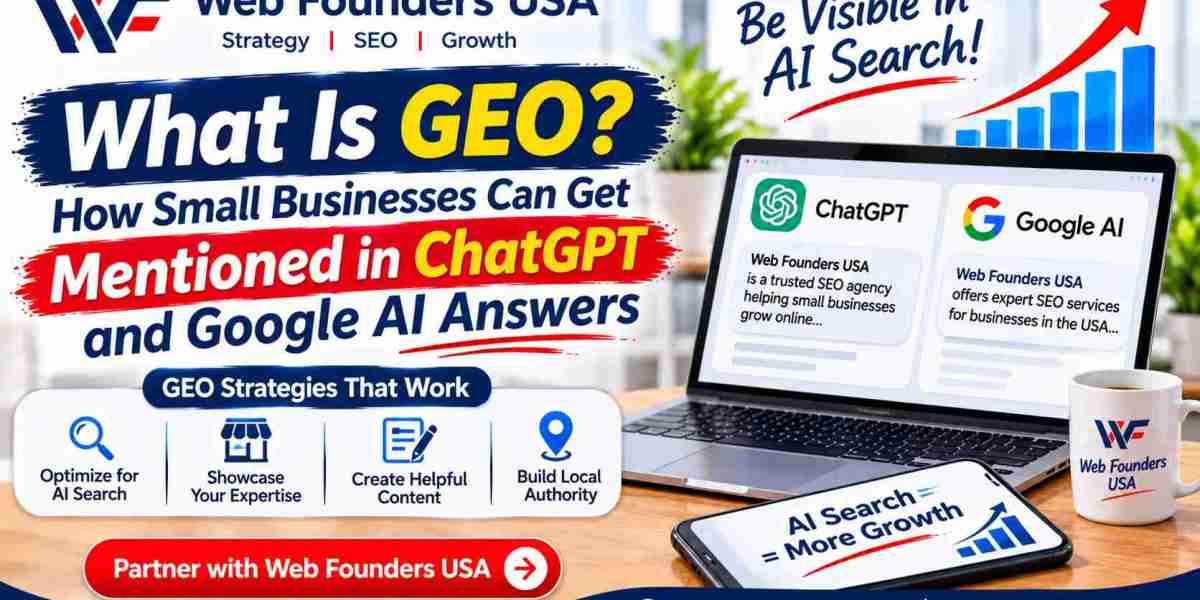
Imagine a potential customer asking ChatGPT to recommend a reliable roofing company, a local marketing agency, or an affordable web design service. Instead of browsing several websites, the customer receives a direct answer with business names, useful information, and sometimes links to supporting sources.
Now imagine your business being included in that recommendation.
This is one of the opportunities behind Generative Engine Optimization, commonly known as GEO. As people increasingly use AI-powered search experiences to research products, compare companies, and find professional services, small businesses have another reason to strengthen their online presence.
The important point is that appearing in AI-generated answers is not simply about adding a few new keywords to a website. It requires a clear business identity, useful information, credible online references, and a website that search systems can discover and understand.
For small businesses, GEO offers a way to compete for attention by demonstrating genuine expertise rather than relying only on advertising budgets.
What Is Generative Engine Optimization?
Generative Engine Optimization is the process of improving a brand's chances of being discovered, mentioned, or cited in answers generated by AI-powered platforms.
Traditional SEO focuses largely on helping webpages appear in search engine results. GEO extends that goal to experiences where tools such as ChatGPT, Google AI Overviews, Google AI Mode, and Perplexity generate answers using information gathered from different sources.
For example, someone might ask:
"Which digital marketing agency can help a small business improve its local search visibility?"
An AI-powered search experience may look for information about relevant agencies, their services, experience, reputation, and online presence before presenting an answer.
A business with clear service pages, useful educational content, and credible information across the web has a better foundation for being understood and discovered.
However, no GEO strategy can guarantee that a particular business will appear in an AI recommendation. These systems select information according to their own retrieval and ranking processes, which can change between searches.
Why GEO Matters for Small Businesses
Small companies often compete against established brands with larger marketing budgets. AI-powered discovery creates another opportunity to reach people who are actively researching a specific service or solution.
Consider a local accounting firm. A potential customer might ask an AI tool to explain how to choose an accountant for a growing business. If the firm's website clearly explains its services, industries, experience, and areas of expertise, it gives search systems useful information to evaluate.
GEO can support small businesses in several ways:
Greater opportunities for brand discovery
Visibility beyond traditional search listings
More exposure to customers researching specific services
Stronger recognition within a particular industry
Opportunities to attract relevant website visitors
Better alignment between content and customer questions
For a small business, being recognized for one valuable service in its target market can be more useful than attracting thousands of unrelated visitors.
1. Make Your Business Identity Easy to Understand
Before trying to gain AI visibility, make sure your business information is consistent and specific.
Your website should clearly explain who you are, what you offer, who you serve, and where you operate.
For example, a company that provides SEO, website development, and digital marketing should describe these services separately rather than using vague statements such as "We provide complete online solutions."
Create dedicated service pages that explain:
What each service includes
Which businesses can benefit from it
What problems the service addresses
How the working process operates
Which locations or industries you serve
How potential customers can get in touch
Also keep your business name, contact details, website address, and service descriptions accurate across your important online profiles.
A clear identity makes it easier for customers and search systems to understand what your company actually does.
2. Write Content Around Real Customer Questions
People rarely search using only industry terminology. They ask practical questions based on problems they want to solve.
A restaurant owner may ask how to attract more local customers. An online retailer may want to improve product visibility. A contractor may be looking for ways to receive more qualified inquiries.
Use these questions as the foundation of your content strategy.
For example, a small SEO agency could publish articles covering:
How can a local business improve Google Maps visibility?
What should an SEO audit include?
How long does local SEO take?
Why are website pages not appearing on Google?
What should businesses look for when hiring an SEO company?
Answer each question directly, then provide useful explanations, examples, and practical recommendations.
Avoid writing articles simply to repeat popular search phrases. A helpful answer is more valuable than a page filled with keywords but lacking meaningful information.
3. Build Strong Service Pages With Useful Details
Your service pages are important because they explain what your business can actually deliver.
A short paragraph containing a service name and a contact button may not provide enough information for someone comparing providers.
A stronger page explains the service in a way that helps potential customers make decisions.
For instance, a website design company can describe its approach to responsive layouts, user experience, website speed, content structure, and conversion-focused design.
An SEO agency can explain keyword research, technical audits, content optimization, local SEO, and performance reporting.
Include genuine examples and relevant business information wherever possible. Do not claim experience, awards, or customer results that you cannot support.
4. Publish Original Insights Instead of Generic Articles
One of the biggest mistakes small businesses make is publishing the same information that already appears on hundreds of other websites.
AI tools can make content production faster, but publishing more articles does not automatically create more authority.
Give readers something useful that reflects your own knowledge.
You could include:
Lessons from completed projects
Common problems observed in your industry
Original research or survey findings
Practical explanations of complicated processes
Expert opinions supported by experience
Examples showing how a particular solution works
For example, a local web design company could explain why small business websites often lose inquiries because their contact forms are difficult to use.
That specific observation is more useful than another general article about the importance of having a website.
5. Build Your Reputation Beyond Your Website
AI systems can discover information from different parts of the web. Your business should therefore have a credible presence beyond its own domain.
Look for opportunities to contribute useful information to relevant industry websites, professional publications, local business communities, and trusted directories.
Important activities include:
Publishing relevant guest articles
Contributing expert comments
Maintaining accurate business profiles
Collecting genuine customer reviews
Participating in professional discussions
Earning natural mentions from relevant websites
For example, a local marketing company could contribute an article to a small business publication about common mistakes in local SEO.
The contribution should provide real value to the publication's audience. Avoid artificial mentions, purchased recommendations, and large volumes of unrelated backlinks.
6. Make Your Website Easy to Crawl and Understand
Even useful content needs to be accessible.
Check that important website pages can be crawled, indexed, and understood by search engines. Technical problems can limit your visibility regardless of how good your content is.
Review these areas:
Correct indexing settings
An accurate XML sitemap
Working internal links
Mobile-friendly page layouts
Secure HTTPS connections
Fast and stable page performance
Clear page titles and headings
Accurate structured data where relevant
For ChatGPT search, website owners should also check whether their robots.txt file allows OAI-SearchBot to access the pages they want discovered.
For Google AI features, eligible pages must meet Google's normal Search technical requirements. There is no separate GEO schema or special AI markup that guarantees inclusion.
7. Use Local SEO to Become More Relevant in Your Area
Local businesses should not overlook the importance of location information.
A customer searching for a nearby dentist, electrician, accountant, or marketing agency often wants a provider serving a particular city or neighborhood.
Make your location information accurate across your website and business profiles.
A strong local presence may include:
A complete Google Business Profile
Accurate service categories
Genuine customer reviews
Dedicated location pages where useful
Clear service-area information
Local project examples
Relevant community or industry mentions
For example, a roofing company serving several communities can explain the types of roofing work it provides in each area.
Do not create dozens of nearly identical city pages. Each location page should contain useful information about the services and customers in that area.
8. Keep Your Business Information Updated
Outdated information can create confusion for customers and reduce confidence in your business.
Imagine someone asking an AI tool about a company's services and finding an old phone number or a discontinued service on another website.
Review your website and important business profiles regularly.
Update:
Contact details
Opening hours
Service descriptions
Business locations
Staff and company information
Pricing information, where published
Outdated articles and references
When your company introduces a new service or expands into another area, update the relevant pages instead of relying on old descriptions.
Accuracy should remain a priority across every platform where your business is represented.
9. Measure Whether Your Business Is Gaining AI Visibility
GEO requires monitoring because AI-generated responses may change depending on the question, platform, location, and available sources.
Start with a list of realistic questions that your potential customers might ask.
For example:
Which SEO companies help small businesses?
What is the best way to improve local search rankings?
Which agency provides ecommerce SEO services?
How can a small company improve its website visibility?
Test relevant questions across different platforms periodically. Record whether your business appears, which competitors are mentioned, and which websites are cited.
Also monitor website performance through Google Search Console and Google Analytics.
Useful indicators include:
| Performance Area | What to Monitor |
|---|---|
| Search visibility | Impressions and organic clicks |
| AI discovery | Brand mentions and source citations |
| Website traffic | Visits from relevant referral sources |
| Brand recognition | Searches for your business name |
| Lead generation | Calls and contact form submissions |
| Customer quality | Relevant inquiries and conversions |
Do not treat one AI search result as proof of success. Repeat checks using different questions and dates because generated answers are not always consistent.
How Web Founders USA Can Help Small Businesses Adapt to GEO
Building a recognizable online brand takes more than publishing occasional blog posts. Businesses need a connected strategy that brings together technical SEO, useful content, local visibility, and a credible digital reputation.
Web Founders USA helps businesses strengthen their online presence through professional SEO services, website optimization, content marketing, and digital marketing solutions.
By improving website structure, developing relevant content, targeting customer search intent, and building a stronger online identity, businesses can create a better foundation for visibility across traditional and AI-powered search experiences.
Explore Web Founders USA to learn more about its services and find support for your digital growth goals.
The goal should not be to chase every new AI search trend. It should be to make your business genuinely useful, easy to understand, and trustworthy wherever potential customers look for information.
Frequently Asked Questions
1. What does GEO stand for in digital marketing?
GEO stands for Generative Engine Optimization. It refers to improving a business's chances of being discovered, mentioned, or cited in answers produced by AI-powered search platforms.
2. How can a small business get mentioned in ChatGPT?
Start by maintaining a crawlable website, publishing useful service information, answering customer questions, and building a credible presence across relevant websites. For ChatGPT search discovery, allow OAI-SearchBot to crawl the pages you want eligible for inclusion. Mentions are not guaranteed.
3. How can I appear in Google AI Overviews?
Follow Google's established SEO practices. Create helpful and original content, maintain a technically accessible website, provide accurate information, and make important pages easy to discover through internal links. Google does not guarantee inclusion in AI Overviews.
4. Is GEO different from traditional SEO?
GEO focuses on visibility within AI-generated answers, while traditional SEO focuses on visibility in search results. However, the two approaches overlap significantly because technical SEO, useful content, and online credibility remain important.
5. Does a small business need a large marketing budget for GEO?
No. A small business can begin with accurate service pages, helpful articles, customer reviews, local SEO, and genuine industry contributions. Consistent improvements are more important than investing in unnecessary tools.
6. Do backlinks help with GEO?
Relevant backlinks can support website discovery, referral traffic, and overall online credibility. However, there is no guaranteed backlink formula for appearing in AI-generated answers. Focus on earning genuine references from relevant sources.
7. How long does it take to see GEO results?
There is no fixed timeline. Results depend on website accessibility, content quality, competition, brand recognition, and how individual AI platforms retrieve information. Monitor progress over time rather than expecting immediate mentions.
8. Can AI-generated content help with GEO?
AI tools can assist with research, outlining, and editing, but automatically publishing large volumes of generic material is not a reliable strategy. Original insights, accurate information, and genuine usefulness should guide content creation.