
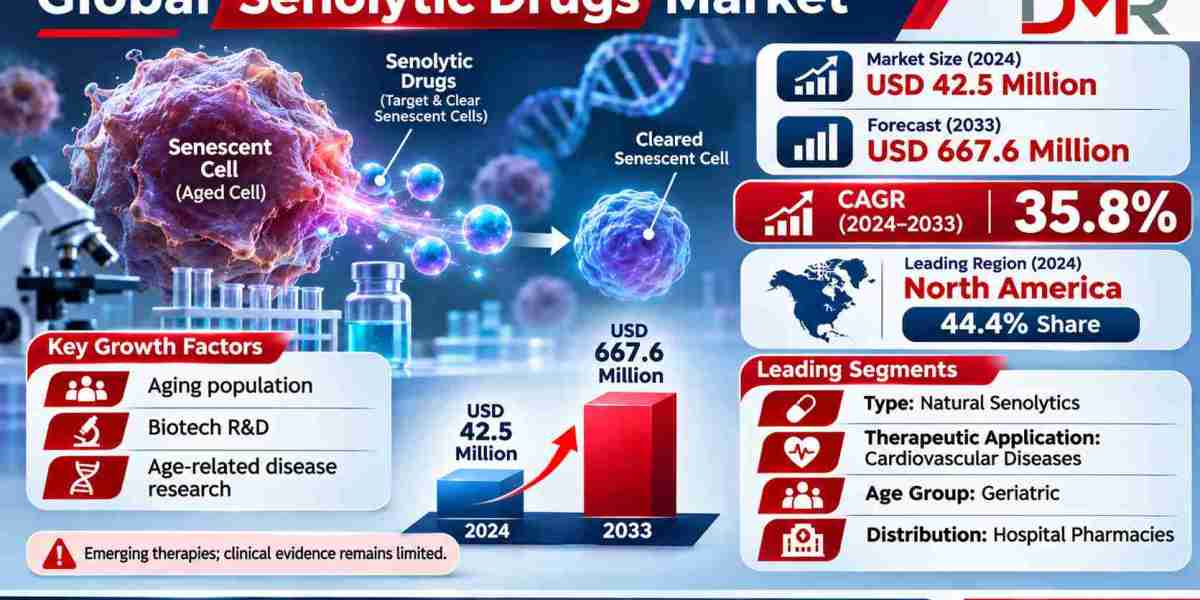
The global Senolytic Drugs Market is attracting increasing attention as biotechnology companies and healthcare researchers investigate innovative treatments for aging-related diseases. Growing interest in cellular aging, regenerative medicine, and targeted therapies is creating new opportunities for pharmaceutical research and drug development.
According to Dimension Market Research, the global Senolytic Drugs Market was estimated at USD 42.5 million in 2024 and is forecast to reach USD 667.6 million by 2033, registering a compound annual growth rate (CAGR) of 35.8% during 2024 to 2033.
Increasing research into cellular senescence, rising prevalence of chronic age-related disorders, and advancements in biotechnology are supporting the market outlook. However, limited human clinical evidence and regulatory uncertainty remain significant challenges, making clinical validation essential for future commercialization.
What Is the Senolytic Drugs Market?
Senolytic drugs are experimental therapeutic agents designed to selectively eliminate senescent cells, which are damaged or aged cells that have stopped dividing but remain metabolically active.
These cells can accumulate in tissues over time and contribute to chronic inflammation, tissue dysfunction, and age-associated diseases through inflammatory signaling.
Senolytic therapies aim to reduce the accumulation of harmful senescent cells, potentially improving tissue function and addressing diseases associated with biological aging.
The market covers natural senolytics, synthetic compounds, therapeutic applications, administration methods, and distribution channels. Research applications include cardiovascular diseases, neurological disorders, osteoarthritis, cancer, and diabetes.
Importantly, senolytic treatments remain an emerging research area. Their potential benefits for healthy aging and disease management require further clinical evidence before broad therapeutic use can be established.
What Is Driving Senolytic Drugs Market Growth?
Rising Geriatric Population and Age-Related Diseases
The increasing global elderly population is encouraging research into therapies addressing the biological mechanisms associated with aging.
Age-related conditions such as cardiovascular diseases, osteoarthritis, and neurological disorders represent major healthcare challenges.
Researchers are investigating whether removing senescent cells could reduce disease-related inflammation and improve tissue health, creating opportunities for senolytic drug development.
Advancements in Biotechnology and Drug Discovery
Progress in genomics, molecular biology, and targeted drug development is improving the identification of compounds capable of influencing cellular senescence.
Advancements in screening technologies and disease biomarkers are also supporting research into more selective senolytic mechanisms.
These developments are encouraging pharmaceutical and biotechnology companies to investigate new drug candidates and potential therapeutic applications.
Increasing Research Collaborations
Collaboration between academic institutions, biotechnology companies, and pharmaceutical organizations is supporting senolytic research.
Joint research programs can help distribute development costs, share scientific expertise, and advance promising compounds through preclinical and clinical evaluation.
Such partnerships may accelerate innovation while helping address the financial risks associated with experimental therapies.
Get a Free Sample of the Senolytic Drugs Market Report
https://dimensionmarketresearch.com/request-sample/senolytic-drugs-market/
Senolytic Drugs Market Share by Type, Application and Age Group
By Type: Natural Senolytics Lead the Market
The Natural Senolytics segment was projected to account for the largest market share in 2024, supported by research interest in naturally occurring compounds associated with cellular aging.
Natural senolytics covered in the report include quercetin, fisetin, and curcumin.
These compounds are being studied for their potential effects on senescent cells, oxidative stress, and inflammatory processes.
Synthetic senolytics, including Navitoclax, Dasatinib, FOXO4-DRI, and UBX0101 (Unity Biotech), represent another important area of research.
The effectiveness, safety, and clinical suitability of individual compounds remain essential considerations for future development.
By Therapeutic Application: Cardiovascular Diseases Dominate
Cardiovascular Diseases are projected to lead the therapeutic application segment, reflecting the relationship between cellular senescence, vascular inflammation, and age-associated cardiovascular dysfunction.
Research is examining whether senolytic approaches could help address mechanisms involved in atherosclerosis, vascular stiffness, and other cardiovascular conditions.
Neurological Disorders, Osteoarthritis, Cancer, and Diabetes represent additional therapeutic areas under investigation.
Expanding research across these conditions may create future development opportunities, depending on clinical results.
By Age Group: Geriatric Population Leads
The Geriatric segment was projected to dominate the market in 2024 due to the increasing prevalence of age-associated health conditions among older adults.
Senescent cell accumulation is closely associated with biological aging, making geriatric populations an important focus for experimental therapeutic development.
The Middle-Aged segment also represents a research opportunity as scientists investigate earlier intervention strategies targeting age-related cellular changes.
By Mode of Administration: Oral Drugs Hold the Leading Share
Oral Drugs were projected to dominate the administration segment in 2024 because of their convenience and potential suitability for long-term treatment strategies.
Oral formulations may improve patient acceptability compared with more invasive administration methods.
However, drug absorption, bioavailability, dosing, and safety remain important challenges during clinical development.
By Distribution Channel: Hospital Pharmacies Lead
Hospital Pharmacies were expected to account for the largest distribution channel share in 2024.
The report associates this position with the potential importance of specialized healthcare settings in managing emerging therapies.
Retail Pharmacies and Online Pharmacies represent additional channels covered by the market analysis, although their future roles depend on regulatory approvals and commercialization.
Senolytic Drugs Market Share and Regional Growth Analysis
North America Leads with 44.4% Market Share
North America was projected to dominate the global Senolytic Drugs Market with approximately 44.4% revenue share in 2024.
The region benefits from advanced biotechnology infrastructure, established pharmaceutical research capabilities, and significant investment in experimental therapeutics.
The United States market was estimated at USD 16.4 million in 2024, with growing research interest in cellular senescence and aging-related disease treatments.
Collaboration between academic institutions, research organizations, and biotechnology companies supports regional innovation.
Asia-Pacific Records the Fastest Regional Growth
Asia-Pacific is identified as the fastest-growing regional market, supported by its expanding elderly population, increasing healthcare requirements, and biotechnology research investment.
China and India represent important opportunities due to rising awareness of age-related diseases and expanding pharmaceutical research capabilities.
Japan, South Korea, and other Asia-Pacific economies also contribute to the regional research landscape.
Europe Supports Senolytic Research and Innovation
Europe represents an important market for biotechnology development and aging-related therapeutic research.
Germany, the United Kingdom, France, and other European countries are included in the regional market assessment.
Research institutions and pharmaceutical companies are exploring innovative approaches to chronic disease management, creating potential opportunities for cellular senescence research.
Emerging Trends Influencing Senolytic Drugs Market Growth
Increasing Focus on Combination Therapies
Researchers are investigating whether senolytic compounds could be combined with anti-inflammatory treatments or existing disease therapies.
Combination approaches may offer opportunities to address multiple biological pathways involved in chronic diseases.
However, potential interactions, treatment effectiveness, and patient safety require careful clinical evaluation.
Growing Interest in Personalized Medicine
Advancements in genomics and biomarker research are supporting interest in personalized senolytic treatments.
Researchers aim to identify patient characteristics and disease mechanisms that could help determine who may benefit from specific therapies.
These developments may eventually support more targeted clinical research and treatment strategies.
Competitive Landscape and Senolytic Drugs Market Opportunities
The competitive landscape includes biotechnology companies, pharmaceutical developers, and research organizations exploring cellular senescence-related therapeutic approaches.
Prominent companies identified in the report include Unity Biotechnology, Cleara Biotech, Gero LLC, Novartis AG, Sierra Oncology, Senolytic Therapeutics Inc, Vera Therapeutics, FoXBio Inc, Numeric Biotech, and Agex Therapeutics.
Competition is shaped by drug discovery capabilities, research collaborations, clinical development progress, and potential therapeutic applications.
High research costs, limited clinical evidence, safety concerns, and regulatory uncertainty remain important barriers.
Nevertheless, opportunities exist in biomarker development, targeted drug discovery, combination therapies, and collaborations between pharmaceutical companies and academic research institutions.
Senolytic Drugs Market Growth Outlook Through 2033
The market is forecast to expand as research into cellular senescence advances and interest in age-related therapeutics increases.
Future development will depend on the ability of researchers to demonstrate meaningful clinical benefits, establish acceptable safety profiles, and obtain necessary regulatory approvals.
For pharmaceutical manufacturers and investors, evaluating clinical evidence, intellectual property, therapeutic differentiation, and development risks will remain important strategic priorities.
View the Senolytic Drugs Market Report and Purchase Options
https://dimensionmarketresearch.com/checkout/senolytic-drugs-market/
Frequently Asked Questions About Senolytic Drugs Market Size, Share and Growth
1. What is the global Senolytic Drugs Market Size?
The global Senolytic Drugs Market was estimated at USD 42.5 million in 2024 and is projected to reach USD 667.6 million by 2033.
2. What is the expected Senolytic Drugs Market Growth Rate?
The global market is forecast to register a CAGR of 35.8% during 2024 to 2033, supported by biotechnology advancements and growing research into cellular aging and age-related diseases.
3. Which segment dominates Senolytic Drugs Market Share?
Natural Senolytics were projected to lead the type segment in 2024, while Cardiovascular Diseases represented the leading therapeutic application.
4. Which region holds the largest Senolytic Drugs Market Share?
North America was projected to dominate with approximately 44.4% of global market revenue in 2024, supported by advanced biotechnology research and pharmaceutical development infrastructure.
5. Which region is expected to experience the fastest Senolytic Drugs Market Growth?
Asia-Pacific is identified as the fastest-growing regional market, supported by its expanding elderly population, increasing healthcare needs, and growing biotechnology research investment.
Conclusion: Senolytic Drugs Market Growth Opportunities Through 2033
The global senolytic drug industry represents an emerging area of pharmaceutical research focused on the biological mechanisms of aging and chronic disease development.
Growing interest in cellular senescence, biotechnology innovation, and personalized therapeutic approaches is supporting investment in new research programs.
With the market forecast to reach USD 667.6 million by 2033, opportunities are developing for pharmaceutical companies, biotechnology researchers, and drug discovery organizations.
Future industry expansion will depend heavily on clinical trial outcomes, treatment safety, regulatory approvals, and the successful translation of laboratory findings into effective medical therapies.