Physical AI is transforming how intelligent machines interact with real-world environments. From autonomous mobile robots and warehouse automation systems to humanoid robots and industrial manipulators, modern robotics applications require AI models that can perceive, understand, and respond to constantly changing conditions. However, developing these capabilities requires extensive, diverse, and accurately structured training datasets.
Collecting real-world robotic data can be expensive, time-consuming, and difficult to scale. Robots must encounter different objects, environments, lighting conditions, obstacles, and unexpected situations before they can operate reliably. This is where digital twins and synthetic data are becoming essential components of modern robotics development.
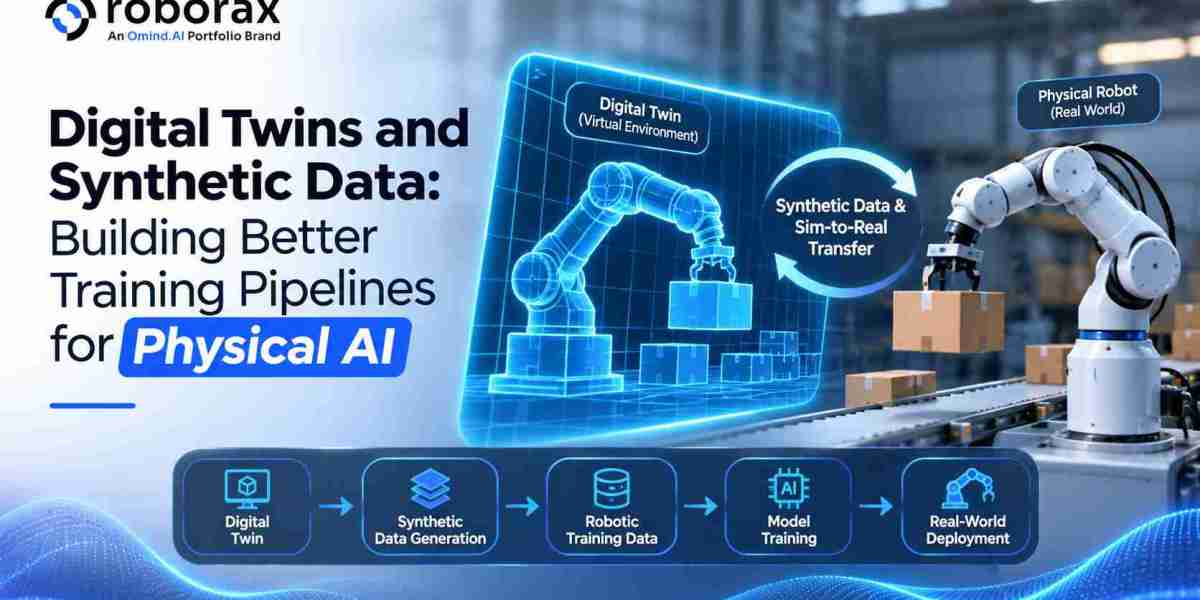
By combining virtual replicas of physical environments with computer-generated training datasets, robotics teams can create more efficient training pipelines. Digital twins and synthetic data & sim-to-real transfer techniques help bridge the gap between simulated learning and real-world performance, enabling more scalable development of Physical AI systems.
Understanding Digital Twins in Physical AI
A digital twin is a virtual representation of a physical object, machine, robot, or operating environment. It uses engineering models, sensor information, and simulation technologies to reproduce the behavior and characteristics of its real-world counterpart.
In robotics, digital twins allow developers to test robot movements, interactions, navigation strategies, and decision-making processes without relying entirely on physical hardware.
For example, a warehouse robot can be represented inside a virtual warehouse containing shelves, packages, loading areas, workers, and moving obstacles. Developers can simulate different operational conditions and evaluate how the robot responds to each situation.
Digital twins provide several advantages:
Virtual experimentation: Test robot behaviors without repeatedly conducting physical experiments.
Environment customization: Create different operating scenarios and environmental conditions.
Performance evaluation: Analyze navigation, manipulation, and perception capabilities.
Risk reduction: Identify potential failures before deploying robots in real environments.
Continuous optimization: Update simulation environments using real-world operational data.
These capabilities make digital twins valuable for developing and validating Physical AI systems.
How Synthetic Data Strengthens Robotic Training Pipelines
Synthetic data refers to artificially generated datasets that replicate real-world conditions. In robotics, these datasets can include RGB images, depth maps, point clouds, LiDAR measurements, motion trajectories, segmentation masks, and sensor readings.
Instead of collecting every possible scenario using physical robots, developers can generate thousands of controlled scenarios through simulation platforms.
Synthetic datasets help address several challenges associated with traditional data collection.
1. Expanding Dataset Diversity
Robots must recognize objects, navigate environments, and perform tasks under different conditions. Real-world data collection may not capture every possible combination of lighting, object positions, environmental layouts, and obstacles.
Synthetic data allows developers to generate variations of these scenarios, helping AI models learn from broader training distributions.
2. Generating Rare and Edge-Case Scenarios
Some robotic situations occur infrequently but can significantly affect operational safety. Examples include unexpected obstacles, object collisions, unstable surfaces, and sensor failures.
Simulation environments can deliberately reproduce these conditions, allowing developers to train and evaluate robotic systems against challenging scenarios.
3. Reducing Data Collection Costs
Collecting physical robotic demonstrations requires equipment, operational facilities, human operators, and significant testing time.
Synthetic data reduces dependence on repeated physical experiments by generating training examples within virtual environments.
4. Improving Annotation Efficiency
Synthetic datasets can include automatically generated ground-truth labels, including object boundaries, semantic segmentation, depth information, and 3D coordinates.
This reduces manual annotation requirements while supporting consistent labeling standards across large datasets.
Connecting Digital Twins with Synthetic Data Generation
The real value of these technologies emerges when digital twins and synthetic data work together.
Digital twins provide realistic virtual environments, while synthetic data generation converts simulated interactions into structured datasets for AI training.
Consider a robotic arm designed to pick and place packages in a distribution facility.
Developers can create a digital twin of the robotic arm and its surrounding workspace. The simulation can introduce different package dimensions, weights, positions, surface properties, and lighting conditions.
As the robot performs virtual picking operations, the system generates corresponding sensor observations, movement trajectories, and object interaction data.
These outputs become robotic training data that can support perception, grasp prediction, motion planning, and task execution models.
A well-designed pipeline typically includes:
Digital environment creation: Develop virtual representations of robots, objects, workspaces, and operating conditions.
Scenario generation: Introduce environmental variations, object configurations, and task-specific challenges.
Simulation execution: Run robotic operations and capture sensor observations and movement data.
Data generation: Export images, point clouds, trajectories, and other training information.
Data validation: Check label accuracy, physical consistency, and dataset completeness.
Model training: Use the generated datasets to train and evaluate Physical AI models.
Real-world testing: Validate model performance using physical robots and actual operational environments.
This integrated approach creates a repeatable training pipeline that can evolve alongside robotic systems.
Overcoming the Sim-to-Real Transfer Challenge
Despite their advantages, simulated environments cannot perfectly reproduce every real-world condition. Differences in physics, friction, object deformation, lighting, sensor noise, and environmental complexity can affect how robots perform after deployment.
This challenge is commonly known as the sim-to-real gap.
Effective synthetic data & sim-to-real transfer strategies help minimize these differences.
Some important techniques include:
Domain Randomization: Developers vary environmental parameters such as lighting, textures, object positions, friction, and sensor noise during simulation. This encourages models to learn robust features instead of relying on specific simulated conditions.
Physics-Based Simulation: Accurate physical modeling helps reproduce gravity, collisions, force interactions, and object dynamics. This is particularly important for robotic manipulation and locomotion.
Real-World Data Calibration: Actual sensor observations and robotic demonstrations can be used to refine simulation parameters, making virtual environments more representative of physical operations.
Hybrid Training: Combining synthetic datasets with real-world observations helps models benefit from simulation scalability while retaining exposure to actual operating conditions.
Continuous Validation: Models should be evaluated against real-world scenarios to identify performance gaps and guide further dataset generation.
These approaches help robotics teams develop training pipelines that support more reliable deployment.
The Role of High-Quality Robotic Training Data
Even sophisticated simulation platforms cannot compensate for poorly structured datasets. Training data must accurately represent the physical interactions and tasks that robotic systems are expected to perform.
High-quality robotic training data should include:
Accurate object detection and segmentation labels.
Consistent spatial coordinates and 3D annotations.
Synchronized multimodal sensor information.
Reliable movement trajectories and action labels.
Diverse environmental conditions and task variations.
Clearly documented dataset versions and quality standards.
Data validation is equally important. Incorrect object positions, inconsistent coordinate systems, missing sensor timestamps, or unrealistic physical interactions can introduce errors into downstream AI models.
Robotics teams should establish structured quality assurance processes to verify dataset accuracy, consistency, and relevance before model training.
How Roborax Supports Advanced Physical AI Training
Building effective Physical AI systems requires more than simulation infrastructure. It also requires reliable data generation, structured robotic demonstrations, and scalable training operations.
Roborax supports robotics development through its focus on robotics data annotation, synthetic and simulation-based training workflows, teleoperation, and human demonstrations.
By combining robotics-focused expertise with structured data operations, Roborax helps robotics teams address the challenges associated with developing high-quality training datasets for intelligent machines.
From supporting multimodal sensor data workflows to preparing task-oriented robotic datasets, the objective is to help organizations build stronger foundations for robot perception, manipulation, navigation, and decision-making.
As Physical AI adoption expands, integrated approaches to simulation, data generation, and real-world validation will become increasingly important.
Conclusion
Digital twins and synthetic data are reshaping how robotics teams develop and train intelligent machines. By creating realistic virtual environments and generating diverse training datasets, developers can reduce dependence on expensive physical experiments while exploring a broader range of operating conditions.
However, successful Physical AI development requires a balanced approach that combines accurate simulation, reliable robotic training data, real-world observations, and continuous validation.
Organizations investing in synthetic data & sim-to-real transfer can build more scalable and adaptable training pipelines, helping robots transition from controlled virtual environments to complex real-world applications.
With its focus on robotics data operations and Physical AI training workflows, Roborax aims to support this evolution toward more capable, reliable, and intelligent robotic systems.
Suggested FAQs
1. What is the role of digital twins in Physical AI?
Digital twins create virtual representations of robots and their operating environments, allowing developers to simulate tasks, test robot behavior, and generate training datasets without depending entirely on physical hardware.
2. How does synthetic data improve robotic training?
Synthetic data expands dataset diversity, generates rare scenarios, reduces manual data collection requirements, and provides structured ground-truth labels for training robotics AI models.
3. What is sim-to-real transfer in robotics?
Sim-to-real transfer is the process of applying knowledge learned in simulated environments to physical robots. Techniques such as domain randomization, physics-based simulation, and real-world calibration help reduce performance differences.
4. Why is high-quality robotic training data important?
Accurate and diverse robotic training data helps AI models learn object recognition, spatial understanding, movement planning, and physical interactions, improving their ability to perform real-world tasks.