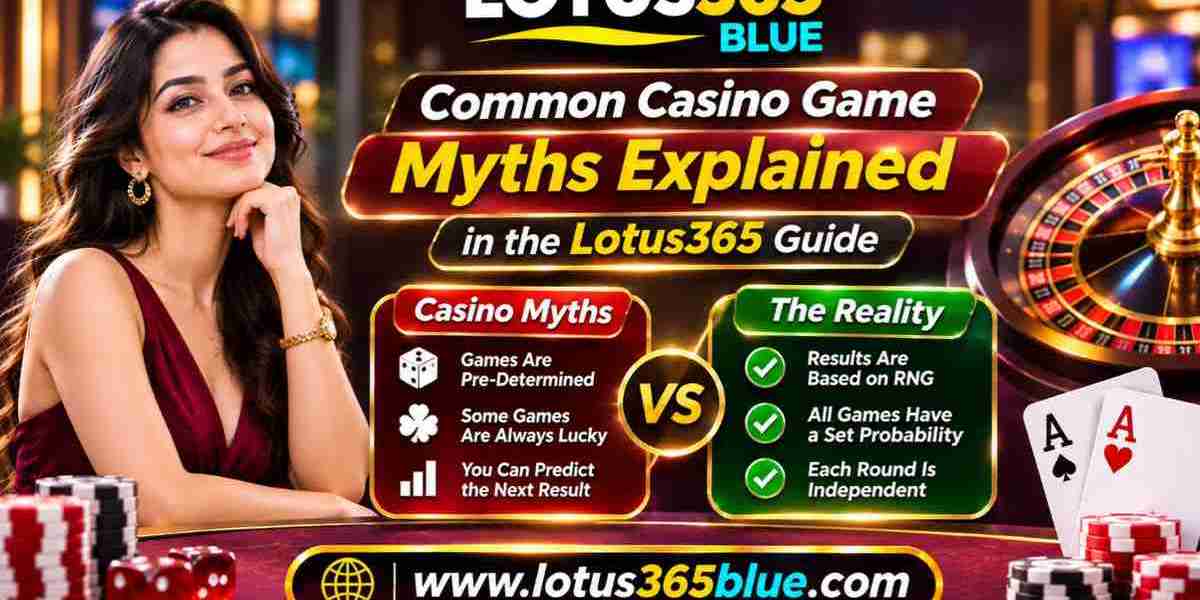
Casino games are often surrounded by theories, assumptions and popular beliefs about how outcomes supposedly work. Some of these ideas come from traditional casino experiences, while others have become common through online gaming discussions. The problem is that many of these beliefs confuse probability with prediction. Understanding the difference is especially important when exploring different game categories on Lotus365 Casino.
For beginners using Lotus365, learning the rules of a game is only one part of becoming an informed player. It is equally important to recognize common casino myths. Ideas such as “a machine is due for a win,” “previous losses guarantee a future payout,” or “a certain pattern can reveal the next result” can create unrealistic expectations. For random games, previous outcomes generally do not determine the next outcome.
This guide looks at some of the most common casino myths and explains what they actually mean in the context of digital slots, roulette, blackjack, baccarat and other casino-style games. The goal is not to promote a particular game, but to help readers distinguish mathematical facts from assumptions.
Get lotus365 id-https://lotus365blue.com/
Myth 1: A Game Is “Due” for a Win
One of the most common casino myths is that a game becomes due for a win after a long sequence of losses.
For example, someone may see several losing results in a row and conclude that the next spin must be successful. This idea is sometimes described as the gambler's fallacy.
For a properly random game, previous outcomes do not create an obligation for the next result to change. The Gambling Commission explains that in random machines, the odds of achieving a win in the current game are not affected by wins or losses in previous games.
Therefore, seeing ten unsuccessful spins does not mean the eleventh spin is guaranteed to produce a winning combination.
The same principle applies in reverse. A series of winning results does not mean a loss must immediately follow.
Myth 2: Previous Results Predict the Next Result
Another common belief is that studying recent results can reveal what is likely to happen next.
Players may look at a sequence of roulette numbers, colors or slot symbols and try to identify a pattern.
While previous results can be displayed as historical information, they should not automatically be treated as a prediction tool.
For RNG-based games, random number generation is specifically designed to make future outputs unpredictable. Regulatory guidance describes acceptable RNG outputs as unpredictable and notes that knowing previous generated numbers should not make the next number practically predictable.
This means a history screen can show what has already happened, but it does not necessarily tell you what will happen next.
Myth 3: A High RTP Guarantees Better Short-Term Results
RTP, or Return to Player, is frequently misunderstood.
Suppose a game displays a theoretical RTP of 96%. Some beginners may interpret this as meaning they should receive approximately 96% of their money back during their next session.
That is not how RTP works.
RTP represents a long-term theoretical average calculated over a large number of game plays. The Gambling Commission specifically explains that RTP is an average and should not be interpreted as the amount a player should expect to receive during a particular session.
A game with a higher theoretical RTP may have a different mathematical profile from another game, but the RTP figure does not guarantee an individual result.
When comparing games on Lotus365 Casino, RTP should therefore be treated as game information rather than a promise of short-term returns.
Myth 4: The Casino Can Change Every Spin Because You Are Losing
Players sometimes believe that a casino can simply see that they are losing and then change the next outcome specifically against them.
This claim should not be generalized across all online casino systems.
For regulated RNG-based gaming systems, random-number-generation requirements are designed around unpredictable outcomes and prohibit adaptive behavior that changes probabilities during play in the manner described by this myth.
However, users should distinguish between the general technical principles of regulated RNG systems and the specific standards applicable to any individual website or jurisdiction.
The practical lesson is to check the game's rules, provider information and applicable regulatory details instead of relying on rumors about personal targeting.
Myth 5: Increasing Your Stake After a Loss Helps Recover the Money
This belief is often connected with the idea of doubling a stake after every loss.
The reasoning sounds simple: if a future win occurs, it might recover previous losses.
However, this approach does not remove the underlying probability of the game. Increasing the stake can simply increase the amount of money exposed to future outcomes.
A losing sequence can also continue longer than expected, making escalating stakes particularly risky.
There is no universal betting progression that transforms a game of chance into a guaranteed-profit system.
For responsible use of Lotus365, a predetermined spending limit is more sensible than increasing stakes because of previous losses.
Myth 6: A Bigger Bet Improves the Odds
Another common misconception is that placing a larger wager makes a winning outcome more likely.
In many casino games, the stake changes the amount that can be won or lost, but it does not necessarily change the underlying probability of the game outcome.
For example, if a particular digital game uses a fixed probability model, increasing the stake does not magically make the random result more favorable.
The exact mechanics depend on the game, so players should read its rules rather than assume that stake size changes probability.
The key distinction is between changing the amount at risk and changing the mathematical chance of an outcome.
Myth 7: Certain Casino Symbols Are “Lucky”
Lucky numbers, lucky symbols and personal superstitions are common in casino culture.
A player may believe that a particular number, color or symbol has special significance because it has produced wins in the past.
In a random game, however, personal beliefs do not alter the underlying probability.
A roulette number does not become statistically stronger because someone considers it lucky. Similarly, a slot symbol does not become more likely because it recently appeared in a winning combination.
The visual design of casino games can make certain symbols memorable, but appearance and probability are separate concepts.
Myth 8: A Winning Streak Will Continue
The opposite of the “due for a win” myth is the belief that a winning streak will continue because the player is currently “hot.”
A player might win several rounds and decide that their current luck means another win is more likely.
This is another form of pattern-based thinking.
A sequence of previous results does not automatically create a reliable prediction about the next random outcome.
The correct way to view a winning streak is simply as a sequence of results that has already occurred.
Myth 9: Roulette Has a Memory
Roulette is particularly associated with the idea that the wheel has a memory.
For example, if black appears several times, someone may believe that red is now more likely because red has been absent.
The underlying logic is incorrect for an independent random outcome.
If a particular roulette variant has fixed probabilities for its outcomes, previous spins do not create a requirement that a particular color or number appear next.
This is why roulette history should not be confused with a predictive system.
Myth 10: “Hot” and “Cold” Slots Can Be Identified Easily
Online casino discussions sometimes describe slots as either “hot” or “cold.”
A “hot” slot is supposedly one that is currently paying frequently, while a “cold” slot is considered to be withholding wins.
The problem is that short-term results can be misleading.
A slot's theoretical RTP is based on its long-term mathematical design, while actual performance over a limited number of plays can vary considerably due to volatility and random variation.
A short period of frequent wins does not establish that the game will continue producing them.
Likewise, a period of losses does not necessarily mean that a payout is about to occur.
Myth 11: A Slot's Visual “Near Miss” Means a Win Is Close
Modern slot games can include animations where symbols appear close to forming a winning combination.
This can create the impression that a winning result was almost achieved.
However, the appearance of a near match does not mean the next spin has a higher probability of producing a win.
In fact, regulators have specifically examined game-design features that can make players perceive an outcome as more successful than it actually was, including “losses disguised as wins.”
The important question is not whether the animation looks close to a win, but whether the final result actually satisfies the game's published winning conditions.
Myth 12: A Small Win Means You Are Profitable
Some slot interfaces may celebrate individual winning combinations with sounds, animations or visual effects.
However, a winning combination does not always mean that the player made a net profit on the overall spin.
For example, imagine a hypothetical spin with a total stake of ₹100 that produces a ₹60 payout. The game may register ₹60 as a win, but the player is still ₹40 below the original stake for that spin.
This distinction is important because casino interfaces can visually emphasize individual winning events.
The Gambling Commission has discussed the concept of “losses disguised as wins,” where a game can celebrate a payout even though the player has received less than their total stake.
Myth 13: Live Casino Is Easier to Predict
Some players believe that live casino games are more predictable because they can watch a real dealer, physical cards or a roulette wheel.
Watching the physical process can certainly make the experience feel more transparent or immersive, but it does not create a reliable prediction method.
The outcome remains uncertain.
For live casino games, physical equipment and dealing procedures are subject to their own integrity controls. The Gambling Commission notes that live dealer games involve physical equipment such as roulette wheels and decks of cards, with integrity measures surrounding their operation.
Seeing the wheel or dealer does not mean the next result can be accurately forecast.
Myth 14: Digital Casino Games and Live Games Work Exactly the Same Way
Another misconception is that a digital roulette game and live roulette game are technically identical simply because the rules look similar.
The rules may overlap, but the way the result is produced can differ.
Digital games may use RNG-based software, while live games can use physical cards, wheels or other equipment operated by a dealer.
This distinction is useful when exploring different categories on Lotus365 Casino.
A player should always check the individual game's information rather than assuming that two similarly named games use exactly the same mechanics.
Myth 15: RTP Means Every Player Gets the Same Percentage Back
RTP does not work at an individual-player level.
If a game has a theoretical RTP of 96%, that percentage describes the mathematical design over a sufficiently large number of plays.
It does not mean every player receives exactly 96% of their personal stake.
One person can experience a highly successful short session, while another can experience an unsuccessful session.
Theoretical RTP and individual results therefore need to be kept separate.
Myth 16: The More You Play, the More You Are Guaranteed to Win
Some players believe that continuing to play long enough will eventually produce a guaranteed profitable result.
This confuses long-term statistical averages with personal outcomes.
A game's theoretical RTP may become more stable over a very large number of plays, but that does not mean an individual player is guaranteed to finish ahead.
In fact, continuing to play simply because a desired outcome has not occurred can increase the amount of money exposed to risk.
More play does not create a guaranteed positive personal result.
Myth 17: Casino Strategies Can Eliminate the House Edge
Some strategies can help players make decisions in games where skill or choice affects the mathematical outcome.
However, no general strategy can transform every casino game into a guaranteed-profit activity.
For games determined substantially by chance, the underlying probability structure remains important.
In banker's games such as roulette and blackjack, mathematical house-edge concepts exist because the game rules give the operator an advantage under specified conditions.
Understanding strategy and understanding probability are therefore two different things.
Myth 18: Previous Losses Should Influence Your Next Decision
A player may think, “I have already lost ₹1,000, so I should continue until I get it back.”
This is another common psychological trap.
The previous loss has already happened. The next decision should be evaluated based on the current situation rather than the desire to erase the previous result.
Increasing stakes or extending a session simply because of an earlier loss can turn a limited loss into a larger one.
For users of Lotus365, setting a budget before playing can help separate entertainment decisions from attempts to recover previous outcomes.
How to Approach Casino Information More Rationally
A useful approach is to replace prediction-based thinking with rule-based understanding.
Before playing a game, learn what determines the outcome.
For digital games, this may include RNG mechanics, paylines, symbols, RTP and volatility.
For table games, it may include probabilities, payout structures, dealer rules and available actions.
Instead of asking, “Which result is coming next?” a better question is, “What does this game's rule set actually say?”
This shift makes casino information much easier to understand.
What Beginners Should Remember About Lotus365 Casino Games
When exploring casino-style games on Lotus365, several principles are worth keeping in mind.
First, historical results are not automatically predictions.
Second, RTP is a long-term statistical measurement rather than a guarantee for an individual session.
Third, increasing a stake does not automatically improve the probability of a winning result.
Fourth, visual effects and winning animations do not necessarily indicate a net profit.
Finally, responsible limits matter regardless of whether the game is digital or live.
These principles help separate genuine game information from myths that can encourage unrealistic expectations.
Responsible Gaming Matters More Than Casino Myths
Myths can become especially problematic when they encourage players to chase losses or increase spending.
A sensible approach is to establish a fixed entertainment budget before playing and avoid using money needed for essential expenses.
Players should also consider setting time limits and taking breaks.
If gambling stops feeling recreational and begins affecting finances, relationships, work or daily responsibilities, stopping and seeking appropriate support is more important than finding another strategy or betting system.
No myth-busting guide can change the fundamental uncertainty of casino outcomes.
Final Thoughts
Casino myths often come from attempts to find patterns in uncertain outcomes. Ideas such as “the machine is due,” “red must appear next,” “a losing streak guarantees a win,” or “a higher RTP guarantees today's result” sound convincing but confuse long-term mathematics with short-term prediction.
For users exploring Lotus365 Casino, understanding these myths can make game information easier to interpret. Random-game outcomes are designed to be unpredictable, while RTP describes long-term theoretical performance rather than an individual's result.
The most useful approach is to learn the actual rules of each game, understand the difference between probability and prediction, and avoid treating previous outcomes as signals about what must happen next.
Lotus365 game information should ultimately be viewed through the same principle: know the rules, understand the mathematics, and keep expectations realistic. Casino games involve uncertainty, so responsible limits should always take priority over myths, patterns or supposed guaranteed systems.