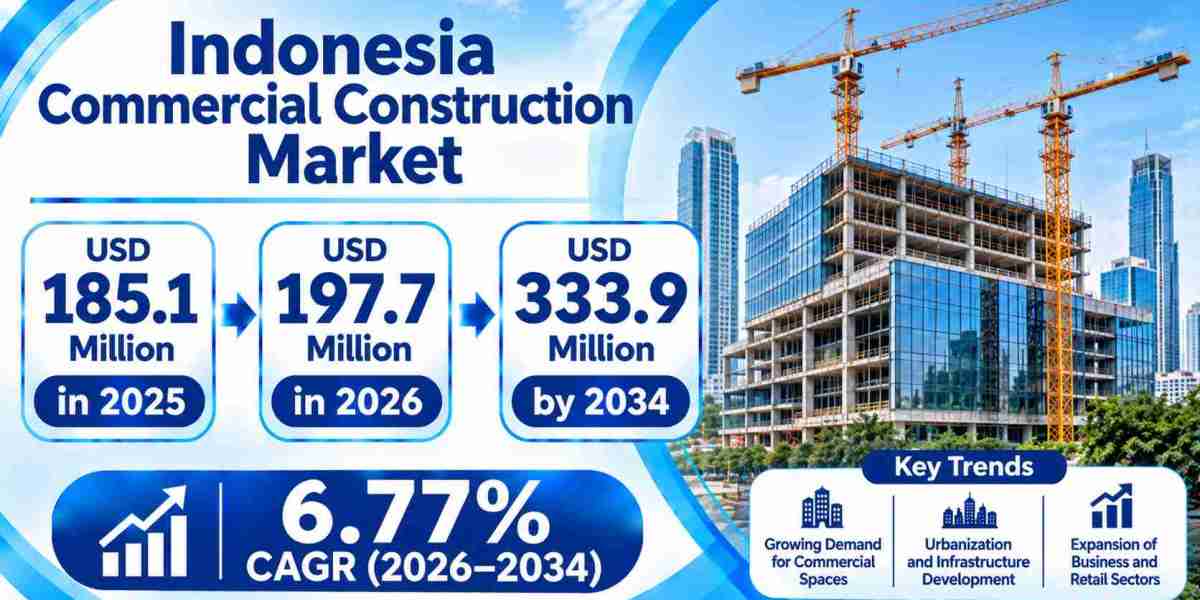
IMARC Group, a leading global market research and management consulting firm, has published its latest market intelligence report on the Indonesia Commercial Construction Market. The Indonesia commercial construction market size increased from USD 185.1 Million in 2025 to USD 197.7 Million in 2026 and is projected to reach USD 333.9 Million by 2034, exhibiting a CAGR of 6.77% during 2026-2034. Growth is being driven by the growing demand for malls, shopping centers, and retail outlets, an increasing focus on the construction of schools, colleges, and training centers, and favorable government initiatives.
Commercial construction covers the planning, design, and building of offices, retail spaces, hotels, restaurants, institutional facilities, and industrial warehouses, creating the spaces where Indonesians work, shop, dine, learn, and stay. As the country pushes ahead with urbanization, tourism growth, and public programs for schools and health facilities, demand for commercial buildings is climbing steadily across Java, Sumatra, Kalimantan, Sulawesi, and the other regions. At the same time, e-commerce is driving distribution centers and logistics hubs, building information modeling is improving efficiency, and developers are adopting more sustainable building practices. Combined with strong government backing through public works budgets, institutional building programs, and incentives for real estate development, these forces are reshaping the competitive landscape and setting the stage for steady, long-term growth across the archipelago.
Indonesia Commercial Construction Market at a Glance:
- Market Size (2025): USD 185.1 Million
- Market Size (2026): USD 197.7 Million
- Market Forecast (2034): USD 333.9 Million
- Growth Rate (2026-2034): CAGR of 6.77%
- Base Year: 2025 | Historical Period: 2020-2025 | Forecast Period: 2026-2034
How AI is Reshaping the Future of the Indonesia Commercial Construction Market
- Building Information Modeling Adoption: The rising adoption of construction technology such as building information modeling is enhancing the efficiency and quality of projects in Indonesia, according to the report. BIM supports coordinated design, clash detection, and cost control, which is increasingly valuable on large commercial and institutional developments.
- Digital Infrastructure Driving New Building Types: Data centers are growing across Southeast Asia's biggest digital economy, with colocation inventory in Jakarta having tripled since 2021 according to JLL, creating demand for specialized commercial facilities alongside offices and warehouses.
- Efficient and Sustainable Building Practices: Advancements in technologies are enabling more efficient and sustainable building practices, and developers are focusing on quality, higher-grade buildings. Colliers noted in Q3 2026 that tenants are increasingly choosing high-quality offices, with Grade A buildings near 78% occupancy and premium buildings approaching 84%.
Grab a sample PDF of this report: https://www.imarcgroup.com/indonesia-commercial-construction-market/requestsample
Indonesia Commercial Construction Market Trends and Drivers:
Demand for commercial construction across Indonesia is being underpinned by growing demand for commercial infrastructure on account of urbanization. Jakarta's office market is showing early signs of recovery: Colliers reported central business district occupancy of about 76.3% in the third quarter of 2026, with leasing driven by relocations to higher-quality space and selective expansion, and JLL reported net Grade A absorption of more than 25,000 sq m, led by technology companies. The supply pipeline has also thinned, with JLL noting no new CBD office buildings completed in the first quarter of 2026 and none expected for two years.
The market's structural differentiator is the strength of logistics and warehouse construction. Modern warehouse occupancy in Greater Jakarta reached 97% in the third quarter of 2026, according to JLL, supported by e-commerce and manufacturing relocation, and Colliers expects warehouse supply to reach about 3.2 million sq m by the end of 2026 from 3.1 million sq m in Q3, with the East Corridor accounting for 83% of future supply. New completions included KIIC Warehouse 4 in Karawang, about 45,000 sq m, and MMP Block H in Cibitung, about 18,000 sq m.
A third driver is tourism, retail, and public institutional building. Rising construction of hotels, resorts, and entertainment venues accommodates tourists, and foreign tourist arrivals reached 7.45 million in the first half of 2026, up 5.71%. At the same time, government programs are driving institutional construction, including the Sekolah Rakyat boarding schools and an upgrade of 10,000 community health centers, while the report notes rising construction of hospitals, clinics, and medical facilities, a dynamic that is set to intensify over the coming decade.
Government Schemes and National Vision Programs Driving Demand:
- Ministry of Public Works 2026 Budget: The Ministry of Public Works has a 2026 budget of Rp 118.5 trillion, almost USD 7 billion, up about 38% from Rp 86 trillion in 2025, for priority programs including road, dam, and bridge construction. Analysts note that the 2026 budget gives priority to social spending, with much infrastructure funding channeled through state-owned enterprises, public-private partnerships, and the sovereign wealth fund Danantara.
- Sekolah Rakyat (People's Schools): The tuition-free boarding school program targets construction of 104 schools in 2026, and the second phase of construction covers 100 locations across 32 provinces. The Sekolah Rakyat Integrated School 2 in Surabaya, built on 6.6 hectares, has a construction contract of Rp 3.52 trillion, about USD 212 million.
- Health and School Facility Upgrades: The government plans to upgrade 10,000 community health centers and renovate schools nationwide, accelerating the program in 2027 and 2028 so that no child studies in classrooms with leaking roofs, cracked walls, or unsafe conditions.
- Village and Urban Cooperatives Merah Putih: About 80,000 Village and Urban Cooperatives had been established by August 2025, and the government targeted 40,000 operating by the end of 2026, creating demand for local commercial and logistics buildings for retail, storage, and services in villages.
- Hotel Development Controls and Destination Diversification: Bali's moratorium on new hotels in saturated districts is diverting hospitality development capital toward Lombok, Raja Ampat, and Labuan Bajo, according to JLL, spreading commercial construction to new tourism destinations.
Indonesia Commercial Construction Market Industry Segmentation:
The report has segmented the market into the following categories:
Breakup By Type:
- Office Building Construction
- Retail Construction
- Hospitality Construction
- Institutional Construction
- Others
The report provides a detailed breakup and analysis of the market by type, covering office building construction, retail construction, hospitality construction, institutional construction, and others. Offices are stabilizing at about 7.4 million sq m of stock in Jakarta, retail is seeing selective additions such as a new shopping centre of about 16,000 sq m in East Jakarta in the third quarter of 2026, hospitality is spreading to new destinations, institutional building is expanding through schools and health centers, and warehouses and logistics hubs fall within others.
Breakup By Region:
- Java
- Sumatra
- Kalimantan
- Sulawesi
- Others
The report provides a comprehensive analysis of all major regional markets, including Java, Sumatra, Kalimantan, Sulawesi, and others. Java dominates commercial activity, with Jakarta's offices and malls and the logistics corridor through Karawang, Cibitung, and Bekasi, while institutional programs such as Sekolah Rakyat extend construction across 32 provinces and tourism is spreading construction to Lombok, Labuan Bajo, and other destinations.
Competitive Landscape:
The report has provided a comprehensive analysis of the competitive landscape in the Indonesia commercial construction market, covering market structure, key player positioning, top winning strategies, a competitive dashboard, and a company evaluation quadrant, along with detailed profiles of all major companies. Competition is shaped by contractors, developers, and project owners competing on quality, speed, technology adoption, and the ability to deliver large public and private projects.
What Does The Full Report Cover?
- Historical, current, and forecast market size for the Indonesia commercial construction market from 2020 to 2034
- Market breakup by type and region
- Type analysis covering office building, retail, hospitality, and institutional construction, and others
- Regional analysis covering Java, Sumatra, Kalimantan, Sulawesi, and other regions
- Key driving factors, challenges, and opportunities shaping the Indonesia commercial construction market
- Porter's Five Forces analysis assessing new entrants, competitive rivalry, supplier power, buyer power, and threat of substitution
- Competitive landscape, market structure, and detailed profiles of major companies
Recent News and Developments in the Indonesia Commercial Construction Market
- January 2026: JLL's 2026 outlook reported that Jakarta office demand returned to pre-pandemic levels in 2025, rental growth turned positive after a decade of compression, and the supply pipeline had thinned, while around two million sq m of office space remains vacant after a decade of heavy new supply.
- August 2026: Finance Minister Purbaya Yudhi Sadewa reaffirmed state budget support for the Sekolah Rakyat program during a visit to Sekolah Rakyat Integrated School 2 in Surabaya, which has a construction contract of Rp 3.52 trillion.
- October 2026: The Ministry of Public Works announced the expansion of Sekolah Rakyat construction to 100 locations across 32 provinces in the second phase, with infrastructure quality described as the top priority.
- October 2026: Colliers reported in its Q3 2026 review that Jakarta CBD office occupancy reached about 76.3%, with oil and gas, technology, and logistics firms contributing to selective expansion demand, and projected demand of 198,555 sq m for 2026.
- November 2026: JLL reported that modern warehouse occupancy in Greater Jakarta reached 97% in Q3 2026, Grade A CBD offices recorded net absorption of more than 25,000 sq m, and a new shopping centre of about 16,000 sq m opened in East Jakarta.
Note: If you require specific details, data, or insights that are not currently included in the scope of this report, we are happy to accommodate your request. As part of our customization service, we will gather and provide the additional information you need, tailored to your specific requirements. Please let us know your exact needs, and we will ensure the report is updated accordingly to meet your expectations.
Key Questions This Report Answers
- What is the current size of the Indonesia commercial construction market?
- What is the expected growth rate of the Indonesia commercial construction market during 2026-2034?
- What factors are driving the growth of the Indonesia commercial construction market?
- Which segments are covered in the Indonesia commercial construction market report?
- What is the breakup of the Indonesia commercial construction market by type and region?
- Who are the key players in the Indonesia commercial construction market, and how is the competitive landscape evolving?
- What role are BIM, institutional programs, and logistics construction playing in the future of Indonesia commercial construction?
About Us
IMARC Group is a global management consulting firm that helps the world's most ambitious changemakers to create a lasting impact. The company provides a comprehensive suite of market entry and expansion services. IMARC offerings include thorough market assessment, feasibility studies, company incorporation assistance, factory setup support, regulatory approvals and licensing navigation, branding, marketing and sales strategies, competitive landscape and benchmarking analyses, pricing and cost research, and procurement research.
Media and Sales Contact
IMARC Group
Email: sales@imarcgroup.com
United States: +1-201-971-6302
India: +91-120-433-0800
United Kingdom: +44-753-714-6104