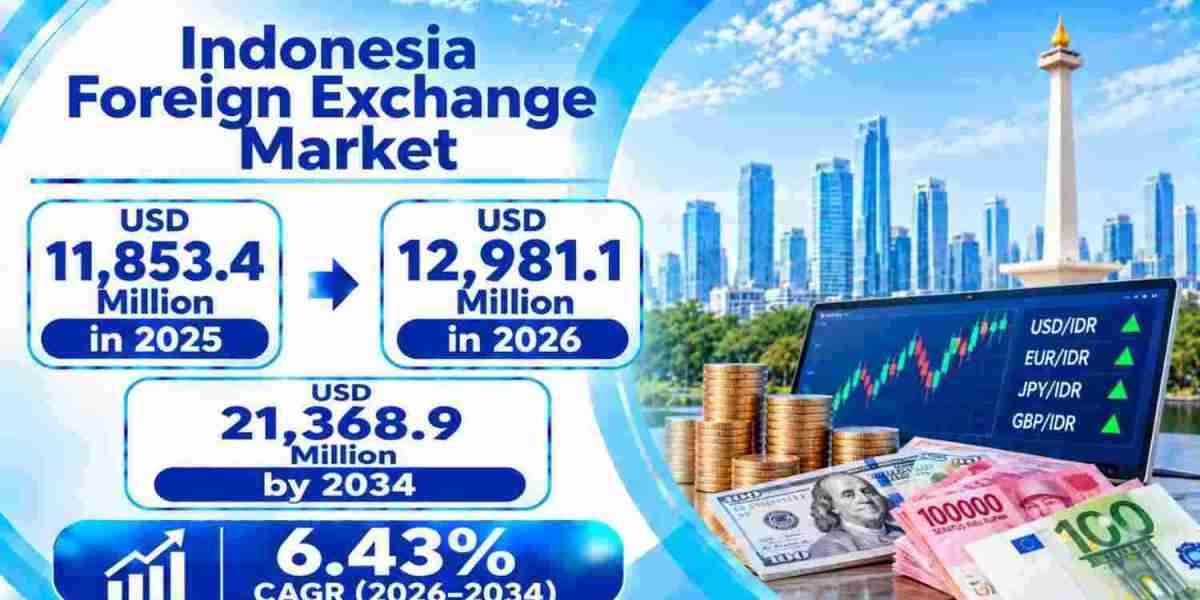
IMARC Group, a leading global market research and management consulting firm, has published its latest market intelligence report on the Indonesia foreign exchange market. The Indonesia foreign exchange market size reached USD 11,853.4 Million in 2025, is estimated at USD 12,981.1 Million in 2026, and is projected to reach USD 21,368.9 Million by 2034, exhibiting a CAGR of 6.43% during 2026-2034. Growth is being driven by rising cross-border trade, Bank Indonesia's sustained efforts to maintain rupiah exchange rate stability, deeper participation from institutional and foreign investors, and the rapid adoption of digital trading and payment platforms that are improving liquidity and execution efficiency.
Indonesia's foreign exchange market is being reshaped by a combination of structural reforms, commodity-linked capital flows, and an increasingly active central bank. As one of Southeast Asia's largest commodity exporters, the country channels billions of dollars in export proceeds through its domestic financial system every month, creating steady demand for spot, forward, and swap transactions. Bank Indonesia has spent the past two years building out market infrastructure, from Domestic Non-Deliverable Forward (DNDF) contracts cleared through a central counterparty to a network of FX Primary Dealers and new electronic trading platforms. At the same time, bilateral Local Currency Transaction (LCT) frameworks with Asian partners are diversifying settlement away from the U.S. dollar, while external shocks such as U.S. Federal Reserve policy shifts and geopolitical tensions keep hedging needs high among corporates and investors. Together, these forces are driving Indonesia foreign exchange market trends and steadily widening the market's participant base and transaction depth.
Indonesia Foreign Exchange Market at a Glance:
- Market Size (2025): USD 11,853.4 Million
- Market Size (2026): USD 12,981.1 Million
- Forecast Market Size (2034): USD 21,368.9 Million
- CAGR (2026-2034): 6.43%
- Counterparties Covered: Reporting Dealers, Other Financial Institutions, Non-financial Customers
- Types Covered: Currency Swap, Outright Forward and FX Swaps, FX Options
- Regions Covered: Java, Sumatra, Kalimantan, Sulawesi, Others
How AI is Reshaping the Future of the Indonesia Foreign Exchange Market
- AI-Driven Supervision and Policy Analytics: Bank Indonesia has deployed artificial intelligence for the analysis and projection of key economic indicators and within its supervisory technology, using AI-supported behaviour analysis and network analysis to detect liquidity pressures and monitor interlinkages among market participants. The central bank has stated it will continue to expand AI and machine learning based data innovation across its monetary, macroprudential, and payment system functions, strengthening its ability to read and respond to rupiah market stress.
- Predictive FX Pricing for Corporates: Bank Mandiri's Kopra by Mandiri platform offers a multi-currency foreign exchange transaction management system equipped with predictive algorithms to optimize exchange rates and reduce fluctuation risks, with API integration and real-time analytics dashboards. International coal traders such as Sakari Resources Limited and Tiger Energy Trading have used the platform to streamline cross-border payments, illustrating how algorithmic pricing is moving into everyday corporate FX execution.
- Governed AI Adoption in Treasury and Banking: In 2025, the Financial Services Authority (OJK) published its Artificial Intelligence Governance for Indonesian Banking guideline, setting minimum expectations for how banks develop, oversee, and audit AI systems. Demand is clearly there: HSBC's Voices of Treasury 2025 report found that Indonesian treasurers see significant benefits from AI in cash flow projections and predicting hedging needs, even as 48% cited cybersecurity as the biggest hurdle to real-time treasury, the highest share among markets polled.
Grab a sample PDF of this report: https://www.imarcgroup.com/indonesia-foreign-exchange-market/requestsample
Indonesia Foreign Exchange Market Trends and Drivers:
The core driver of the Indonesia foreign exchange market is the country's expanding trade and capital flow base, combined with a rapidly digitalizing investor population. Export proceeds from natural resources alone run at around USD 13-15 billion per month, while portfolio inflows, foreign direct investment, and external borrowing generate continuous demand for conversion and hedging. On the retail side, Indonesia had about 212 Million internet users as of January 2025, accounting for 74.6% of the population, and mobile trading apps and fintech platforms offering competitive spreads and real-time analytics are bringing millennials and tech-savvy individuals into a market that was once dominated by institutional players.
Indonesia's structural differentiator is the sensitivity of the rupiah to commodity cycles and global risk sentiment, which keeps volatility, and therefore hedging demand, persistently high. The rupiah ended 2024 at IDR 16,095 per U.S. dollar, compared with IDR 15,397 at the end of 2023 and IDR 12,385 a decade earlier, and traded at Rp17,985 per U.S. dollar on October 20, 2026, with Bank Indonesia attributing recent pressure to Middle East tensions, a hawkish U.S. Federal Reserve trajectory, and risk-off sentiment among foreign equity investors. Swings in crude oil and palm oil prices and China's economic trajectory feed directly into Indonesia's trade balance, making currency swaps, outright forwards, and FX options essential risk management tools for exporters, importers, and investors alike.
Policy and market infrastructure reform form the third major growth pillar. Bank Indonesia's Blueprint for Money Market and Foreign Exchange Market Deepening (BPPU) 2030 targets a modern, liquid, and digitally integrated market, and the central bank has backed this with FX Primary Dealers, CCP-cleared DNDF contracts, margin rules for non-centrally cleared derivatives, and generous hedging incentives. Government regulation is also anchoring foreign currency liquidity onshore through mandatory export proceeds retention, while the LCT framework is broadening the range of currency pairs actively traded in the domestic market, setting the stage for the national programs outlined below.
Government Schemes and National Policy Initiatives Driving Demand:
- Government Regulation (PP) No. 8 of 2025 on Natural Resource Export Proceeds (DHE SDA): Effective 1 March 2025, the regulation requires 100% of natural resource export proceeds valued at or above USD 250,000 to be placed in the Indonesian financial system, with the retention requirement for non-oil and gas resources raised from 30% for 3 months to 100% for 12 months. Bank Indonesia reports placements in special accounts of around USD 11-12 billion per month, equivalent to 87-89% of total natural resource exports, with exporter compliance of 94% for non-oil and gas and 100% for oil and gas.
- Bank Indonesia Hedging Incentive Package (DNDF and Buy Swap): Since June 2026, Bank Indonesia has offered premium reductions on DNDF and conventional hedging buy swap instruments for foreign funding transactions, and in October 2026 raised the DNDF premium reduction from 25% to 40% for 6-month tenors and from 30% to 45% for 12-month tenors. The package had attracted USD 9.9 billion in foreign capital inflows as of 20 October 2026.
- Local Currency Transaction (LCT) Framework: Indonesia operates LCT cooperation with Malaysia, Thailand, Japan, China, South Korea, the United Arab Emirates, and, from August 2026, Singapore. LCT transaction value reached the equivalent of USD 25.7 billion in 2025 and USD 52.57 billion in January-September 2026, a 186.79% year-on-year increase, supported by local currency bilateral swap arrangements including CNY 400 billion with the People's Bank of China and KRW 10.7 trillion with the Bank of Korea.
- Blueprint for Money Market and FX Market Deepening (BPPU) 2030: Bank Indonesia's roadmap sets five visions, including a modern market integrated with pro-market monetary operations, varied and liquid products with efficient pricing, interconnected and interoperable infrastructure, and granular, real-time market data. Delivery milestones include FX Primary Dealers launched in the second half of 2025, standardized DNDF transactions cleared via a Central Counterparty in line with G20 OTC derivatives reform, and margin requirements for non-centrally cleared derivatives effective 1 September 2025.
- P2SK Law Transfer of FX Derivatives Supervision: Under Law No. 4 of 2023 on the Development and Strengthening of the Financial Sector and Government Regulation No. 49 of 2024, regulation and supervision of money market and foreign exchange market derivatives moved from Bappebti to Bank Indonesia on 10 January 2025, while OJK took over capital market derivatives and digital financial assets, applying a same activity, same risk, same regulation principle. Indonesia's foreign exchange reserves stood at USD 156.5 billion at the end of December 2025, equivalent to 6.4 months of imports, giving Bank Indonesia ample capacity to back these reforms.
Indonesia Foreign Exchange Market Industry Segmentation:
The report has segmented the market into the following categories:
Breakup By Counterparty:
- Reporting Dealers
- Other Financial Institutions
- Non-financial Customers
The report provides a detailed breakup and analysis of the market by counterparty. Reporting dealers, including the banks appointed as FX Primary Dealers and Appointed Cross-Currency Dealers, form the interbank core of price discovery and liquidity provision, while other financial institutions such as asset managers and insurers are drawing on DNDF and swap instruments to hedge portfolio exposure. Non-financial customers, particularly commodity exporters and import-dependent manufacturers, are a growing source of flow as export proceeds retention rules and LCT settlement bring more corporate FX activity onshore.
Breakup By Type:
- Currency Swap
- Outright Forward and FX Swaps
- FX Options
The report includes a detailed breakup and analysis of the market by type. Outright forwards and FX swaps are central to Indonesia's hedging ecosystem, given Bank Indonesia's active use of DNDF contracts and conventional swap facilities to stabilize the rupiah and attract foreign funding. Currency swaps support longer-dated corporate and bank funding needs, while FX options remain a developing segment with scope to expand as market depth, pricing transparency, and risk management capabilities improve under the BPPU 2030 roadmap.
Breakup By Region:
- Java
- Sumatra
- Kalimantan
- Sulawesi
- Others
The report also provides a comprehensive analysis of all major regional markets. Java, home to Jakarta's banking headquarters, financial markets infrastructure, and a large share of corporate and retail activity, anchors national FX trading, while resource-rich Sumatra, Kalimantan, and Sulawesi generate substantial export-linked foreign currency flows from coal, palm oil, and mineral processing that feed conversion and hedging demand.
Competitive Landscape:
The competitive landscape includes established players, emerging businesses, and specialized providers, competing on product quality, innovation, pricing, distribution, and customer service. Companies strengthen their presence by enhancing offerings, improving efficiency, expanding distribution, and adapting to consumer preferences. Technology, regulation, and shifting demand also shape strategies, driving greater emphasis on differentiation, value creation, and customer-centric approaches.
What Does The Full Report Cover?
- Historical market performance from 2020-2025 and forecasts for 2026-2034 for the Indonesia foreign exchange market
- Market size and growth analysis by counterparty, covering reporting dealers, other financial institutions, and non-financial customers
- Detailed breakup by type, including currency swap, outright forward and FX swaps, and FX options
- Regional analysis across Java, Sumatra, Kalimantan, Sulawesi, and others
- Key market drivers, challenges, and opportunities, including digitalization, exchange rate volatility, and regulatory reforms
- Value chain analysis and Porter's five forces assessment of the Indonesia foreign exchange industry
- Competitive landscape covering market structure, key player positioning, top winning strategies, and company profiles
Recent News and Developments in Indonesia Foreign Exchange Market
- March 2025: Indonesia implemented Government Regulation No. 8 of 2025, mandating that exporters of natural resources keep all foreign exchange earnings within the domestic financial system for at least one year, and Bank Indonesia issued Regulation No. 3 of 2025, effective 1 March 2025, adding foreign currency securities (SVBI) and sukuk (SUVBI) as placement instruments to strengthen reserves and onshore FX liquidity.
- June 2025: Bank Mandiri highlighted its Kopra by Mandiri digital platform for international transactions, featuring multi-currency FX management with predictive algorithms to optimize exchange rates, API integration, and real-time monitoring, already used by coal companies Sakari Resources Limited and Tiger Energy Trading.
- April 2026: Indonesia Stock Exchange's Alternative Market Operator System (SPPA), licensed by Bank Indonesia as an Intermarket Electronic Trading Platform in November 2025, went live on 1 April 2026 as the quotation platform for Money Market and Foreign Exchange (PUVA) Primary Dealers, with 13 of the 21 appointed primary dealers already using the system.
- August 2026: Bank Indonesia and the Monetary Authority of Singapore operationalized their Local Currency Transaction framework, enabling direct rupiah and Singapore dollar quotations and settlement through appointed cross-currency dealers, including Bank Mandiri, Bank Central Asia, and Bank Negara Indonesia on the Indonesian side and DBS, OCBC, and UOB in Singapore.
- October 2026: Bank Indonesia held the BI-Rate at 5.75% and expanded DNDF hedging incentives, raising premium reductions to 40% for 6-month and 45% for 12-month tenors, after reporting that its hedging incentive package had drawn USD 9.9 billion in foreign capital inflows since June 2026.
Note: If you require specific details, data, or insights that are not currently included in the scope of this report, we are happy to accommodate your request. As part of our customization service, we will gather and provide the additional information you need, tailored to your specific requirements. Please let us know your exact needs, and we will ensure the report is updated accordingly to meet your expectations.
Key Questions This Report Answers
- How has the Indonesia foreign exchange market performed so far, and how will it perform from 2026 to 2034?
- What is the breakup of the Indonesia foreign exchange market by counterparty, including reporting dealers, other financial institutions, and non-financial customers?
- How is the market split across currency swap, outright forward and FX swaps, and FX options?
- Which regions, including Java, Sumatra, Kalimantan, and Sulawesi, account for the largest share of FX activity?
- How are Bank Indonesia's DNDF incentives, export proceeds retention rules, and LCT expansion shaping market demand?
- What are the key driving factors and challenges in the Indonesia foreign exchange market?
- What is the structure of the market, who are the key players, and what is the degree of competition?
About Us
IMARC Group is a global management consulting firm that helps the world's most ambitious changemakers to create a lasting impact. The company provides a comprehensive suite of market entry and expansion services. IMARC offerings include thorough market assessment, feasibility studies, company incorporation assistance, factory setup support, regulatory approvals and licensing navigation, branding, marketing and sales strategies, competitive landscape and benchmarking analyses, pricing and cost research, and procurement research.
Media and Sales Contact
IMARC Group
Email: sales@imarcgroup.com
United States: +1-201-971-6302
India: +91-120-433-0800
United Kingdom: +44-753-714-6104