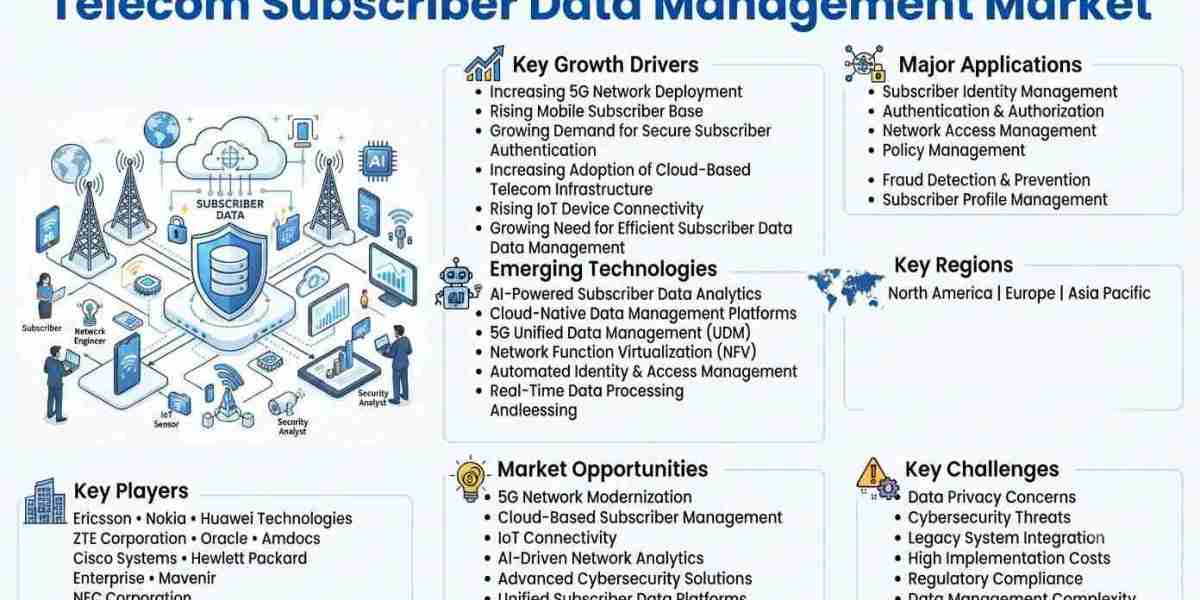
According to Transpire Insight, the Telecom Subscriber Data Management Market size is estimated at USD 7.7 Billion in 2026 and is anticipated to reach USD 17.71 Billion by 2033, growing at a CAGR of 12.64% from 2026 to 2033. The growth will be fueled by increasing 5G network deployment, rising mobile subscriber numbers, growing demand for secure subscriber authentication, and the need for efficient management of subscriber information.
The market is expected to benefit from increasing adoption of cloud-based telecom infrastructure, expansion of IoT connectivity, and growing investments in network modernization. Advancements in AI-powered data analytics, cloud-native platforms, and automated subscriber management solutions are also creating new opportunities for manufacturers and service providers.
Why the Telecom Subscriber Data Management Market Is Influencing the Telecommunications Industry
Subscriber data management plays an important role in modern telecommunications infrastructure by providing centralized systems for storing, managing, and accessing subscriber information. Solutions such as Home Subscriber Server (HSS), Home Location Register (HLR), Unified Data Management (UDM), and User Data Repository (UDR) support subscriber authentication, authorization, and service delivery.
As telecom operators expand their networks and introduce advanced digital services, managing subscriber information across multiple platforms becomes increasingly important. Efficient data management helps improve service availability, support seamless connectivity, and maintain consistent customer experiences. The growing transition toward 5G and cloud-native network infrastructure is further increasing demand for advanced subscriber data management solutions.
Read more: https://www.transpireinsight.com/report/telecom-subscriber-data-management-market
Key Factors Supporting Telecom Subscriber Data Management Market Growth
Expansion of 5G Networks and Mobile Connectivity
The growing deployment of 5G networks is a major factor supporting market expansion. Telecom operators require advanced subscriber management systems to handle increasing data traffic, connected devices, and complex network requirements. The growing adoption of Internet of Things (IoT) applications is also increasing the need for scalable systems capable of managing large subscriber databases.
Rising Demand for Network Security and Subscriber Authentication
Increasing concerns regarding data privacy, identity protection, and network security are encouraging telecom operators to invest in advanced subscriber data management solutions. These platforms support secure authentication, access control, and subscriber identity management. Growing cybersecurity requirements are further encouraging the adoption of centralized and reliable data management infrastructure.
Growing Adoption of Cloud-Based Telecom Infrastructure
Telecommunications companies are increasingly adopting cloud-native network architectures to improve scalability, operational flexibility, and resource utilization. Cloud-based subscriber data management solutions allow operators to manage subscriber information across distributed network environments while supporting faster service deployment and infrastructure modernization.
Key Players in the Telecom Subscriber Data Management Market
Ericsson
Nokia Corporation
Huawei Technologies
ZTE Corporation
Oracle Corporation
Amdocs
Cisco Systems
Hewlett Packard Enterprise
Mavenir
NEC Corporation
Segmentation of the Telecom Subscriber Data Management Market
By Component
Solutions
Services
By Deployment Mode
On-Premises
Cloud-Based
By Application
Subscriber Authentication and Authorization
Subscriber Identity Management
Network Management
Policy Management
Fraud Detection and Security
By End User
Mobile Network Operators
Telecom Service Providers
Virtual Network Operators
Communication Service Providers
How Technological and Industry Developments Are Changing Demand
Integration of 5G and Cloud-Native Technologies
The development of cloud-native subscriber management platforms is improving network flexibility and scalability. Technologies such as microservices and containerization allow telecom operators to deploy and manage subscriber data functions more efficiently. These developments are particularly important for supporting advanced 5G standalone network architectures.
Artificial Intelligence and Data Analytics
Artificial intelligence and advanced analytics are creating opportunities to improve subscriber data management. These technologies can help telecom operators identify unusual network activity, analyze subscriber behavior, improve service personalization, and support predictive network operations.
Regional Patterns and Emerging Demand in the Telecom Subscriber Data Management Market
North America represents an important market due to its advanced telecommunications infrastructure, growing 5G deployment, and investments in cloud-based network technologies. Europe also contributes significantly through telecom modernization initiatives, digital connectivity programs, and increasing focus on network security.
Asia-Pacific is emerging as a promising region, supported by expanding mobile subscriber bases, increasing smartphone adoption, and large-scale 5G infrastructure investments in countries such as China, India, Japan, and South Korea. Growing demand for digital communication services is further encouraging telecom operators to upgrade subscriber management infrastructure.
Challenges Companies Need to Consider in the Telecom Subscriber Data Management Industry
Despite favorable growth prospects, the market faces challenges related to data security, integration complexity, and infrastructure modernization costs. Telecom operators often operate legacy systems alongside newer network technologies, making seamless data migration and integration difficult.
Additionally, increasing volumes of subscriber information create challenges related to data privacy, regulatory compliance, and system reliability. Maintaining interoperability across different network environments and technology platforms also requires continuous investment.
Future Opportunities in the Telecom Subscriber Data Management Market
The market is expected to benefit from expanding 5G standalone networks, increasing IoT connectivity, and the transition toward cloud-native telecommunications infrastructure. Developments in artificial intelligence, automated network management, and unified subscriber data platforms may create additional growth opportunities.
Furthermore, increasing investments in private 5G networks and advanced enterprise connectivity solutions could expand demand for scalable subscriber management systems. Collaborations between telecom operators, software providers, and network equipment manufacturers will remain important for developing innovative solutions.
What This Means for the Telecom Subscriber Data Management Industry
The expansion of the telecom subscriber data management market highlights the growing importance of efficient subscriber information management in modern telecommunications networks. Increasing 5G adoption, rising cybersecurity requirements, and cloud-based infrastructure modernization are creating new opportunities for technology providers. Companies investing in scalable platforms, advanced authentication systems, and AI-driven network solutions will be better positioned to capitalize on emerging demand. Going forward, monitoring network technology developments, data privacy regulations, and evolving telecom requirements will be essential for maintaining competitiveness in this rapidly changing industry.
Latest Reports:
https://in.pinterest.com/pin/1083819466608251121/
https://in.pinterest.com/pin/1083819466608208476/
https://in.pinterest.com/pin/1083819466608124660/
https://in.pinterest.com/pin/1083819466608093791/
https://www.quora.com/What-is-the-difference-between-Nutanix-and-VMware/answer/Devashish-217
https://www.quora.com/What-are-the-benefits-brought-by-the-railways/answer/Devashish-217