


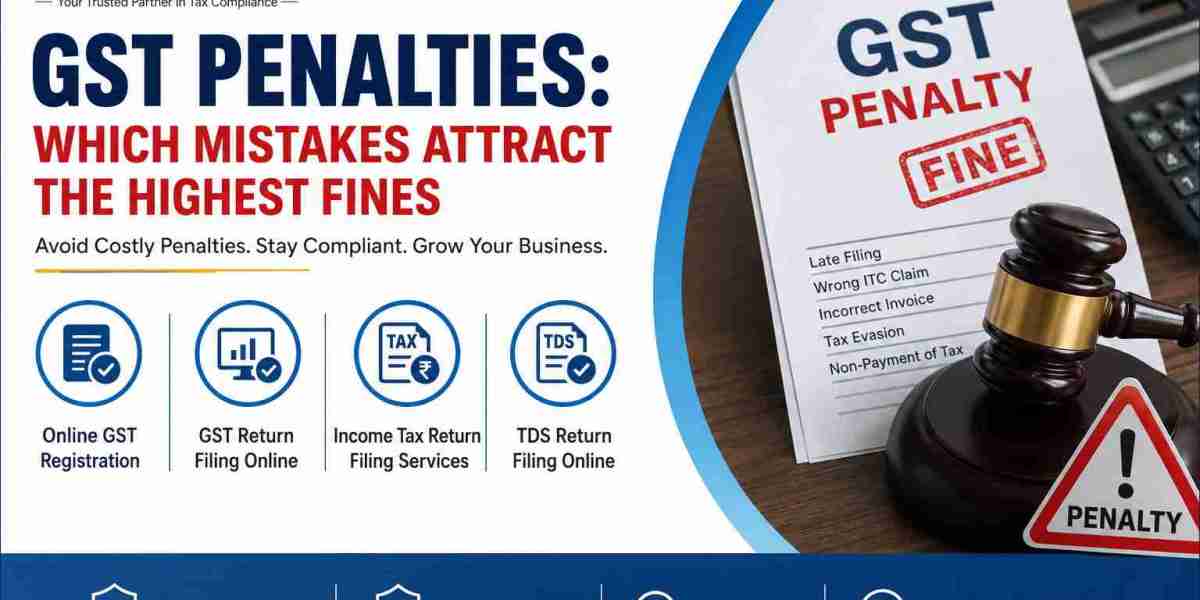
Running a business in India comes with many tax responsibilities. The Goods and Services Tax (GST) system has made taxation more transparent, but it also has strict rules. If a business fails to follow these rules, it may have to pay heavy penalties.
Many businesses receive GST notices because of small mistakes like filing returns late, issuing incorrect invoices, or claiming the wrong Input Tax Credit (ITC). While some penalties are small, others can reach 100% of the tax amount.
This blog explains the GST mistakes that attract the highest penalties, how these penalties are calculated, and how businesses can avoid them.
What Are GST Penalties?
GST penalties are fines imposed by the tax department when a registered taxpayer fails to follow GST laws. The purpose of these penalties is to encourage businesses to file returns on time, pay taxes correctly, and maintain proper records.
Depending on the type of mistake, penalties can range from a few hundred rupees to the entire amount of tax involved.
Common GST Mistakes That Attract Heavy Penalties
1. Late Filing of GST Returns
One of the most common mistakes is filing GST returns after the due date.
Businesses registered under GST must file returns regularly, even if there is no business activity during a particular month.
Penalty
- Late fee of ₹50 per day (₹25 CGST + ₹25 SGST)
- Nil return: ₹20 per day
- Interest at 18% per annum on unpaid tax
Timely GST Return Filing Online helps businesses avoid these unnecessary costs.
- Failure to Register Under GST
Businesses crossing the prescribed turnover limit must obtain GST registration within the required time.
Operating without registration is considered a serious violation.
Penalty
The penalty may be:
- ₹10,000, or
- 100% of the tax due,
whichever is higher.
Choosing Online GST Registration on time helps businesses avoid these penalties.
- Incorrect GST Invoice
GST invoices must contain all required details such as:
- GSTIN
- Invoice number
- Date
- Tax amount
- HSN/SAC code
- Customer details (where applicable)
Issuing incorrect or fake invoices can attract severe penalties.
Penalty
The taxpayer may have to pay:
- ₹10,000, or
- Tax amount involved,
whichever is higher.
- Claiming Wrong Input Tax Credit (ITC)
Input Tax Credit helps businesses reduce their tax liability. However, claiming ITC without valid invoices or using fake invoices is a major offence.
Common mistakes include:
- Claiming ITC twice
- Claiming ITC on blocked items
- Using fake invoices
- Claiming ITC without receiving goods
Penalty
Businesses may face:
- Recovery of tax
- Interest
- Penalty up to 100% of tax
- Non-Payment or Short Payment of GST
Sometimes businesses calculate GST incorrectly or intentionally pay less tax.
If the tax department detects underpayment, additional penalties may apply.
Penalty
For genuine mistakes:
- 10% of tax due
- Minimum ₹10,000
For fraud or intentional evasion:
- 100% of tax due
- Tax Evasion
Tax evasion is one of the most serious GST offences.
Examples include:
- Hiding sales
- Fake billing
- Fake purchases
- Maintaining false accounts
Penalty
Businesses may face:
- 100% penalty
- Interest
- Prosecution
- Imprisonment in serious cases
- Not Maintaining Proper Records
GST law requires businesses to keep books of accounts, invoices, stock records, and tax documents for the prescribed period.
Failure to maintain records can result in penalties.
Penalty
Up to ₹25,000 depending on the violation.
- Failure to Deduct or Deposit TDS Under GST
Certain government bodies and notified entities must deduct Tax Deducted at Source (TDS) under GST.
Failure to deduct or deposit TDS attracts penalties.
Businesses already using TDS Return Filing Online should ensure all tax deductions are deposited within the prescribed timelines.
- Obstructing GST Officers
If a taxpayer prevents GST officers from carrying out inspections or audits, penalties may be imposed.
Penalty
Up to ₹25,000.
- Failure to Issue Invoice
Every taxable supply must be supported by a valid GST invoice.
Failure to issue invoices may be treated as tax evasion.
Penalty
₹10,000 or tax amount involved, whichever is higher.
GST Penalty Chart
GST Mistake | Maximum Penalty |
Late GST Return | Late fee + Interest |
No GST Registration | ₹10,000 or 100% of tax |
Wrong GST Invoice | ₹10,000 or tax amount |
Wrong ITC Claim | Up to 100% of tax |
Short Payment of GST | 10% to 100% of tax |
Tax Evasion | 100% of tax + prosecution |
No Records | Up to ₹25,000 |
Failure to Issue Invoice | ₹10,000 or tax amount |
How to Avoid GST Penalties
Businesses can avoid penalties by following a few simple practices.
- Complete Online GST Registration as soon as eligibility arises.
- File GST returns before the due date.
- Verify invoices before claiming ITC.
- Maintain proper books of accounts.
- Pay GST on time.
- Reconcile GSTR-1, GSTR-3B, and purchase records regularly.
- Keep digital copies of invoices and tax records.
- Respond promptly to GST notices.
Importance of Professional GST Compliance
Many penalties occur because businesses are unaware of changing GST rules.
Professional experts can help businesses by:
- GST registration
- GST return filing
- GST notice handling
- Input Tax Credit reconciliation
- GST audit support
- Annual GST compliance
Many businesses also combine GST compliance with Income Tax Return Filing Services to manage all tax obligations efficiently.
How Corpbiz Can Help
Corpbiz offers complete GST compliance solutions for startups, SMEs, and large businesses across India.
Our services include:
- Online GST Registration
- GST Return Filing Online
- GST Notice Reply
- GST Advisory
- GST Audit Support
- Input Tax Credit Reconciliation
- Income Tax Return Filing Services
- TDS Return Filing Online
Our experienced tax professionals ensure your business remains compliant while reducing the risk of penalties and notices.
Conclusion
GST penalties can become expensive if businesses ignore compliance. Simple mistakes like late filing, incorrect invoices, wrong ITC claims, or delayed tax payments can result in heavy fines, interest, and even legal action.
Regular compliance, accurate record keeping, and timely return filing are the best ways to avoid penalties. Seeking professional support can further reduce compliance risks and help businesses focus on growth rather than tax disputes.
Frequently Asked Questions (FAQs)
1. What is the penalty for late GST return filing?
Late filing attracts a late fee of ₹50 per day (₹20 per day for nil returns) along with interest at 18% per annum on unpaid tax.
2. Can I be penalized for not taking GST registration?
Yes. If your business is required to register but fails to do so, the penalty can be ₹10,000 or 100% of the tax due, whichever is higher.
3. What happens if I claim the wrong Input Tax Credit?
You may have to reverse the ITC, pay interest, and face a penalty that can go up to 100% of the tax amount in cases involving fraud.
4. Is GST return filing mandatory even if there is no business?
Yes. Registered taxpayers generally need to file applicable GST returns even if there are no transactions during the tax period.
5. Can GST penalties be waived?
In certain cases, the government may provide relief through notifications or amnesty schemes. Otherwise, penalties apply as per GST law.
6. How can businesses reduce the risk of GST penalties?
By maintaining proper records, filing returns on time, paying taxes promptly, reconciling invoices regularly, and taking professional GST compliance assistance.
Author Profile
Atul Shukla
Senior Tax & Regulatory Compliance Writer
Atul Shukla is a legal and financial content writer with expertise in GST, taxation, company law, and regulatory compliance. She creates simple, practical, and SEO-friendly content that helps entrepreneurs and businesses understand complex legal requirements and stay compliant with Indian laws.



