University discussions about artificial intelligence have changed dramatically in just a few years. The biggest question is no longer whether students are using AI. Research now shows that AI use has become part of everyday academic life, forcing universities to rethink how learning should be assessed and how academic integrity should be protected.
According to recent Turnitin data covering Australian higher education, more than half of all university submissions contain some detectable level of AI assistance. At the same time, around one in ten submissions appear to be mostly AI-generated. Those figures suggest that universities can no longer rely on blanket bans or simple detection tools. Instead, they need policies that clearly explain when AI supports learning and when it replaces genuine student work.
AI Adoption Has Outpaced University Policies
Technology often moves faster than institutional rules. That is exactly what has happened with generative AI.
Students now use AI for brainstorming ideas, checking grammar, summarising readings, explaining difficult concepts, and creating study notes. These uses are very different from asking an AI system to produce an entire assignment, yet many students struggle to understand where universities draw the line.
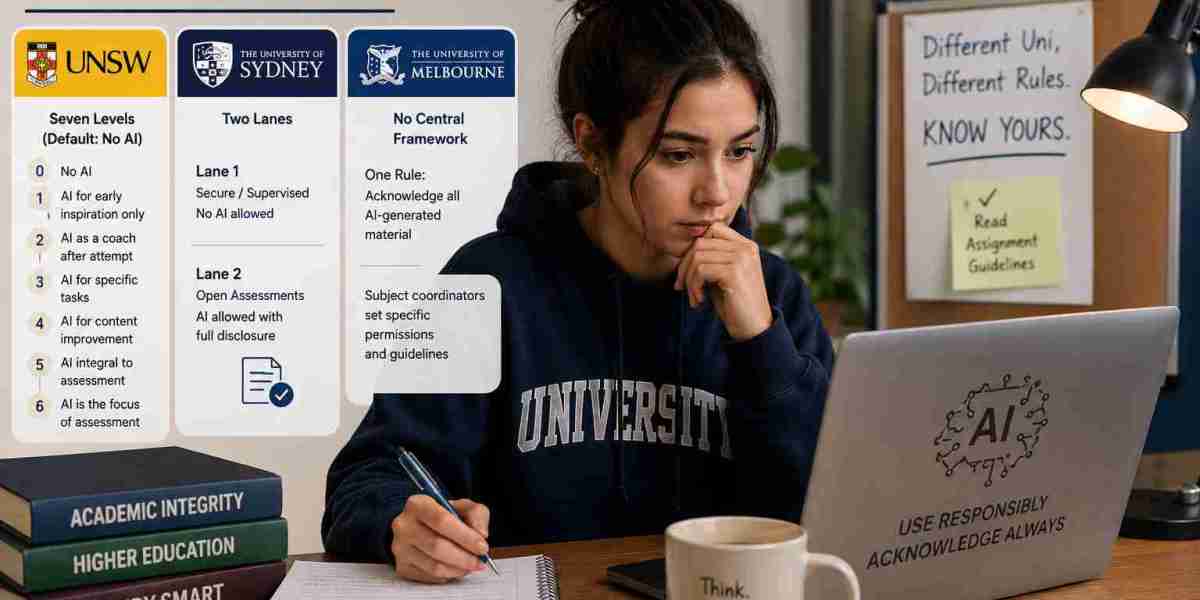
The research shows that Australian universities generally fall into three categories. Some prohibit AI use in assessed work altogether. Others allow limited use if students disclose how AI assisted them. A growing number are redesigning assessments with the expectation that students will use AI responsibly during the learning process.
This variety creates uncertainty. A practice that is acceptable in one university may lead to an academic misconduct investigation at another.
Detection Software Cannot Answer Every Question
AI detection tools remain an important part of academic integrity, but they have clear limitations.
Detection software estimates the likelihood that AI-generated content appears in a document. It cannot determine why AI was used or whether a student violated university policy. Someone who asked AI to improve sentence structure may receive a similar flag to someone who submitted mostly AI-written work, even though the situations are very different.
Research also highlights another challenge. Detection accuracy decreases when AI-generated text has been substantially revised. False positives can also occur, particularly for non-native English speakers. This makes it difficult for universities to depend entirely on automated detection when making academic integrity decisions.
As AI continues to improve, policy and educator judgement become just as important as technology.
Students Need Guidance, Not Guesswork
Many students are not trying to bypass learning. They are simply trying to understand which forms of AI assistance are acceptable.
The safest approach is to treat AI as a learning partner rather than a replacement author. Students can use AI to explain difficult theories, organise research ideas, or identify gaps in their understanding before completing the final work themselves.
When students need subject-specific guidance beyond what AI can provide, resources such as Expertsmind.com's network of academic experts can help clarify difficult concepts, explain assignment requirements, and support independent learning without replacing the student's own work. This aligns closely with the direction many universities are taking as they encourage responsible academic support instead of automated content generation.
Simple habits can also reduce academic risk. Keeping draft versions, saving research notes, and documenting how AI was used provide valuable evidence of genuine learning. Reading assignment-specific AI guidelines is equally important because individual units often have different expectations from university-wide policies.
Assessment Is Changing Alongside AI
Universities are increasingly recognising that detection alone cannot solve the challenges created by generative AI.
Instead of focusing only on the final written submission, many institutions are redesigning assessments to measure the learning process itself. Oral presentations, reflective journals, in-class writing exercises, project documentation, and staged assessments all make it easier to evaluate genuine understanding.
This shift benefits both students and educators. Rather than treating AI as an enemy, universities can encourage responsible use while still ensuring graduates develop the critical thinking, communication, and problem-solving skills employers expect.
The research suggests this trend will continue as institutions become more comfortable integrating AI into teaching while maintaining strong academic standards.
The Future of AI Policy
Artificial intelligence is unlikely to disappear from higher education. If anything, it will become even more deeply integrated into everyday study.
The challenge now is not deciding whether students should use AI but determining how they should use it responsibly. Clear policies, transparent expectations, and thoughtful assessment design will do far more to support academic integrity than relying on detection software alone.
Students who understand their university's AI policy, document their own work, and use AI to strengthen learning rather than replace it will be best prepared for this new academic environment. As universities continue adapting, responsible AI use is becoming less about avoiding technology and more about demonstrating genuine understanding throughout the learning process.