Artificial intelligence is changing the way organizations build, train, and deploy machine learning models. However, even the most advanced AI systems depend on one critical foundation: high-quality labeled data. As datasets continue to grow in size and complexity, traditional manual labeling methods often struggle to keep pace. This has led to the rapid adoption of AI-assisted image annotation, a smarter approach that combines automation with human expertise.
Today, businesses developing computer vision applications are increasingly partnering with a reliable data annotation company to accelerate dataset preparation while maintaining exceptional quality. AI-assisted annotation enables organizations to label millions of images faster, reduce operational costs, and improve consistency without sacrificing accuracy.
In this article, we'll explore how AI-assisted image annotation is transforming data labeling, its benefits, challenges, and why human oversight remains essential for enterprise AI projects.
What Is AI-Assisted Image Annotation?
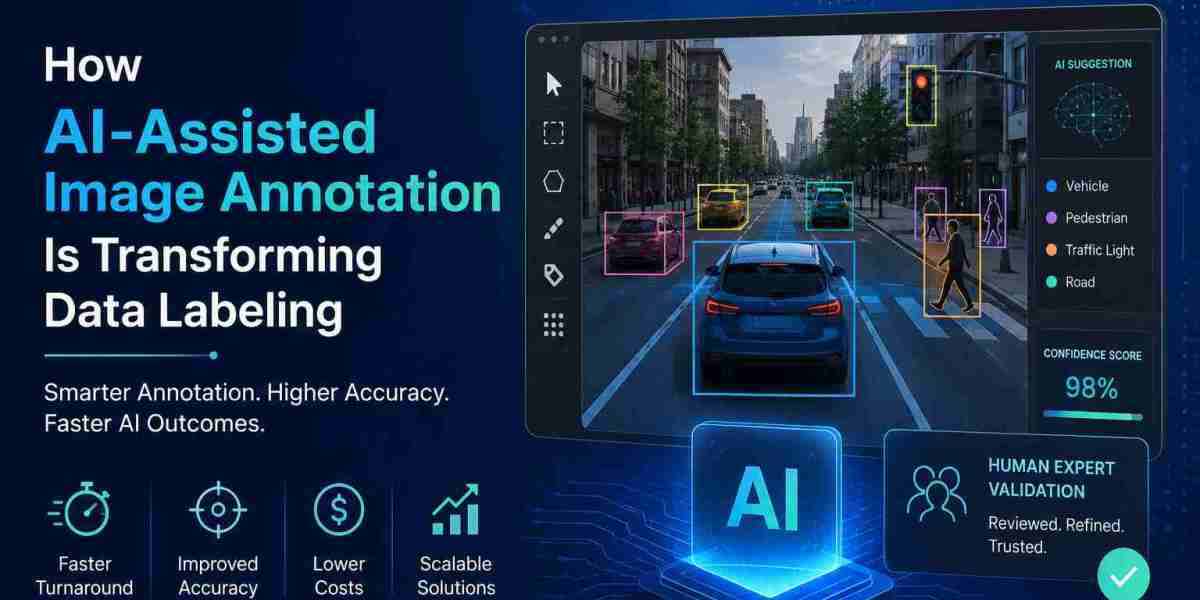
AI-assisted image annotation refers to the use of machine learning models to automate parts of the image labeling process. Instead of annotators manually drawing every bounding box, polygon, segmentation mask, or keypoint, AI algorithms generate initial annotations that human experts review, refine, and validate.
Unlike fully automated labeling, AI-assisted annotation follows a human-in-the-loop workflow where artificial intelligence speeds up repetitive tasks while skilled annotators ensure every label meets quality standards.
This hybrid approach significantly improves productivity while preserving the precision required for production-grade AI systems.
Why Traditional Image Annotation Faces Challenges
Manual image annotation has served the AI industry for years, but growing dataset requirements have introduced several limitations:
Large datasets containing millions of images require enormous manual effort.
Human labeling alone increases project timelines.
Repetitive tasks can reduce annotation consistency.
Complex objects demand specialized expertise.
Scaling annotation teams globally becomes expensive.
These challenges have encouraged organizations to adopt AI-assisted workflows that combine automation with human quality assurance.
How AI-Assisted Annotation Works
A typical AI-assisted image annotation workflow includes several stages:
1. Initial AI Prediction
Pre-trained computer vision models automatically detect objects, identify regions of interest, or generate segmentation masks.
2. Human Review
Professional annotators verify AI-generated labels, correcting inaccuracies, missed objects, and boundary errors.
3. Quality Assurance
Experienced reviewers inspect completed annotations using predefined quality metrics to ensure consistency across datasets.
4. Continuous Learning
Corrected annotations are fed back into AI models, improving prediction accuracy over time.
This continuous feedback loop enables annotation systems to become increasingly efficient while maintaining high-quality outputs.
Key Benefits of AI-Assisted Image Annotation
Faster Dataset Creation
Perhaps the biggest advantage is speed.
AI can automatically pre-label thousands of images in minutes. Human annotators only need to review and adjust predictions instead of creating annotations from scratch. This dramatically shortens project timelines.
Organizations working with autonomous vehicles, healthcare imaging, retail AI, and robotics can significantly accelerate model development using AI-assisted workflows.
Improved Annotation Consistency
Even experienced annotators may interpret complex objects differently.
AI models apply consistent prediction rules across large datasets, reducing variations in labeling. Human reviewers then ensure edge cases receive accurate treatment.
The result is more standardized datasets that improve model performance.
Lower Operational Costs
Manual labeling requires substantial labor, particularly for enterprise-scale datasets.
By automating repetitive annotation tasks, organizations reduce the amount of manual effort required while allowing experts to focus on quality control and complex scenarios.
Many businesses achieve even greater efficiencies through data annotation outsourcing, enabling access to experienced annotation teams and scalable resources without expanding internal operations.
Better Scalability
AI-assisted annotation makes it easier to scale projects involving millions of images.
Instead of hiring large temporary teams, organizations can leverage automated pre-labeling while maintaining manageable review workloads.
This flexibility allows projects to expand rapidly as business needs evolve.
Faster Model Improvement
Every corrected annotation becomes valuable training data.
As human reviewers refine AI-generated labels, annotation models learn from those corrections and gradually improve prediction quality. Over time, annotation becomes faster, smarter, and more accurate.
Industries Benefiting from AI-Assisted Image Annotation
AI-assisted annotation supports a wide range of computer vision applications.
Autonomous Vehicles
Self-driving systems require accurate labeling of vehicles, pedestrians, cyclists, traffic signs, road markings, and environmental conditions.
AI-assisted annotation speeds up the processing of massive driving datasets while ensuring safety-critical accuracy.
Healthcare
Medical AI relies on precisely annotated X-rays, MRIs, CT scans, pathology slides, and ultrasound images.
Human experts validate AI-generated annotations to maintain diagnostic precision.
Retail
Retail AI solutions use image annotation for inventory tracking, shelf monitoring, product recognition, and customer behavior analysis.
Automated labeling accelerates large-scale retail dataset creation.
Manufacturing
Factories deploy computer vision for defect detection, quality inspection, and predictive maintenance.
AI-assisted annotation enables faster development of industrial vision models with consistent labeling standards.
Agriculture
Crop monitoring, disease detection, weed identification, and yield estimation all depend on accurately annotated aerial and ground imagery.
AI-assisted workflows help process agricultural datasets efficiently across diverse environments.
Why Human Expertise Still Matters
Despite impressive advances, AI cannot completely replace experienced annotators.
AI models may struggle with:
Rare edge cases
Occluded objects
Poor lighting conditions
Overlapping objects
Unfamiliar environments
Domain-specific interpretation
Human reviewers provide contextual understanding that machines cannot reliably replicate.
This is why leading organizations partner with an experienced image annotation company that combines AI-powered automation with skilled human annotators.
The most successful annotation strategies are not AI-only—they are AI-assisted and human-validated.
Choosing the Right AI-Assisted Annotation Partner
Selecting the right annotation provider is essential for building reliable AI datasets.
Look for a provider that offers:
AI-assisted annotation workflows
Human-in-the-loop quality assurance
Multi-stage review processes
Domain-specific annotation expertise
Secure data handling
Flexible project scalability
Support for multiple annotation types, including bounding boxes, polygons, semantic segmentation, keypoints, and instance segmentation
An experienced provider also understands when automation should be trusted—and when human intervention is necessary.
Organizations seeking faster dataset development often benefit from image annotation outsourcing, gaining access to specialized talent, scalable operations, and enterprise-grade quality assurance without increasing internal overhead.
The Future of AI-Assisted Image Annotation
As foundation models, computer vision algorithms, and generative AI continue to evolve, AI-assisted annotation will become even more intelligent.
Future annotation platforms are expected to deliver:
Higher pre-labeling accuracy
Real-time collaborative annotation
Active learning for smarter sample selection
Automated quality scoring
Improved support for multimodal datasets
Better handling of complex edge cases
However, human expertise will remain indispensable for validating outputs, resolving ambiguities, and maintaining the high-quality datasets required for trustworthy AI systems.
Conclusion
AI-assisted image annotation is reshaping how organizations create high-quality training datasets. By combining automation with human expertise, businesses can accelerate annotation projects, reduce costs, improve consistency, and scale efficiently without compromising quality.
Rather than replacing human annotators, AI empowers them to focus on complex decision-making and quality assurance where their expertise adds the greatest value.
At Annotera, we combine advanced AI-assisted workflows with experienced annotation professionals to deliver accurate, scalable, and production-ready datasets for enterprise AI initiatives. Whether you require specialized computer vision datasets or are considering data annotation outsourcing or image annotation outsourcing, partnering with an experienced team ensures your AI models are built on reliable, high-quality data that drives long-term success.