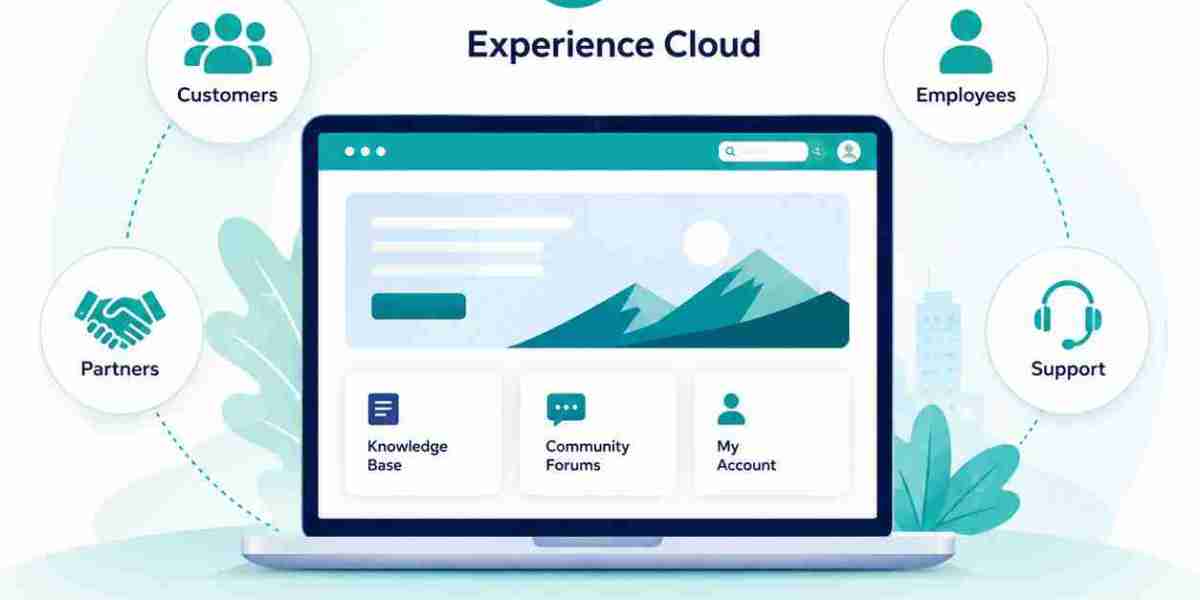
Most companies run their CRM for internal teams and stop there. Customers, partners, and vendors are left checking email or calling support for basic updates. Salesforce Experience Cloud closes that gap by giving external users their own branded portal, connected directly to your Salesforce data, so they can find answers, track orders, and get support without picking up the phone.
What Experience Cloud Actually Does
Experience Cloud is Salesforce's platform for building customer portals, partner communities, and self-service sites. Instead of building a separate website and manually syncing it with your CRM, you build directly on top of the data you already have. A customer logs in and sees their own case history, order status, or account details in real time, because it's pulled straight from the same records your sales and support teams use.
This is why a well-planned Salesforce Experience Cloud implementation tends to pay off fast. Support tickets drop because customers can self-serve. Sales cycles shorten because partners have direct access to deal registration and lead status. And your team stops manually re-entering information that already exists in Salesforce.
Where It Fits Best
Experience Cloud shows up most often in a few situations:
- Customer self-service portals – account management, order tracking, billing history, support cases
- Partner communities – deal registration, co-selling tools, shared pipelines
- Employee and franchise portals – internal knowledge bases, HR requests, franchise operations
- Industry-specific patient or client portals – appointment scheduling, secure document sharing, intake forms
Healthcare organizations, for instance, use it to let patients schedule appointments and view records without a phone call. Law firms use it so clients can check case status and upload documents securely. Financial services firms use it for client onboarding and account visibility.
Why the Implementation Part Matters
Experience Cloud is flexible, and that flexibility is also where projects go wrong. Get the data model, sharing rules, or component setup wrong, and you end up with a portal that either exposes too much data or too little. A Salesforce Experience Cloud implementation needs someone who understands both the platform and your specific sharing and security requirements, not just someone dragging components onto a page.
This is where working with an experienced partner matters. SP Tech is a Salesforce Summit Partner that has built Experience Cloud portals across healthcare, financial services, legal, and other regulated industries, where getting data visibility and compliance right isn't optional. SP Tech's team handles the setup work, from sharing rules to custom components, so the portal actually reflects how your business operates instead of a generic template.
Getting Started
If your team is fielding the same questions over and over, or your partners are waiting on emails for information they should be able to see themselves, that's usually the sign it's time to look at Experience Cloud. A short discovery conversation is usually enough to figure out whether a full implementation makes sense or whether a smaller pilot portal is the better starting point.
SP Tech offers a free Salesforce consultation for teams weighing this decision, which is a low-risk way to see what a portal built around your actual data would look like before committing to a full build.