Autonomous vehicles rely on advanced perception systems to understand their surroundings and make safe driving decisions. Cameras, LiDAR, and radar generate vast amounts of sensor data, but raw data alone is not enough. It needs precise labeling to help AI models recognize and interpret objects. This is where 3D bounding box annotation becomes essential.
What Is 3D Bounding Box Annotation?
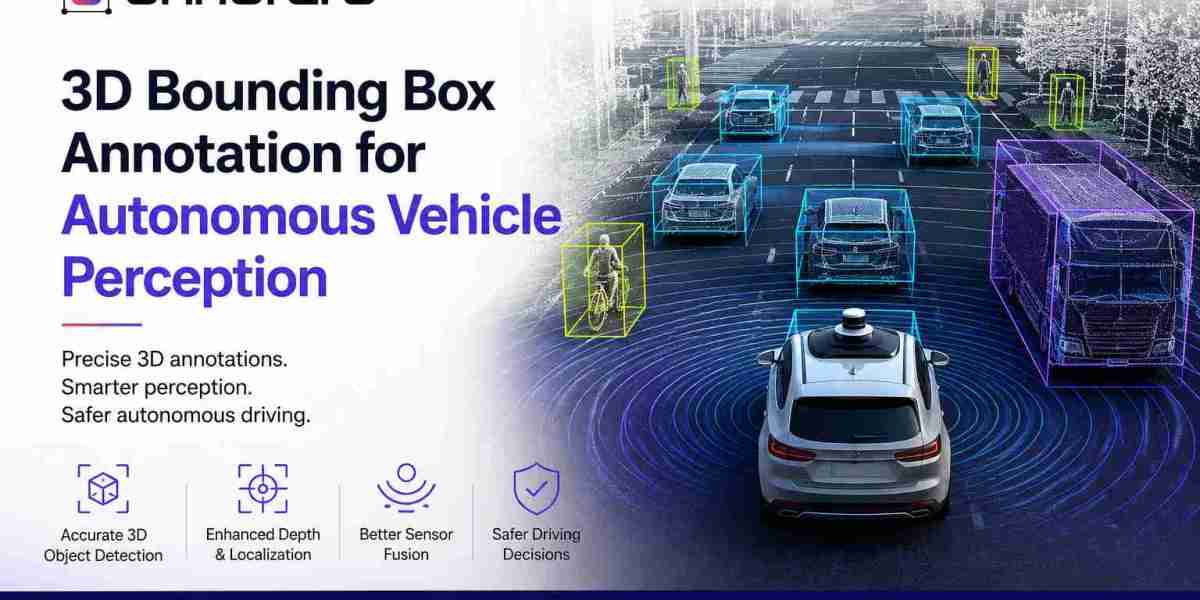
3D bounding box annotation involves creating three-dimensional boxes around objects such as cars, pedestrians, cyclists, trucks, and road obstacles within LiDAR or other 3D sensor data. Unlike 2D boxes, 3D annotations capture an object's length, width, height, position, and orientation.
This additional spatial information allows autonomous driving models to better understand where an object is located and how it may move through the surrounding environment.
Why Does It Matter?
Accurate 3D annotations support several critical perception tasks:
- Object detection: Helps models identify vehicles, pedestrians, and obstacles.
- Depth and distance estimation: Provides information about an object's position relative to the vehicle.
- Object tracking: Supports consistent tracking of moving objects across frames.
- Path planning: Helps autonomous systems anticipate potential obstacles and select safer routes.
- Sensor fusion: Enables AI systems to combine LiDAR, camera, and radar information more effectively.
High-quality labels are particularly important for challenging scenarios such as crowded roads, intersections, night driving, rain, and partially occluded objects.
The Role of Annotation Expertise
Creating accurate 3D bounding boxes requires trained annotators, detailed labeling guidelines, and rigorous quality control. Small errors in object dimensions, orientation, or position can affect downstream perception models.
For companies handling large datasets, data annotation outsourcing can provide access to skilled annotation teams and scalable workflows without requiring extensive in-house resources.
Annotera delivers data annotation for autonomous vehicle applications, supporting high-quality 3D labeling for perception and machine learning workflows. With structured processes and human-led quality checks, Annotera helps AV developers transform complex sensor data into reliable training datasets.
Conclusion
3D bounding box annotation provides the spatial intelligence autonomous vehicles need to understand real-world environments. Accurate, consistent, and scalable annotation can ultimately contribute to stronger perception models and safer autonomous driving systems.