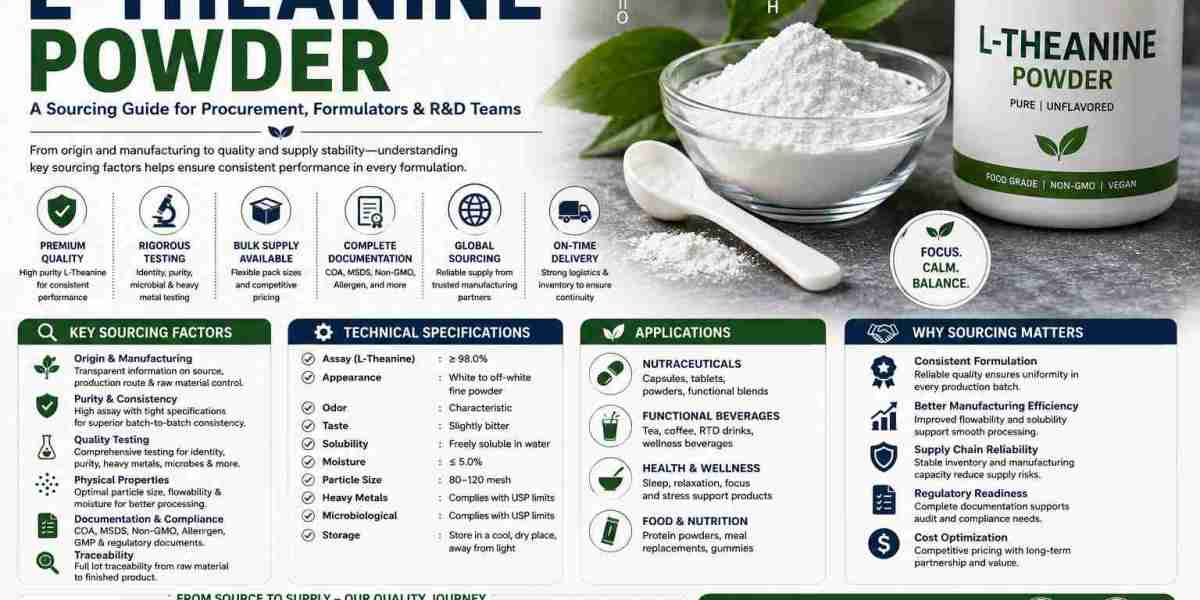
In most sourcing scenarios, the important questions begin with origin, manufacturing route, purity, particle characteristics, documentation, and supply continuity. These factors can influence how an ingredient performs during blending, dissolution, packaging, and storage. For manufacturers purchasing L-Theanine Powder Bulk, supplier qualification therefore becomes a technical and operational decision rather than a simple purchasing exercise.
Understanding L-Theanine Powder in Commercial Manufacturing
L-Theanine is a non-protein amino acid naturally associated with tea leaves, particularly Camellia sinensis. Commercial L-theanine ingredients may be produced through different manufacturing routes, including fermentation-based processes or extraction and purification approaches. The production route matters because it can influence purity, supporting specifications, and documentation requirements.
For procurement teams, the first question should be whether the material is intended for use as a standalone L-theanine ingredient or as part of a broader functional formulation. Buyers should also distinguish between pure L-theanine powder and blended products containing additional carriers or ingredients.
Common technical parameters evaluated during qualification include:
- L-theanine assay
- Identity confirmation
- Moisture content
- Particle size
- Residual solvents, where applicable
- Heavy metals
- Microbiological limits
- Physical appearance
- Packaging and storage requirements
These specifications establish a baseline, but they should not be the only criteria used to approve a bulk supplier.
Why Supplier Qualification Goes Beyond COAs
One issue we often see is an overreliance on Certificates of Analysis. A current COA is essential, but procurement teams also need to understand how consistently a supplier can reproduce the same material.
For L-Theanine Powder Bulk procurement, buyers may evaluate:
- Manufacturing location
- Production method
- Raw material or fermentation-source controls
- Lot traceability
- Quality management systems
- Testing frequency
- Packaging controls
- Production capacity
- Lead times
- Inventory availability
For products entering the US market, documentation should also align with the manufacturer's regulatory and quality requirements. Depending on the intended application, buyers may request allergen statements, non-GMO documentation, GMP-related information, country-of-origin details, and other supporting records.
Formulation Behavior Matters at Scale
L-Theanine Powder is generally used in relatively precise quantities, which makes assay consistency particularly important for formulation teams. Small differences in potency can affect the amount of raw material required to achieve the intended formulation specification.
Solubility and dispersibility are also important when L-theanine is incorporated into functional beverage systems. Powder characteristics, particle size, and processing conditions can influence how efficiently the ingredient incorporates into a finished blend.
In dry formulations, R&D teams may assess:
- Flowability
- Particle size
- Bulk density
- Blend uniformity
- Moisture
- Dissolution performance
- Compatibility with other powdered ingredients
A material that performs well in a laboratory trial should still be evaluated under production conditions before a supplier is approved for recurring commercial orders.
Bulk Procurement Challenges
When sourcing L-Theanine Powder at commercial volumes, supply continuity becomes a significant consideration. Procurement teams need to understand whether the supplier maintains finished inventory, manufactures against purchase orders, or depends on upstream production schedules.
One practical sourcing challenge is lead-time variability. A supplier may provide an attractive price for a single shipment but create operational problems if subsequent lots require substantially longer production or transit periods.
Before committing to L-Theanine Powder Bulk, sourcing teams can request:
- Multiple recent batch COAs
- Representative production samples
- Assay and identity testing
- Heavy metal and microbiological reports
- Residual-solvent information where relevant
- Manufacturing-process information
- Lot traceability records
- Packaging specifications
- Minimum order quantities
- Typical lead times
- Supply continuity plans
Comparing several production lots is often more informative than evaluating a single sample.
Choosing Between Different Ingredient Formats
The appropriate L-theanine format depends on the finished product and manufacturing process. A high-purity powder may be preferable for precise capsule or tablet formulations, while beverage manufacturers may place greater emphasis on dissolution and dispersion characteristics.
This is where procurement and R&D teams should work together. Selecting an ingredient solely on assay or price can overlook practical manufacturing requirements.
If a formulation requires a highly controlled ingredient profile, standardized specifications and consistent batch testing become particularly important. For simpler applications, physical characteristics and handling properties may receive greater attention.
Market Outlook and Sourcing Priorities
The continued development of functional beverages, powdered nutrition products, dietary supplements, and combination formulations is creating additional demand for specialty ingredients such as L-Theanine Powder.
At the same time, manufacturers are becoming more disciplined about supplier qualification. Traceability, transparent manufacturing information, reliable documentation, repeatable quality, and predictable lead times are increasingly important procurement criteria.
For sourcing teams, this shift means that supplier evaluation should begin before commercial volumes are ordered. Early sample testing, technical review, and production-batch comparison can identify potential problems before they affect finished-product manufacturing.
Conclusion
Sourcing L-Theanine Powder successfully requires a combination of technical evaluation and supply-chain assessment. Purity and assay remain fundamental, but manufacturing route, physical properties, documentation, traceability, production capacity, and lead-time reliability can be equally important.
For procurement managers and R&D teams purchasing L-Theanine Powder Bulk, the most reliable approach is to evaluate suppliers based on repeatable performance rather than a single specification sheet or price quotation. That approach provides a stronger foundation for consistent formulations, predictable production planning, and long-term raw-material supply.