
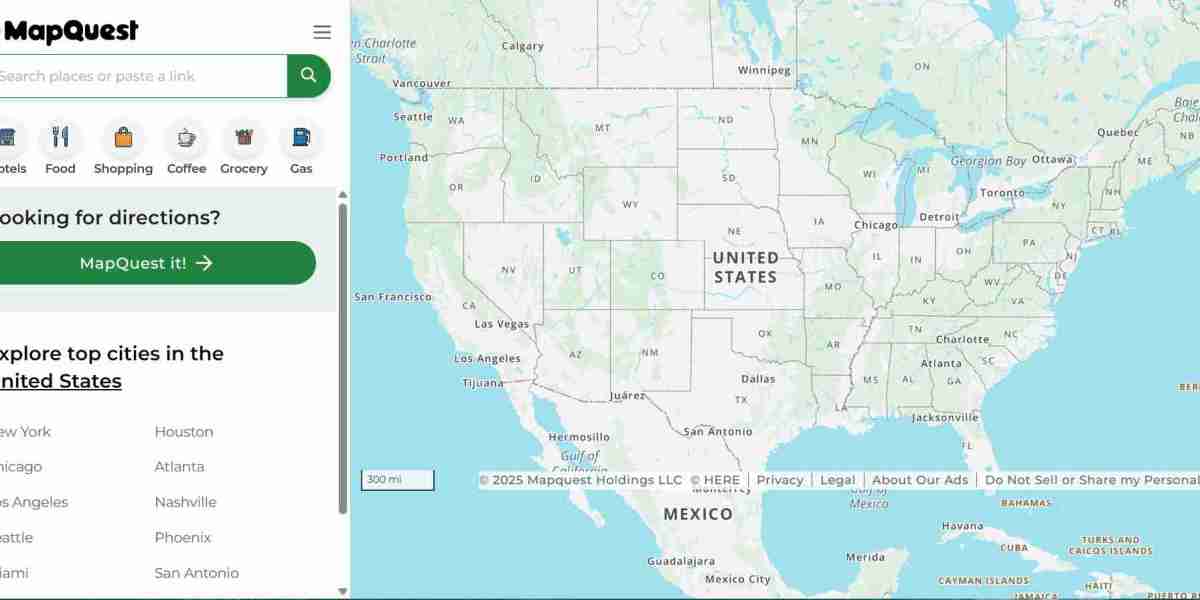
But here’s the real question: is MapQuest still relevant today, or is it just riding on nostalgia?
Surprisingly… it’s still very much alive.
Mapquest driving directions started as a simple idea: help people get from Point A to Point B without getting lost or asking strangers for directions. In the early internet days, it was the tool for road trips, job interviews, and visiting relatives you barely wanted to see. You typed in an address, hit “Get Directions,” and prayed the printer didn’t jam.
Fast-forward to now. The world has Google Maps, Waze, Apple Maps, and a dozen other navigation apps. Yet MapQuest didn’t quit. It adapted.
Today, MapQuest offers turn-by-turn navigation, live traffic updates, route optimization, ETA estimates, and even gas price tracking. It’s available on the web and as a mobile app, and it does what it has always done best—simple, no-nonsense directions.
One thing MapQuest gets right is clarity. The interface isn’t trying to overwhelm you with ten layers of features you’ll never use. You open it, enter your destination, and it shows you clear routes with distance and time. That’s it. No drama.
It also gives you multiple route options. Want to avoid highways? Prefer the shortest distance instead of the fastest time? MapQuest lets you tweak routes without digging through confusing menus. For people who actually like understanding their route instead of blindly following a blue line, this matters.
Another underrated feature is gas prices. When fuel costs are all over the place, knowing where cheaper gas stations are along your route is genuinely useful. Not flashy—but practical.
That said, let’s be honest. MapQuest isn’t winning the real-time traffic war. Apps like Waze and Google Maps usually react faster to accidents, road closures, and sudden congestion. If you’re navigating a chaotic city during rush hour, MapQuest might feel a step behind.
But here’s where MapQuest still shines: planning.
If you’re sitting at a laptop planning a road trip, mapping multiple stops, or just want clean printable directions, MapQuest is still one of the best tools around. It’s especially useful for long drives, rural routes, or situations where you don’t want constant rerouting every five seconds.
There’s also something refreshingly old-school about it. No account required. No aggressive data collection vibe. No endless pop-ups pushing other services. It just… works.
So no, MapQuest isn’t trying to beat Google Maps at its own game. And that’s fine. It doesn’t need to.
MapQuest survives because it knows its role: reliable directions, straightforward planning, and minimal nonsense. Sometimes, that’s exactly what you want.
In a world obsessed with doing everything, MapQuest quietly sticks to doing one thing well—getting you where you need to go.